

The Risk Wheelhouse Podcast
The Risk Wheelhouse is the podcast dedicated to exploring how RiskTech is reshaping the future of risk management. Hosted by our experts, Ori Wellington and Sam Jones, each episode delves deep into Integrated Risk Management (IRM), offering insights into the latest trends, technologies, and strategies. Join us to stay ahead in the ever-evolving risk landscape and empower your organization with actionable knowledge.
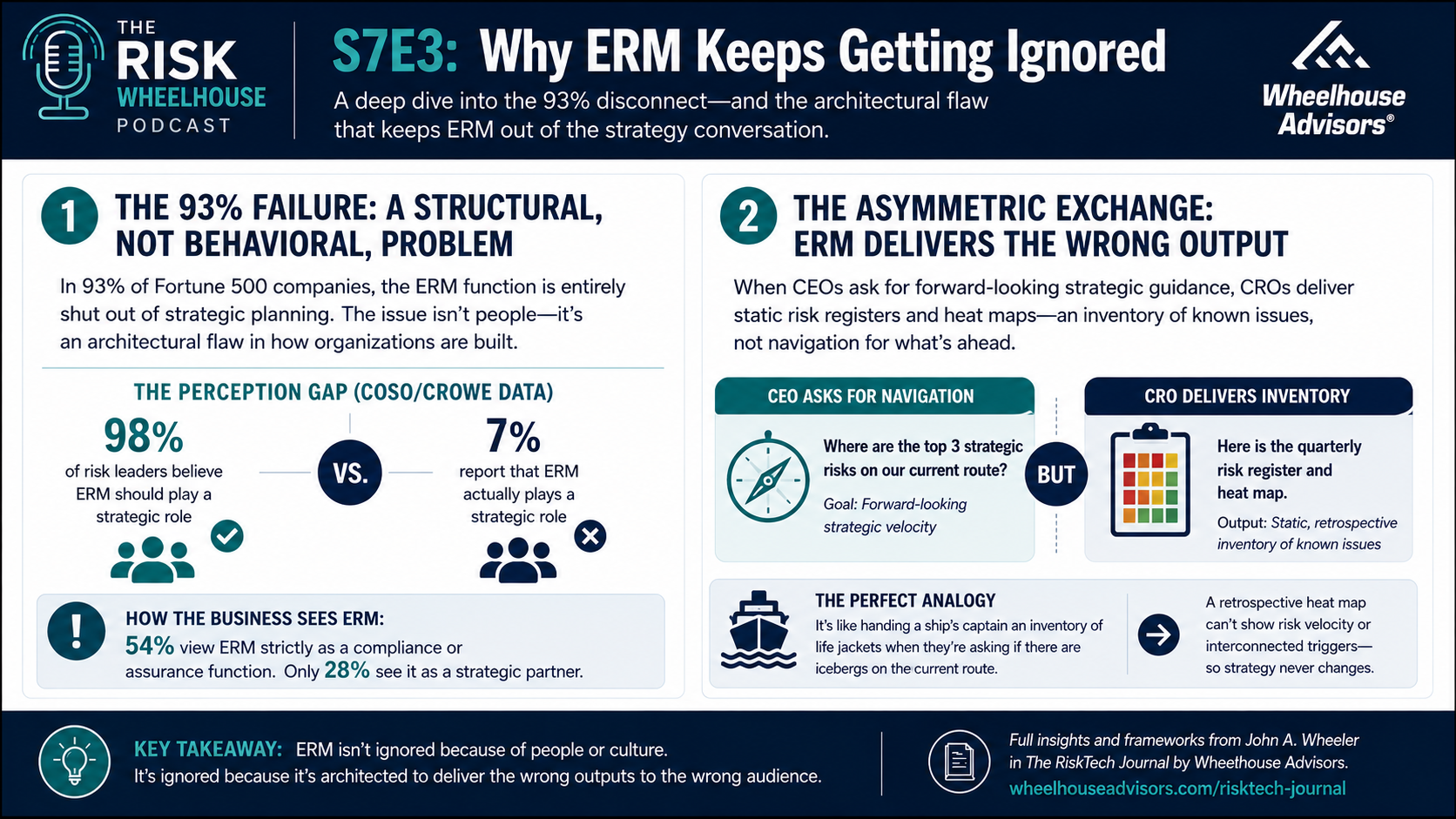
S7E3: Why ERM Keeps Getting Ignored
93% is not a rounding error, it’s a warning flare. When enterprise leaders ask for guidance on the biggest strategic risks ahead, many risk teams respond with a quarterly risk register and a heat map. That’s not “wrong,” it’s simply what a compliance-first system is designed to produce. The result is an asymmetric exchange: executives need a radar, and the organization hands them a snapshot from the past.
We walk through new practitioner research from COSO and Crowe alongside John A. Wheeler’s analysis in the RiskTech Journal to explain why the ERM strategy gap persists. Our core claim is straightforward: the failure of ERM is largely structural, not behavioral. When ERM gets fused with GRC under the same reporting line, tooling, and audit committee cadence, uncertainty gets treated like a defect. That destroys psychological safety, suppresses early warning signals, and leaves strategy teams flying blind.

S5E6: Build An Emerging Risk Reflex Before The Next Shock Hits
The conversation centers on a stubborn truth: most boards are well briefed on emerging risks, yet few translate insight into movement. The research shows 76 percent receive comprehensive risk reports, 42 percent engage meaningfully, and just 22 percent act. That collapse at the decision point is the “funnel of inaction.” The hosts argue that leaders chase the wrong fix by investing in problem precision using hyper-detailed probabilities and impact ranges. This approach only provides a marginal, statistically insignificant uplift in action. Precision invites skepticism, shifts attention to model assumptions, and implies costly, multi-year programs that boards rationally defer. The better path is to reframe conversations around solution options that emphasize low regret actions, the cost of delay, adjustments to existing programs, and clear pacing across quarters.

S3E3: The Missing M—Why Risk Needs Managers, Not Just Playbooks
The moment a baseball season begins, hope fills the air as teams dream of championship glory. But as any sports fan knows, talented players alone can't win championships—they need strong managers making smart calls and adjusting strategy in real-time. This powerful analogy perfectly captures what's often missing in corporate risk management today.
Many companies believe their Governance, Risk and Compliance (GRC) programs provide comprehensive protection against uncertainty. Yet in practice, these programs frequently amount to little more than documenting potential problems and checking compliance boxes—the equivalent of having a playbook without a coach actively managing the game. This fundamental gap between identifying risks and actively managing them represents the critical difference between traditional GRC approaches and the emerging discipline of Integrated Risk Management (IRM).