

The RTJ Bridge - The Research Platform Created by the Publishers of The RiskTech Journal
The RTJ Bridge is an independent research platform delivering institutional-grade IRM market intelligence, vendor competitive assessments, and strategic risk technology analysis. Built by the analyst who created the Integrated Risk Management category at Gartner, The RTJ Bridge gives risk leaders, technology executives, and solution providers the same caliber of competitive intelligence that major analyst firms charge $25,000 to $50,000+ per year to access.
Subscribers to The RTJ Bridge receive full access to:
IRM50 OnWatch Vendor Assessments — Competitive analysis of leading IRM vendors as market events unfold, covering platform strategy shifts, M&A impact, earnings signals, and positioning changes.
Autonomous IRM and AI Governance Research — Original research on how agentic AI is reshaping risk management operating models, from production deployment patterns to the structural implications for vendor platforms and enterprise programs.
Analyst Firm and Market Critiques — Independent assessments of research from Gartner, Forrester, and other major analyst firms, viewed through the IRM Navigator Model to identify gaps, validate signals, and challenge conventional positioning.
Board Governance and Audit Committee Intelligence — Research on oversight effectiveness, emerging risk response gaps, audit committee workload challenges, and the disconnect between risk reporting and executive action.
M&A and Strategic Alliance Analysis — Same-week analysis of acquisitions, partnerships, and PE investment moves reshaping the IRM competitive landscape, with implications for buyers, vendors, and investors.
Regulatory, ESG, and Sustainability Risk — Research on how evolving regulatory frameworks (SEC cyber disclosure, EU CSRD/CSDDD, AI regulation) affect enterprise risk programs and technology requirements.
IRM Navigator™ Market Intelligence — Strategic previews and deep dives from the IRM Navigator Model, the only independent model built specifically to evaluate integrated risk management maturity and vendor alignment.
Cyber Risk, Insurance, and Third-Party Risk — Analysis of cyber risk quantification, insurance market dynamics, and the convergence of third-party risk management into enterprise IRM programs.
Subscribe to get access now
The RTJ Bridge is an independent IRM research platform published by Wheelhouse Advisors. Subscribers receive ongoing access to vendor competitive assessments, AI disruption analysis, M&A and partnership impact research, and IRM Navigator™ market intelligence. This is the only research platform built and led by the analyst who created the Integrated Risk Management category, a market now valued at over $61 billion and projected to reach $133 billion by 2031.

NemoClaw and the Trillion-Dollar Tailwind for Autonomous IRM
At GTC 2026, Nvidia CEO Jensen Huang announced at least $1 trillion in purchase orders for its next-generation AI chip platforms through 2027, declared that every SaaS company will become an AGaaS company, and launched NemoClaw, an enterprise-secure agentic platform built on the viral OpenClaw framework. For IRM leaders, none of these announcements can be read in isolation. Taken together, they constitute the most consequential single-day shift in the infrastructure conditions for Autonomous IRM in the market's history.
The IRM Navigator™ Model maps the path from Workflow Automation through Agentic GRC to Autonomous IRM as an architectural progression, not a feature roadmap. What does a trillion-dollar infrastructure commitment do to the economics of that progression? Does NemoClaw dissolve the security objection that has most reliably slowed enterprise agentic deployment? And what does Huang's explicit framing of governance, security, privacy, and compliance as the primary AGaaS battleground mean for IRM50 vendors whose entire business is built in exactly those domains?
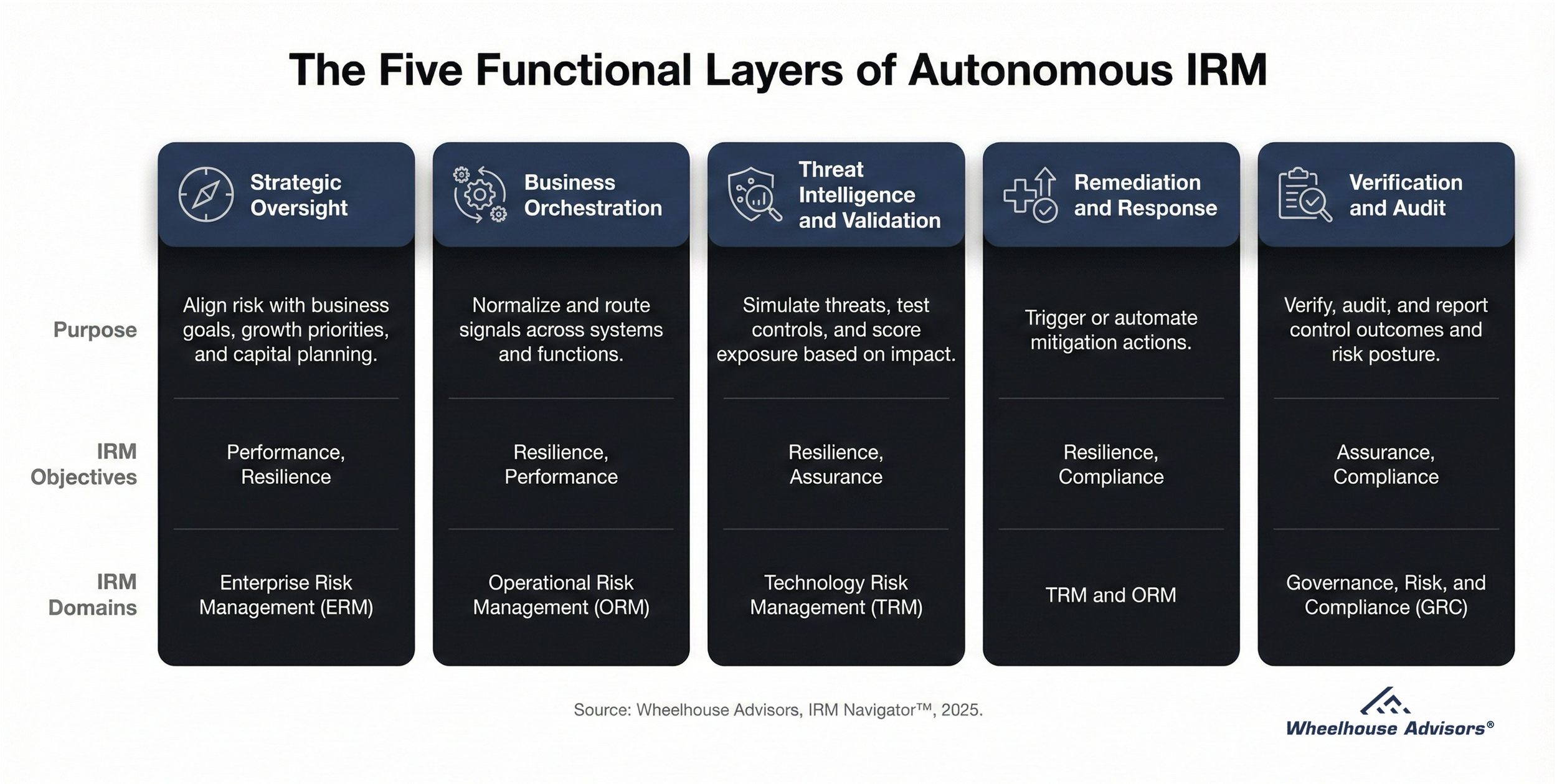
What NVIDIA’s CES 2026 Post Signals for Autonomous IRM
NVIDIA’s January 5, 2026, CES post is not “just a chip announcement.” It is a blueprint for making agentic systems cheaper to run, faster to execute, more distributed (from data center racks to desktops and edge), and more simulation-driven. For Autonomous Integrated Risk Management (Autonomous IRM), the practical implication is that the limiting factor shifts. It becomes less about whether the enterprise can afford the compute and more about whether it can manage autonomous decision loops with bounded execution, reliable orchestration, and audit-grade evidence.
What changed (and why executives should care)
Cadence shifts: more risk work can run continuously rather than quarterly because inference economics and long-context performance are improving.
Scope expands: autonomy moves beyond cyber and compliance into operational resilience and “physical” validation patterns that rely on simulation and long-tail testing.
Expectations rise: decision provenance and replayable evidence become baseline requirements, not premium features.
What follows is the translation of NVIDIA’s CES announcements into Autonomous IRM implications, using an executive pattern: signal, why it matters, implication, program design change, and a measurable buyer proof point.