Could You Explain to Your Board What an Open-Weight AI Model Is, and Why It's Already Their Problem?
Ask a board member to explain what an open-weight AI model is, and the honest answer, most of the time, is silence. Ask whether the organization is already running one somewhere inside its technology stack, and the honest answer is often that nobody in the room actually knows.
That gap became harder to defend on July 24, 2026. Nvidia CEO Jensen Huang used his first-ever post on X, not for a product announcement, but to publish a letter. Twenty-five companies and organizations had signed it, including Microsoft, Meta, Palantir, IBM, Dell, Mozilla, Hugging Face, and Y Combinator, asking Washington to stop treating open-weight AI models as a category that needs to be restricted. Microsoft CEO Satya Nadella backed the same message the same day. Elon Musk publicly endorsed it as well, though SpaceX did not appear among the formal signatories. For a document about model licensing, that is an extraordinary amount of executive attention, and it points directly at the blind spot most boards still have. At Nvidia's CES 2026 press event, Huang cited internal figures suggesting that roughly one out of every four AI tokens generated worldwide today already runs on an open model. If that estimate is even directionally right, a board that cannot answer the first question is very likely already overseeing an organization exposed to the second.
What "Open-Weight" Actually Means
Here is the explanation most boards have never been given.
An AI model is, at its core, a very large set of numerical parameters, its weights, learned during training on enormous volumes of data. A closed model, the kind offered as a hosted service by providers like OpenAI, Anthropic, or Google, keeps those weights inside the provider's own infrastructure. The enterprise sends a prompt to the vendor's servers and gets an answer back. It never touches the model itself.
An open-weight model inverts that arrangement. The provider publishes the trained weights themselves, and anyone can download them, install them on their own infrastructure, and run the model without routing a prompt through the provider's servers again.
That is a meaningfully different thing than "open source," and the letter's signatories were careful with the distinction. Under the Open Source AI Definition published by the Open Source Initiative in 2024, a model only qualifies as open source if the training code and enough detail about the training data are released alongside the weights, enough for a skilled developer to rebuild an equivalent model from scratch. Open-weight models, including Meta's Llama family, Mistral, and China's DeepSeek and Kimi, typically release only the finished weights. The enterprise gets the finished model. It does not get the process that built it. The distinctions break down like this:
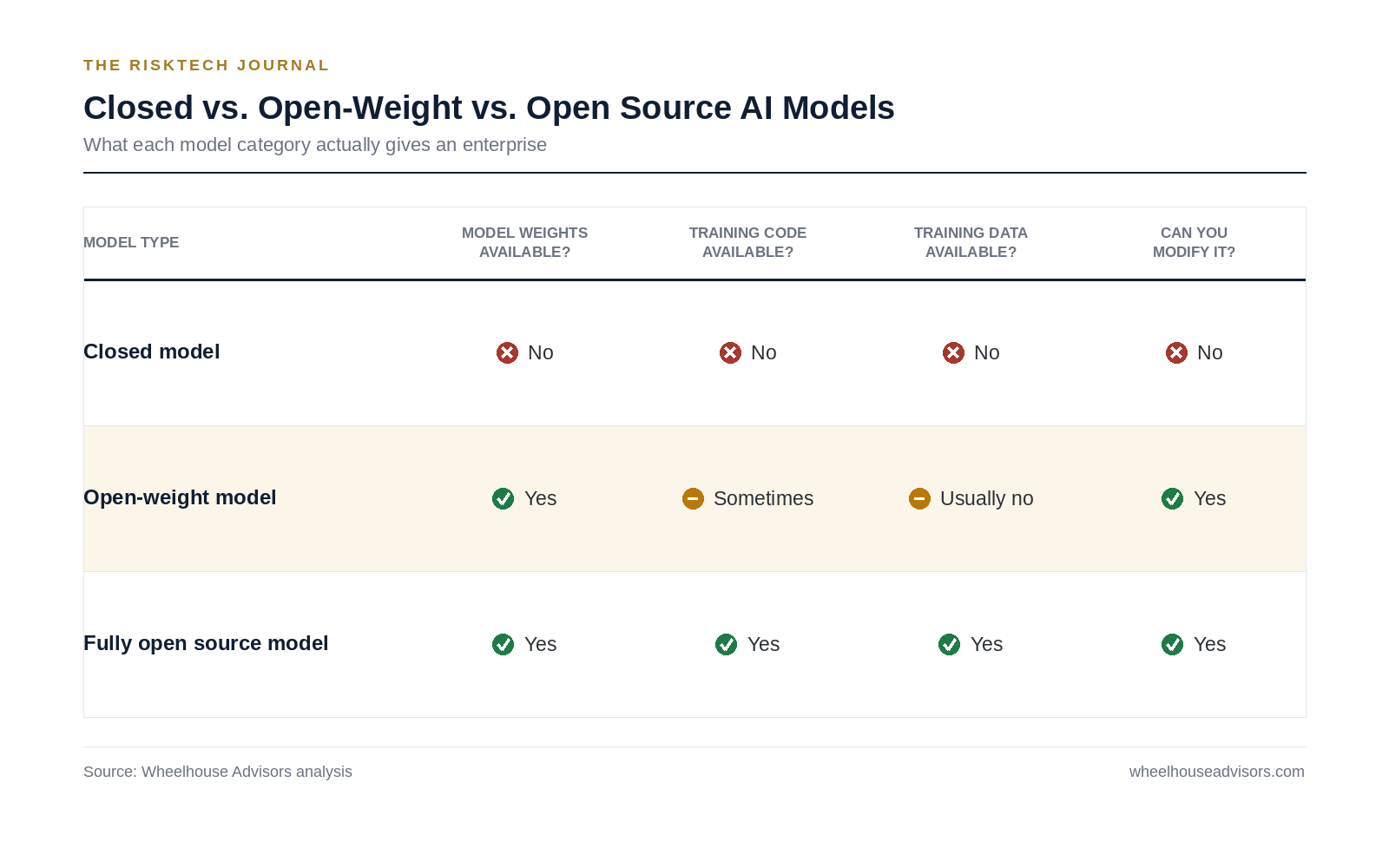
The distinction is easier to hold onto with an analogy. Picture someone building an extraordinarily capable calculator. A closed model is like using that calculator only through a website. Enter numbers, get answers, and never actually possess the calculator itself. An open-weight model is like receiving the finished calculator. Keep it, modify it, repaint it, swap out components, install it inside your own factory. The engineering drawings and manufacturing process that produced it stay with the original builder. A fully open source model goes further: the calculator, every blueprint, every manufacturing machine design, every assembly instruction, every test procedure included. A skilled team could rebuild the entire factory from scratch.
Licensing varies by provider and matters more than it sounds. Mistral and Qwen ship under the permissive Apache 2.0 license. Meta's Llama Community License permits commercial use but requires firms serving more than 700 million monthly active users to negotiate a separate agreement with Meta directly. Which license attaches to which model has become a procurement and legal question as much as an engineering one, and it is worth confirming before a development team quietly adopts one.
The Practical Case for Open-Weight Deployment
For most organizations, the appeal comes down to five concrete advantages, and any one of them is reason enough for a technical team to have already adopted an open-weight model without walking it past the board first.
Data sovereignty. Sensitive data never has to leave the organization's own infrastructure.
Customization. The model can be fine-tuned against internal policy documents, proprietary data, and specific workflows instead of a vendor's generic training set.
Lower operating costs. Once deployed, inference is often significantly cheaper than paying per call against an external API at real enterprise scale.
Vendor independence. The enterprise owns its deployment and can move between infrastructure providers without renegotiating access to the model itself.
Performance tuning. Engineering teams can optimize for latency, memory footprint, or specialized hardware in ways a hosted API does not allow.
That calculus is already playing out competitively. Chinese labs, particularly Moonshot AI with its Kimi models, have released open-weight systems that score competitively against leading American models on independent benchmarks, and Nvidia entered the field directly in June with its own open-weight model, Nemotron 3 Ultra. Enterprise adoption is following the same curve: Together AI, an infrastructure company built around serving open models, recently raised 800 million dollars in new funding, with its CEO pointing to surging enterprise token usage as the driver.
The Hybrid Architecture Taking Shape in Enterprise AI
Few enterprises are picking a single side. Most are converging on a hybrid architecture instead. Closed frontier models, the kind offered by providers like OpenAI, Anthropic, or Google, still get the call for tasks that demand the highest reasoning capability or the fastest access to newly released capability. Open-weight models increasingly handle internal copilots, regulated workloads, and risk analysis, the kind of applications where data privacy, customization, and deployment control matter more than having access to the single most capable model available.
For firms in financial services, healthcare, government, and critical infrastructure, that split often provides a workable balance: state-of-the-art capability where it is genuinely needed, and the governance, security, and deployment control that regulated production environments require everywhere else. Data residency requirements under frameworks like the EU AI Act and GDPR push in the same direction, as do straightforward latency requirements for use cases like fraud detection and clinical decision support, where a round trip to an external API is not fast enough. None of this requires the board to approve model selection line by line. It does require the board to know which pattern the organization has actually chosen, and why.
Why This Is Already the Board's Problem
Buried inside the coalition's policy letter is a governance argument, whether or not its signatories intended it that way. They wrote that leaning on closed models alone provides no guarantee of safety, warning that they can "be breached, misused, or fail in ways that outsiders cannot detect," and that funneling most of the world's advanced AI capability through a small number of closed providers makes that exposure worse rather than better.
That is precisely the kind of question boards exist to oversee: not the technical mechanics of a model, but the concentration and resilience of the risk sitting underneath a piece of infrastructure the organization now depends on. Wheelhouse has argued elsewhere that enterprises cannot outsource accountability for third-party AI systems simply because they did not build them. Whether the organization runs an open-weight model that keeps data in-house or a closed model that hands it to a vendor, someone at the board level is accountable for that choice, whether or not it was ever framed to them as one.
The Control an Enterprise Gains Is the Burden It Inherits
Every advantage above cuts the other way once the enterprise is the one running the model. Control does not eliminate risk. It relocates it, and relocated risk still needs an owner. Running a model locally redraws the security perimeter around attack surfaces that most application security programs were not built to cover, including model weight exfiltration, prompt injection, and unauthorized inference access. Patching, monitoring, and security review, work a managed API vendor would otherwise absorb, now sit with the enterprise itself. And because open-weight models rarely disclose their training data, provenance and bias risk do not disappear just because the weights are visible. The enterprise can see and control the model. It still cannot fully see what built it.
The letter's signatories flagged one more governance question worth watching: the practice of training new models by distilling the outputs of existing ones, which they asked policymakers to address through targeted legal frameworks rather than broad restrictions. Any enterprise fine-tuning or building on open weights should know where those weights originated and whether the training process behind them carries legal exposure of its own, because that is a question a board will eventually ask after the fact if no one raises it first.
The fight over open-weight AI policy will be settled in Washington, not in boardrooms. But the operational shift underneath it, enterprises moving proprietary data and real-time decisions onto models they run themselves, is already underway inside the quarter of global AI traffic Huang cited, whether or not anyone has briefed the board yet. The useful preparation is not a position on the Washington fight. It is a straight answer, ready before the question is asked: what an open-weight AI model is, whether the organization is already running one, and who owns what happens next.