

The RiskTech Journal
The RiskTech Journal is your premier source for insights on cutting-edge risk management technologies. We deliver expert analysis, industry trends, and practical solutions to help professionals stay ahead in an ever-changing risk landscape. Join us to explore the innovations shaping the future of risk management.
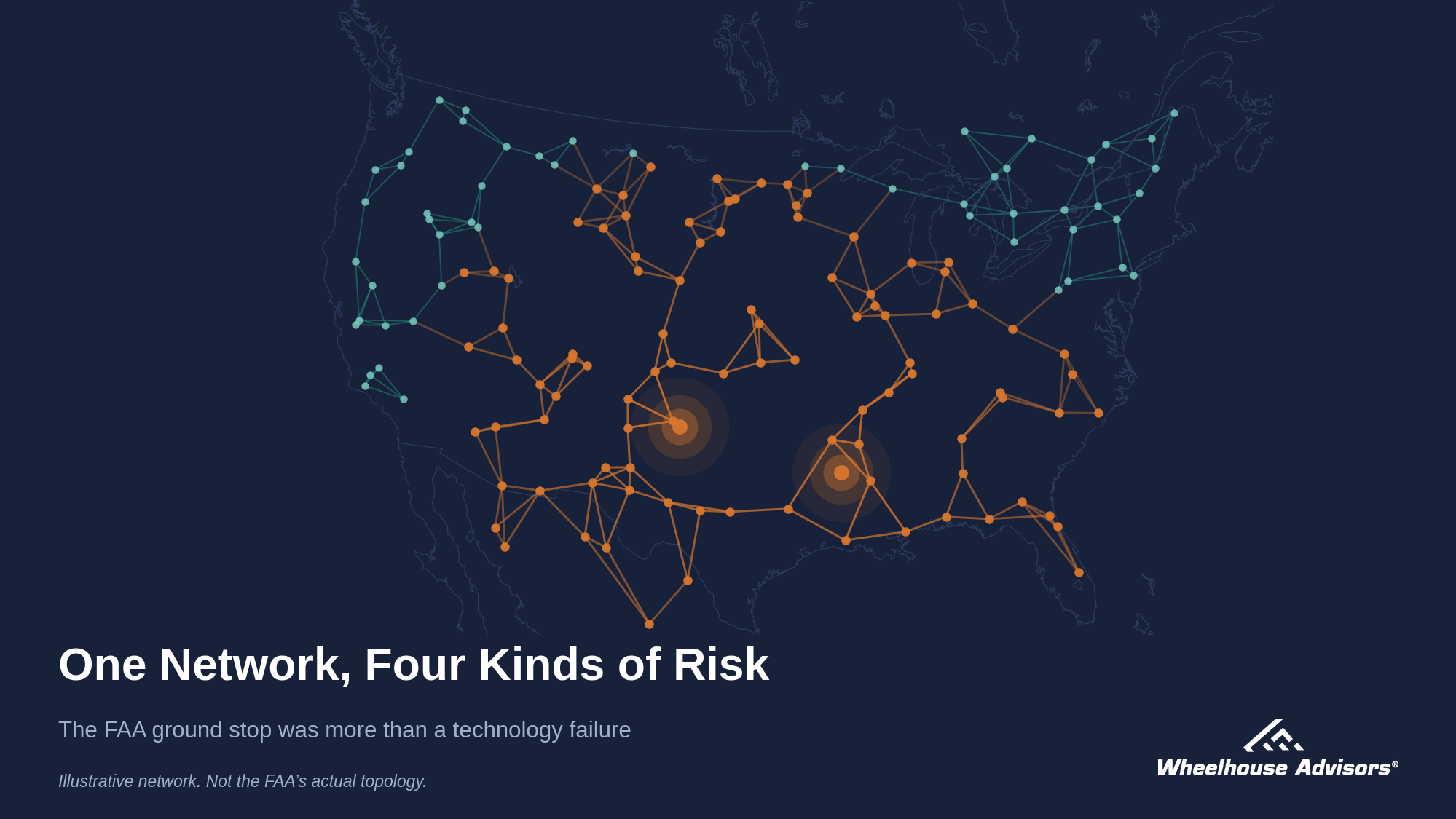
The FAA Ground Stop Was More Than a Technology Failure
A new router at a remote Federal Aviation Administration radio site in El Dorado, Arkansas, began flooding the agency's telecommunications network with data on the afternoon of Friday, November 13, The Wall Street Journal reported. L3Harris, the network's contractor, had installed it not long before, and a second router at a radar site in Amarillo, Texas, added to the flood. Together they disrupted communications at 17 of the FAA's 22 en route centers. At 3:54 p.m. Eastern the agency halted departures nationwide with more than 3,500 aircraft in the air.
The ground stop lasted more than four hours, the longest since September 11, 2001, and FlightAware counted more than 9,100 canceled flights that day. Officials found no evidence of a cyberattack. They have not determined whether the trigger was a faulty installation, a faulty configuration or a defective router.
The first explanations treated the event as a technology failure: old equipment, an overloaded router, a contractor under scrutiny. That account is accurate and incomplete. The fault touched four kinds of risk at once, in technology, operations, governance and enterprise strategy, and each held part of the picture. The lesson for risk executives lies in how those parts failed to connect.

The Case Against Taking a Supplier's Recovery Time on Faith
SIFMA and Protiviti reissued their paper on third-party resilience on October 6, eighteen months after the original. The standards for rebuilding systems, protecting backups, and testing recovery are largely the same. What changed is the clock. The update states that frontier AI models have materially changed the cyber threat environment and are compressing the time a firm has to identify, contain, and recover from a disruptive event.
That matters because of what the paper admits about the starting point. Critical suppliers have historically been reluctant to share details of their recovery capabilities, and when they do share, it is often clear they have not invested enough. Suppliers say they test recovery regularly without stating how often or showing results. They say they can recover within the client's targets without stating their own recovery time. Many of these suppliers serve most of the large financial institutions at once, so one supplier's unproven claim becomes an exposure for the whole sector.