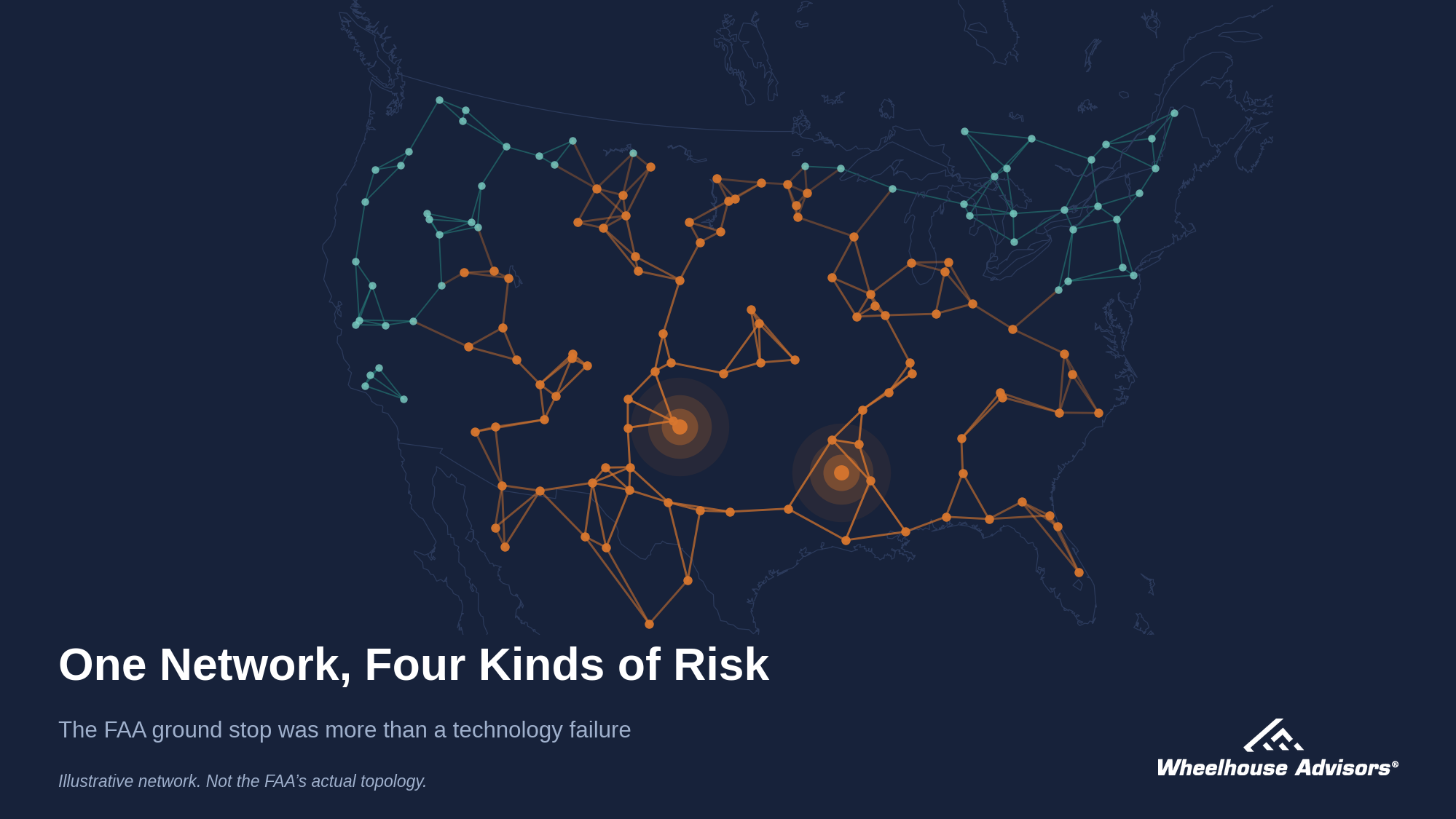
A new router at a remote Federal Aviation Administration radio site in El Dorado, Arkansas, began flooding the agency's telecommunications network with data on the afternoon of Friday, November 13, The Wall Street Journal reported. L3Harris, the network's contractor, had installed it not long before, and a second router at a radar site in Amarillo, Texas, added to the flood. Together they disrupted communications at 17 of the FAA's 22 en route centers. At 3:54 p.m. Eastern the agency halted departures nationwide with more than 3,500 aircraft in the air.
The ground stop lasted more than four hours, the longest since September 11, 2001, and FlightAware counted more than 9,100 canceled flights that day. Officials found no evidence of a cyberattack. They have not determined whether the trigger was a faulty installation, a faulty configuration or a defective router.
The first explanations treated the event as a technology failure: old equipment, an overloaded router, a contractor under scrutiny. That account is accurate and incomplete. The fault touched four kinds of risk at once, in technology, operations, governance and enterprise strategy, and each held part of the picture. The lesson for risk executives lies in how those parts failed to connect.
The Technology Risk Was a Shared Dependency
As frequencies dropped in and out, facilities switched between primary and backup channels. FAA Administrator Bryan Bedford then explained why switching did not help: the backup channels run over the same network. “We don't have two, but one,” he said. The FAA's own risk assessments graded each system on its own terms, and a backup for each channel looks sound in that view. The exposure sat in what the channels shared.
The Operational Risk Was Time to Understanding
Bedford said the agency went to a national ground stop because “we couldn't explain it quickly,” and that a problem confined to a single facility would have been worked through. FAA troubleshooters began their search in Indianapolis, where the symptoms appeared, before tracing the source to Arkansas and Texas, according to the Journal. Once they found the two sites, the FAA disabled both right away and the network stabilized. The search took longer than the fix, and the length of the search set the size of the disruption.
The Governance Risk Was Assurance, Not Policy
The cutover followed the rules. Transportation Secretary Sean Duffy said remote-site work is normally done during the day because it is not expected to affect the wider system, while work at major facilities runs overnight. By that account, the timing of a change turned on the kind of site. The backup control was documented, and the contractor worked under contract. Each control existed. The public record does not show any of them tested against what the El Dorado router could reach. The pattern is not new: in 2009, a router misconfigured during an earlier fiber transition disrupted 129 air traffic facilities.
The Enterprise Risk Was Known Before November 13
In 2023, the FAA's independent safety review team warned that, unless the agency added ways to mitigate them, rising telecommunications outages during an underfunded network migration meant “system risk could quickly reach unacceptable levels.” The FAA has since accelerated its modernization, targeting the end of 2028 for a new system with much of the work running at the same time across the country. Duffy warned of more disruptions until all the copper is replaced. Faster modernization reduces long-term exposure and raises near-term exposure, one cutover at a time.
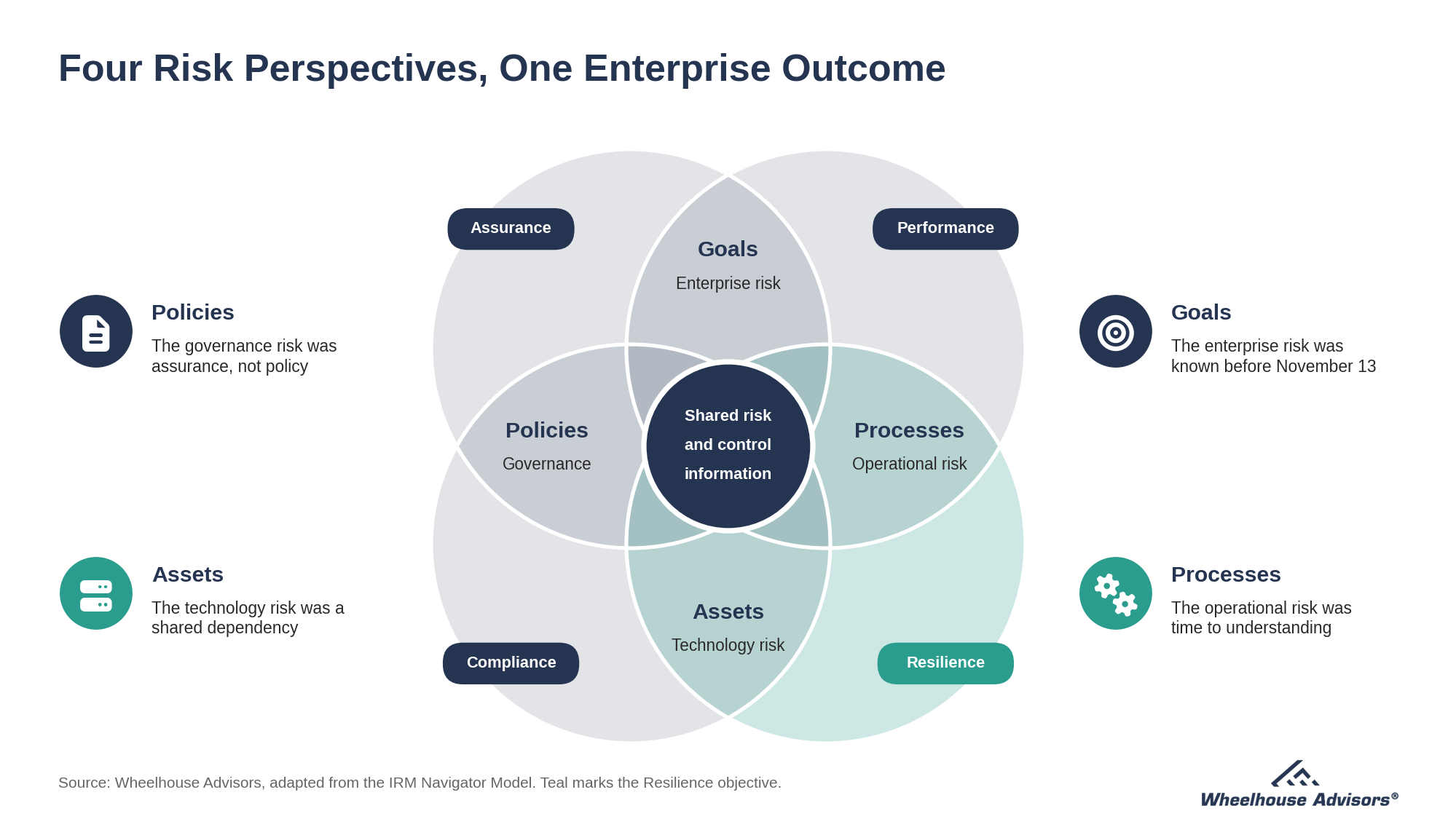
Four risk perspectives, one enterprise outcome. Source: Wheelhouse Advisors, adapted from the IRM Navigator Model.
Connect Risks and Controls Across Domains
Better assessments of individual systems and more reliable equipment both help, and neither connects the four parts of this event. The practical step is to connect risks and controls across domains: rate a change by what depends on the asset, test backups for independence and read operational signals against recent changes to shared infrastructure. Banks, hospital systems and utilities modernizing live operations face the same structure.
The full analysis, including the FAA's modernization record, the GAO findings and the maturity path on the IRM Navigator Curve, is available exclusively on The RTJ Bridge at wheelhouseadvisors.com/rtj-bridge.