The 2026 Convergence: Integrated Risk Management In a New Era
Executive perspective
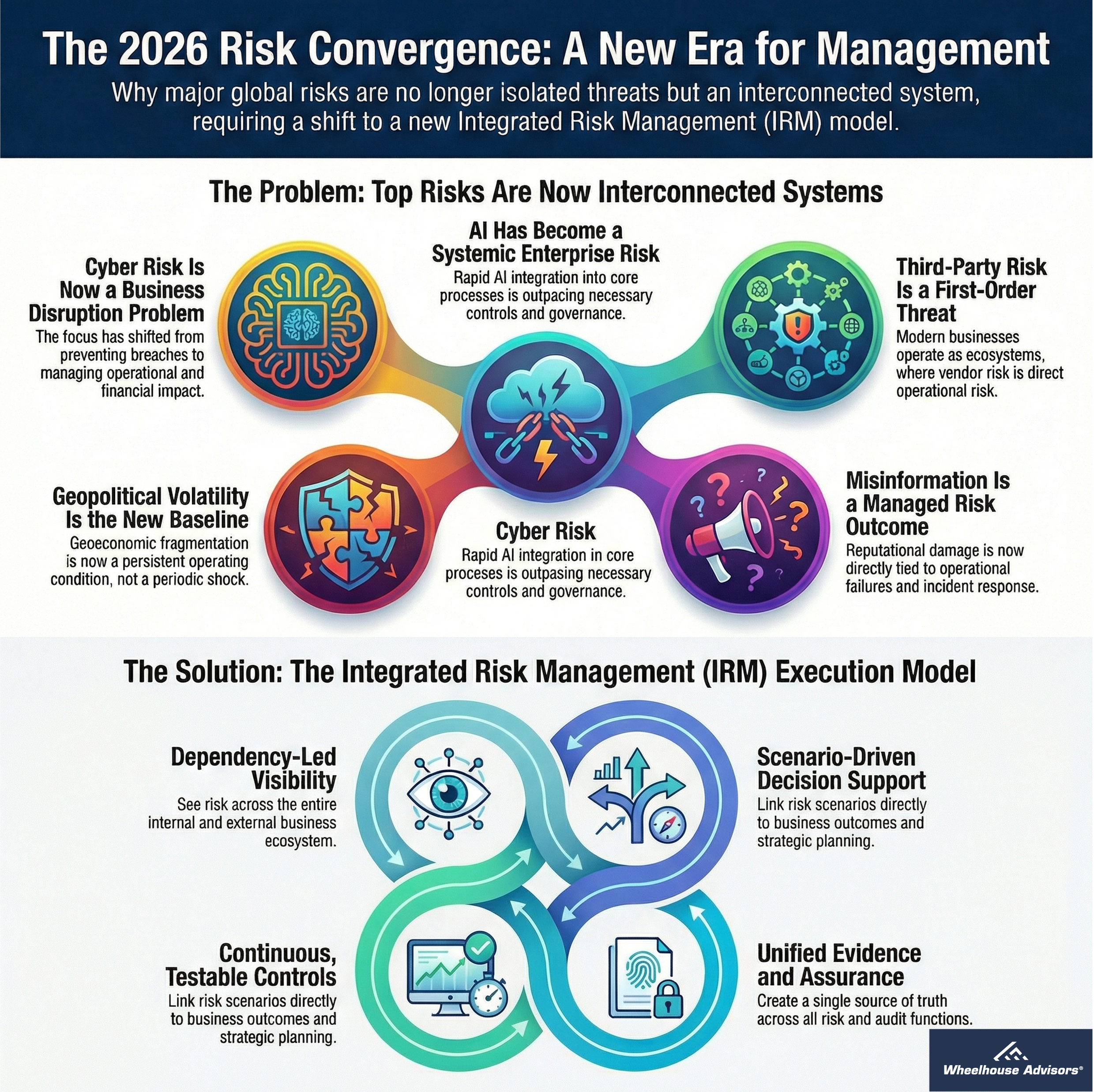
The 2026 global risk survey cycle marks an inflection point in how risk is understood, prioritized, and operationalized by large organizations. For the first time in several years, leading surveys from Aon, Allianz, the World Economic Forum, Protiviti, PwC, Marsh, Zurich, and Eurasia Group are not merely aligned on top risks, they are aligned on why those risks are proving so difficult to manage with legacy approaches.
Cyber remains the top-ranked risk globally. Geopolitical volatility has become a structural operating condition rather than a periodic shock. Artificial intelligence has moved decisively from emerging concern to material enterprise exposure. Third-party dependency is now treated as a first-order risk category. Across these themes, one signal is clear: risk is no longer behaving as a set of discrete domains. It is behaving as an interconnected system of dependencies, amplifiers, and cascading impacts.
This convergence explains why Integrated Risk Management (IRM) is shifting from an architectural aspiration to an execution requirement.
Trend 1: Cyber risk is no longer a security problem, it is a disruption economics problem
Across the 2026 surveys, cyber risk remains the number one global business risk. What has changed is the framing.
Allianz, Aon, Protiviti, and PwC consistently emphasize that cyber risk is now inseparable from business interruption, third-party dependency, and operational resilience. The dominant concern is not breach occurrence, but duration, propagation, and recovery performance. This reframing reflects hard experience. Organizations are less concerned with whether an incident will occur, and more concerned with how quickly it will impair revenue, halt operations, disrupt customers, and trigger regulatory scrutiny.
IRM implication: Cyber risk must be managed through integrated dependency mapping, continuous control verification, and business-impact-led metrics. Siloed cyber dashboards do not answer the questions executives and boards are now asking.
Trend 2: Artificial intelligence shifts from innovation upside to systemic enterprise risk
AI is the fastest-rising risk across the 2026 surveys. Allianz identifies AI as the biggest mover year over year, while the World Economic Forum elevates adverse AI outcomes into the top tier of longer-horizon global risks. What is notable is not concern about AI models themselves, but concern about how rapidly AI is being embedded into core business processes without corresponding control maturity. Data provenance, model drift, third-party AI services, workforce reliance, regulatory exposure, and reputational impact are converging into a single risk surface.
IRM implication: AI risk cannot be governed through policy artifacts alone. It requires continuous testing, traceable evidence, and integration with technology risk, third-party risk, operational risk, and compliance. This is accelerating demand for IRM platforms that support AI risk as a horizontal control layer rather than a standalone program.
Trend 3: Third-party risk becomes a top-tier enterprise risk category
Protiviti’s 2026 executive survey ranks third-party risk among the top global risks, not as a compliance concern, but as a direct constraint on growth, digital execution, and resilience. Allianz reinforces this view by explicitly linking cyber exposure to reliance on external providers for critical data, infrastructure, and services. This reflects a structural shift. Organizations increasingly operate as ecosystems, not enterprises. Risk does not stop at the organizational boundary, and traditional vendor assessments do not reflect real-time operational dependency.
IRM implication: Third-party risk management is converging with cyber, resilience, and operational risk. Leading organizations are unifying taxonomies, evidence, and remediation workflows across procurement, security, risk, and audit functions.
Trend 4: Geopolitical volatility is no longer a scenario, it is the baseline
The World Economic Forum, Eurasia Group, and PwC converge on a shared conclusion: geopolitical and geoeconomic fragmentation is now the default operating environment. Trade restrictions, sanctions, regulatory divergence, and state-sponsored cyber activity are persistent, not episodic. Risk leaders are responding by shifting from annual scenario exercises to decision-grade, continuously refreshed scenarios that link geopolitical shocks to supply chains, technology exposure, regulatory action, and capital planning.
IRM implication: Scenario analysis is becoming an operating discipline, not a periodic report. This requires integration across enterprise risk, operational risk, technology risk, and strategic planning.
Trend 5: Trust, misinformation, and reputation become managed risk outcomes
The World Economic Forum’s 2026 report elevates misinformation and disinformation into the top-tier risk set. Marsh and Zurich reinforce this signal, noting the erosion of trust as both a driver and consequence of technological and geopolitical disruption. This marks a subtle but important shift. Reputation risk is no longer treated as an abstract brand concern. It is increasingly tied to operational signals, cyber incidents, AI misuse, regulatory response, and executive decision-making under pressure.
IRM implication: Trust is becoming an outcome of integrated risk execution. Organizations that cannot link incident response, executive communications, and assurance will struggle to manage reputational impact in real time.
What these signals mean for IRM in 2026
Taken together, the 2026 surveys point to a structural conclusion: risk fragmentation is now the primary failure mode.
The risks that dominate executive agendas are interconnected by nature. Cyber drives operational disruption. AI amplifies third-party dependency. Geopolitics reshapes regulatory exposure and supply chains. Misinformation accelerates reputational damage. These dynamics cannot be managed through isolated risk functions or static reporting.
IRM is evolving from a coordination concept into an execution model defined by:
Dependency-led risk visibility across internal and external ecosystems
Continuous, testable controls rather than periodic assessments
Scenario-driven decision support tied to business outcomes
Unified evidence and assurance across risk domains
Organizations that treat IRM as a platform for management execution, not a reporting framework, will be better positioned to convert risk insight into resilience and performance in an increasingly volatile environment.
References
Aon, Global Risk Management Survey, 10th Edition, 2025
Allianz Commercial, Allianz Risk Barometer 2026, January 2026
World Economic Forum, Global Risks Report 2026, January 2026
Protiviti and NC State ERM Initiative, Executive Perspectives on Top Risks 2026, December 2025
PwC, Global CEO Survey 2026, January 2026
Marsh and Zurich, Global Risks Report 2026 Summary and Outlook, January 2026
Eurasia Group, Top Risks 2026, January 2026