Reality Check: The “Always On” Enterprise Can Burn Itself Out
The uncomfortable truth
The market is falling in love with the idea of the “homeostatic enterprise,” an organization that continuously senses drift and continuously corrects. It sounds like the end of quarterly risk theater and the start of real-time resilience.
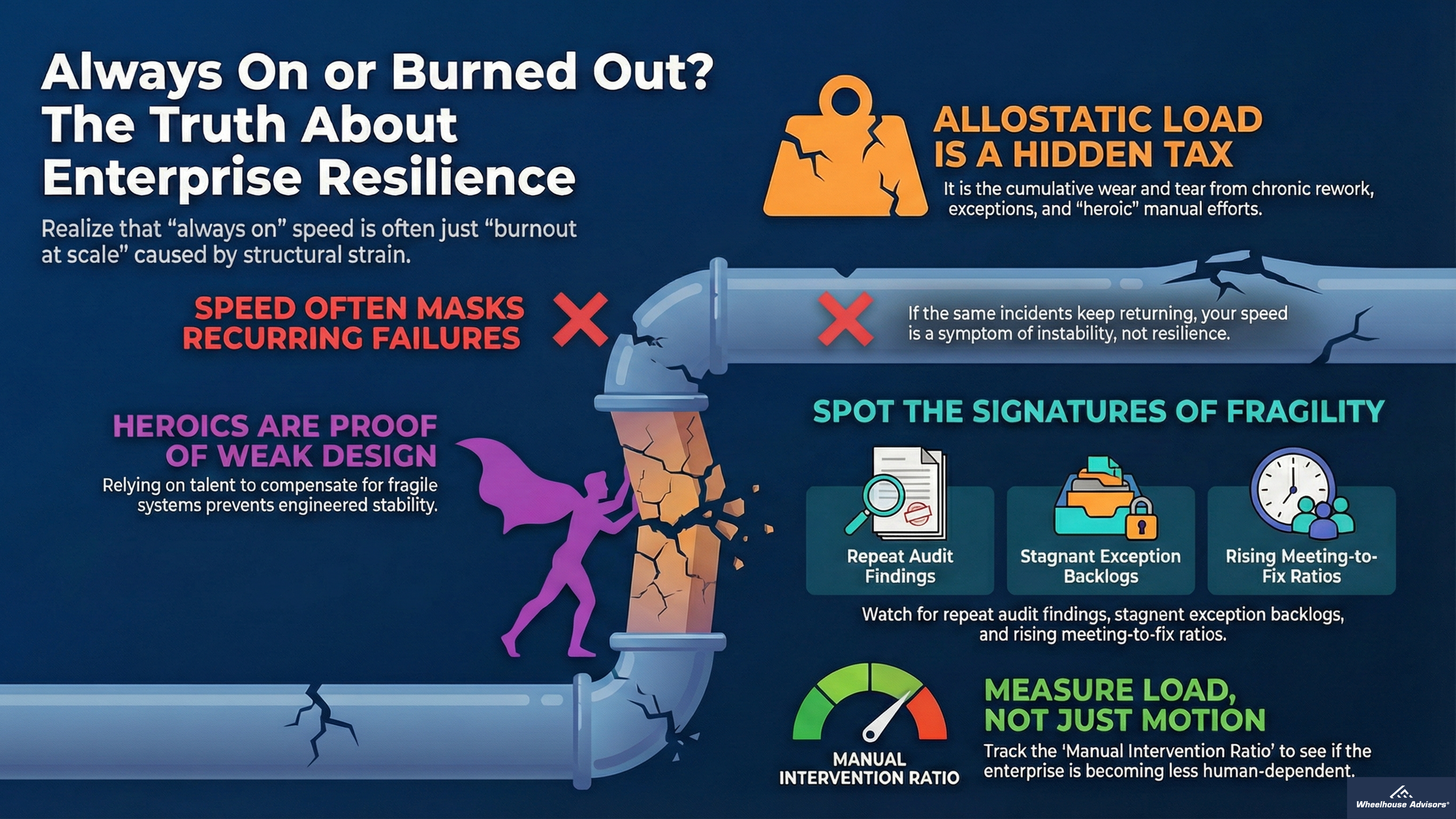
But here is the uncomfortable truth. Many organizations are already “always on,” and they are not stable. They are exhausted.
They survive through constant adaptation, nonstop escalation, and a culture that rewards heroic recovery over engineered stability. Over time, that chronic strain becomes a structural condition. In stress science, the cumulative wear and tear is called allostatic load. In organizations, it shows up as chronic rework, exception overload, control debt, and a widening gap between effort and outcomes.
The risk for leaders is obvious: you can modernize sensing and orchestration and still make the enterprise worse by accelerating the machine that is already burning people and processes down.
Source: wheelhouseadvisors.com
Five seductive lies risk teams tell themselves
Lie 1: “If we respond fast, we are resilient.”
What is really happening: Speed can be a symptom of recurring failure. If the same incidents keep returning, you are not resilient. You are conditioned.
Lie 2: “More signals equals more control.”
What is really happening: More signals often equals more noise. Visibility rises, workload rises, and exposure stays flat.
Lie 3: “Heroics are proof the program works.”
What is really happening: Heroics are proof the system is fragile. You are paying talent to compensate for weak design.
Lie 4: “Orchestration is moving tickets faster.”
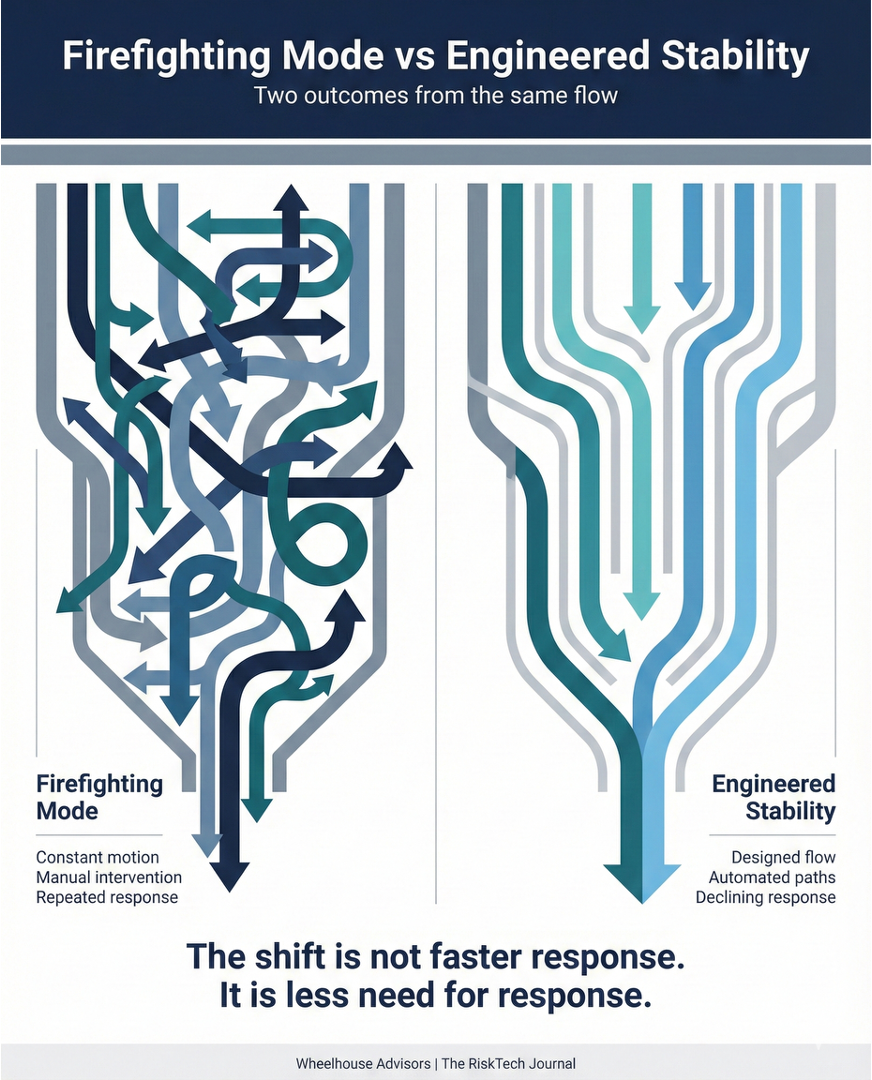
What is really happening: Routing is not orchestration. Orchestration lowers exception volume, reduces rework, and shrinks escalation paths over time.
Lie 5: “AI will close the gap.”
What is really happening: AI can accelerate response, but it can also accelerate instability if your control logic and data are unreliable. Faster wrong is still wrong, and in regulated environments it is also unprovable.
Source: wheelhouseadvisors.com
What allostatic load looks like inside an enterprise
If you want to spot this trap quickly, look for these signatures:
Exception backlogs that never meaningfully decline.
Repeat findings that return every audit cycle with new wording.
Controls that “work” only because people chase evidence manually.
Incidents that close quickly but recur frequently.
Third-party issues that keep resurfacing as urgent because nobody owns permanent remediation.
A rising ratio of meetings and escalations to actual fixes.
When these patterns exist, continuous sensing does not create stability. It creates a higher tempo of distress.
The only scoreboard that matters
If you want an operating model that actually stabilizes, stop measuring motion and start measuring load. Track whether the enterprise is becoming less dependent on human compensation.
Here are five measures that expose the truth:
Recurrence rate: Are the same losses, incidents, and failures repeating less often?
Exception burn-down: Is the exception backlog shrinking, or just rolling forward?
Manual intervention ratio: How much of control testing and evidence is still human chase-and-collect?
Time to permanent fix: How long does it take to eliminate root cause, not just restore service?
Escalation footprint: Are escalation paths shrinking, or multiplying?
If these do not improve, the enterprise is accumulating allostatic load, regardless of how modern the platform sounds.
A one-week gut check for leaders
Next week, do this in one working session:
Identify the top 10 recurring incident types and confirm which have permanent fixes in progress.
Review exception backlog trend for the last two quarters.
Measure the percentage of controls still dependent on manual evidence collection.
List the third-party issues that repeatedly reappear as urgent.
Confirm whether escalations have expanded or contracted over the past year.
If the answers are ugly, you do not need more heroics. You need less need for heroics.
The bottom line
Homeostasis is a destination. It is not a strategy. Allostatic load is the hidden tax that keeps organizations trapped in firefighting mode, even when they invest in better tools. Continuous capabilities only create value when they reduce chronic strain, reduce exceptions, reduce rework, and reduce recurrence.
If “always on” is not reducing the need for response, it is not resilience. It is burnout at scale.
References
GRC 20/20 Research, “Rise of Homeostatic Enterprise and Operational Risk and Resilience in GRC 7.0, GRC Orchestrate,” February 5, 2026. https://www.grc2020.com/2026/02/05/rise-of-homeostatic-enterprise-operational-risk-and-resilience-in-grc-7-0-grc-orchestrate/
McEwen, B.S., “Stress, Adaptation, and Disease: Allostasis and Allostatic Load,” Annals of the New York Academy of Sciences, 1998. https://pubmed.ncbi.nlm.nih.gov/9629234/
Guidi, J., et al., “Allostatic Load and Its Impact on Health: A Systematic Review,” 2021. https://pubmed.ncbi.nlm.nih.gov/32799204/