IRM50 OnWatch: Diligent Says Boards Put “Integration” at the Top of 2026 Capital Priorities
Market signal
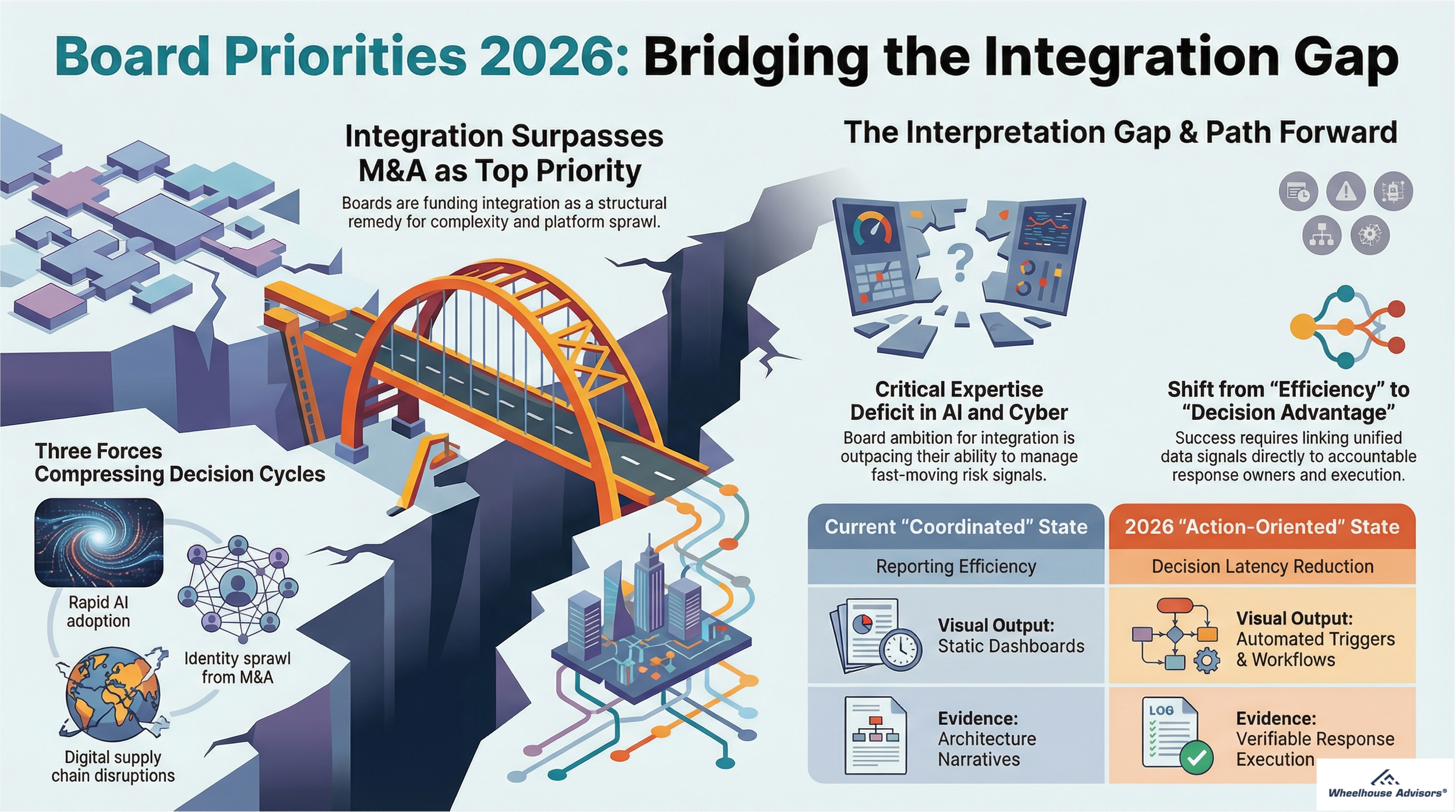
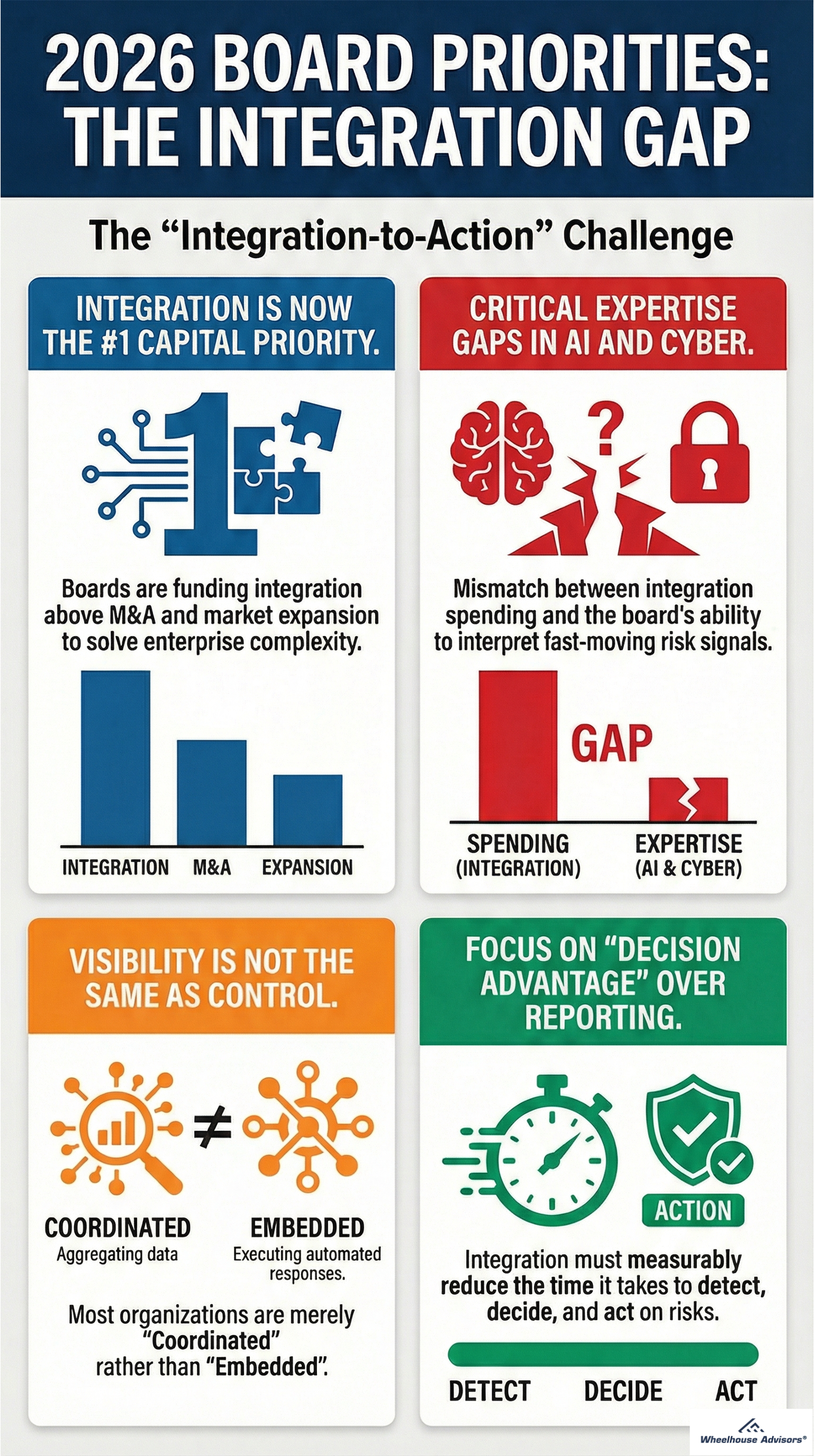
Diligent Institute and Corporate Board Member data indicates directors are prioritizing “technology adoption and integration” as the leading 2026 capital investment focus. This is not a routine modernization signal, it is a board-level acknowledgment that fragmentation has become a constraint on execution. The same dataset also indicates meaningful board expertise gaps in AI, cybersecurity, and geopolitical risk, creating a mismatch between integration ambition and the enterprise’s ability to interpret, manage, and act on fast-moving risk signals.
What changed
Boards are elevating integration above other capital categories, including M&A and market expansion, while simultaneously reporting the largest expertise gap in AI. The combination implies that boards are funding integration as a structural remedy for complexity, even as their confidence in key risk domains that will shape integration outcomes remains limited.
Source: wheelhouseadvisors.com
Why now
Three forces are compressing decision cycles and amplifying dependence risk:
AI adoption is accelerating inside management workflows and board workflows, increasing model, data, and decision risk while expanding regulatory scrutiny.
M&A and market expansion intensify platform sprawl, identity sprawl, and control sprawl, raising the probability that risk evidence becomes inconsistent across systems.
Disruption pathways increasingly run through third parties and digital supply chains, which require unified signals across operational processes and technology assets.
Boards are reacting by investing in integration, but the data suggests many are doing so before the organization has defined what “integrated” risk management outcomes should look like in practice.
Source: wheelhouseadvisors.com
IRM implications
1. Integration spend is shifting from “reporting efficiency” to “manageability.”
For IRM leaders, the opportunity is to reframe integration as a management outcome: reduced time to detect, reduced time to decide, reduced time to act, and verifiable assurance that controls are operating as designed across the enterprise.
2. The market is still predominantly Coordinated, not cleanly Embedded.
Prioritizing integration does not automatically indicate Embedded maturity. Coordinated-stage organizations often improve data aggregation and dashboards without changing ownership, escalation thresholds, and response authority. IRM programs should treat this as a warning: visibility can increase faster than action.
3. Boards are trying to integrate faster than they can interpret.
With notable gaps in AI, cybersecurity, and geopolitical domains, there is a risk that integration becomes a substitute for risk fluency. That failure mode produces “signals without decisions” and “alerts without accountable response owners.” IRM programs should explicitly link integrations to decision rights and to evidence of response execution.
4. Underinvestment in workforce and supply chain is a structural exposure.
Low prioritization of workforce and supply chain investment is misaligned with how disruption propagates. Even strong technical integration can remain brittle if human decision-making, third-party controls, and operational resilience capabilities are not strengthened in parallel.
5. The near-term winner profile in IRM50 shifts toward systems of action.
Vendors that can operationalize integration into management outcomes will be advantaged. The differentiator will be the ability to unify signals across Goals, Processes, Assets, and Policies and convert those signals into triggers, workflows, and evidence that can stand up to executive and board scrutiny.
What to watch next
Board agenda shift from “integration” to “integration for decision advantage.” Watch for explicit board requirements that tie integration investments to measurable reductions in decision latency and improved assurance evidence.
AI management hardening. Expect increased board requests for practical AI management controls, including acceptable use, data handling, model accountability, and evidence trails for AI-influenced decisions.
Third-party dependency instrumentation. Look for movement from static third-party assessments to continuous monitoring tied to critical processes and technology asset exposure.
Vendor messaging evolution. Watch for IRM50 vendors shifting from integration claims to quantified outcomes (cycle-time reduction, automated evidence collection, reduced audit burden, faster remediation, lower loss exposure).
Wheelhouse Horizon View
Horizon View, Market (12 to 18 months, 70% probability): Board-driven integration funding will accelerate consolidation of risk and assurance data layers, increasing demand for platforms that translate unified signals into decision workflows and board-ready evidence. Leadership action: Require vendors and internal teams to prove “integration-to-action” with measurable operational outcomes, not architecture narratives.
Horizon View, Risk (6 to 12 months, 60% probability): Organizations will experience a rise in “visibility without control” incidents, where integrated reporting improves but response authority, thresholds, and AI management controls lag, leading to preventable disruptions and post-event assurance failures. Leadership action: Establish explicit decision thresholds, accountable response owners, and evidence requirements as part of every integration initiative.
References
Diligent Institute and Corporate Board Member, What Directors Think 2026, 23rd Annual Edition: Building Future-Ready Boards (PDF). https://cdn.sanity.io/files/33u1mixi/production/0503ea6e1f86300ba54319afe8db48bbe6632bae.pdf