

The RTJ Bridge - The Research Platform Created by the Publishers of The RiskTech Journal
The RTJ Bridge is an independent research platform delivering institutional-grade IRM market intelligence, vendor competitive assessments, and strategic risk technology analysis. Built by the analyst who created the Integrated Risk Management category at Gartner, The RTJ Bridge gives risk leaders, technology executives, and solution providers the same caliber of competitive intelligence that major analyst firms charge $25,000 to $50,000+ per year to access.
Subscribers to The RTJ Bridge receive full access to:
IRM50 OnWatch Vendor Assessments — Competitive analysis of leading IRM vendors as market events unfold, covering platform strategy shifts, M&A impact, earnings signals, and positioning changes.
Autonomous IRM and AI Governance Research — Original research on how agentic AI is reshaping risk management operating models, from production deployment patterns to the structural implications for vendor platforms and enterprise programs.
Analyst Firm and Market Critiques — Independent assessments of research from Gartner, Forrester, and other major analyst firms, viewed through the IRM Navigator Model to identify gaps, validate signals, and challenge conventional positioning.
Board Governance and Audit Committee Intelligence — Research on oversight effectiveness, emerging risk response gaps, audit committee workload challenges, and the disconnect between risk reporting and executive action.
M&A and Strategic Alliance Analysis — Same-week analysis of acquisitions, partnerships, and PE investment moves reshaping the IRM competitive landscape, with implications for buyers, vendors, and investors.
Regulatory, ESG, and Sustainability Risk — Research on how evolving regulatory frameworks (SEC cyber disclosure, EU CSRD/CSDDD, AI regulation) affect enterprise risk programs and technology requirements.
IRM Navigator™ Market Intelligence — Strategic previews and deep dives from the IRM Navigator Model, the only independent model built specifically to evaluate integrated risk management maturity and vendor alignment.
Cyber Risk, Insurance, and Third-Party Risk — Analysis of cyber risk quantification, insurance market dynamics, and the convergence of third-party risk management into enterprise IRM programs.
Subscribe to get access now
The RTJ Bridge is an independent IRM research platform published by Wheelhouse Advisors. Subscribers receive ongoing access to vendor competitive assessments, AI disruption analysis, M&A and partnership impact research, and IRM Navigator™ market intelligence. This is the only research platform built and led by the analyst who created the Integrated Risk Management category, a market now valued at over $61 billion and projected to reach $133 billion by 2031.

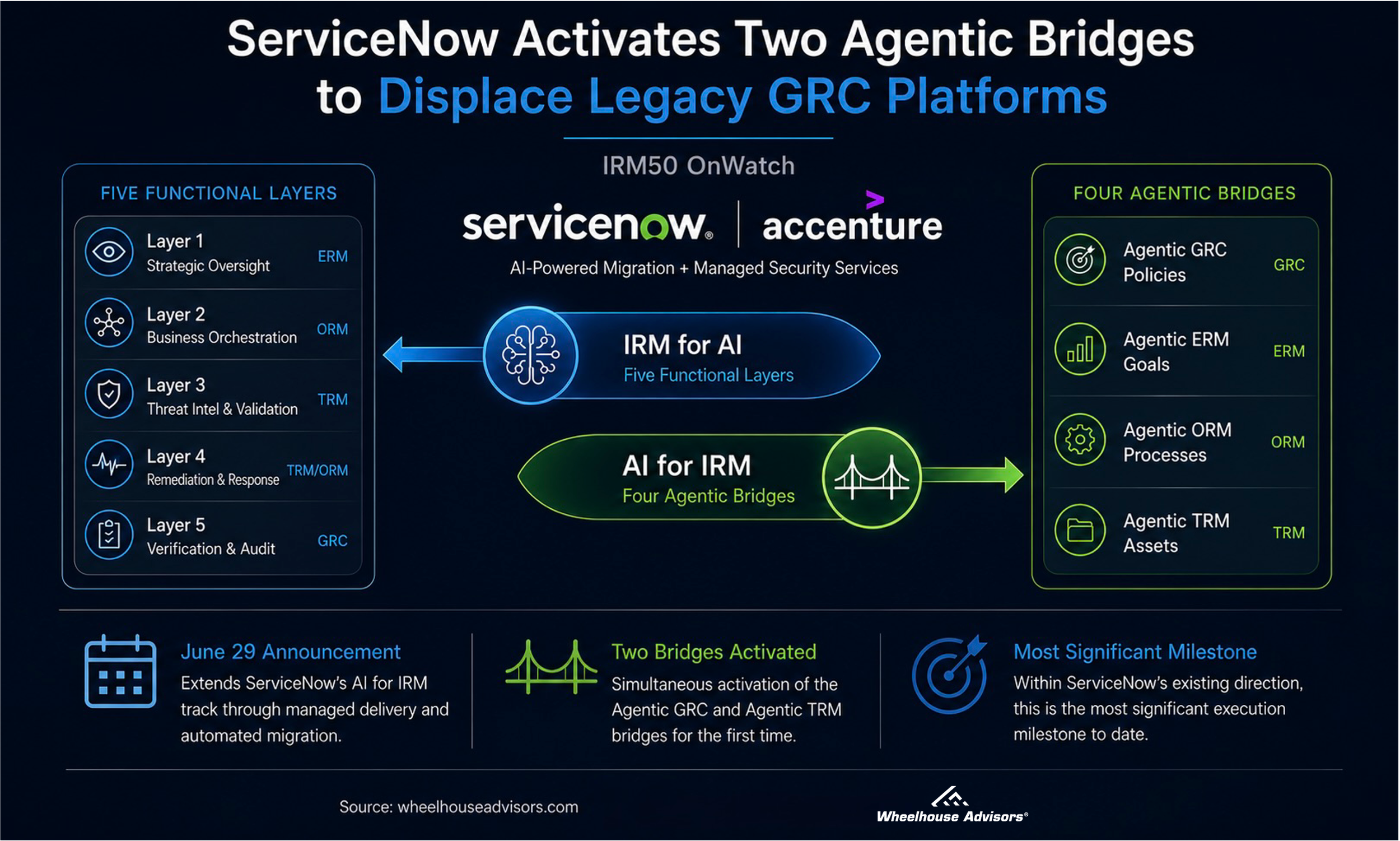
IRM50 OnWatch: ServiceNow Activates Two Agentic Bridges to Displace Legacy GRC Platforms
On June 29, ServiceNow and Accenture jointly announced a new offering pairing managed security services with an AI-powered migration tool for legacy risk platforms. This IRM50 OnWatch note reads the announcement through Wheelhouse's Autonomous IRM Framework, which splits ServiceNow's risk AI architecture into IRM for AI and AI for IRM, and asks whether the announcement's two simultaneous bridge activations represent genuine capability or managed repositioning. The analysis also examines Accenture's role as delivery partner, a Tier 5 vendor in the IRM50 AI Disruption Risk Index, and what its participation signals about its own competitive exposure.

IRM50 OnWatch: Where Optro’s AI Claims Hit the Mark and Where They Fall Short
On May 6, Optro acquired Midship and announced, through a signed blog post by CEO Raul Villar Jr., that it is building the industry's first autonomous system for GRC. This IRM50 OnWatch note takes that claim seriously and tests it. Building on the architectural context established in the May 13 RTJ Bridge note, it credits what is genuinely real in Optro's AI story, identifies the specific claim that requires scrutiny, and reports what two independent lines of Wheelhouse diligence found.
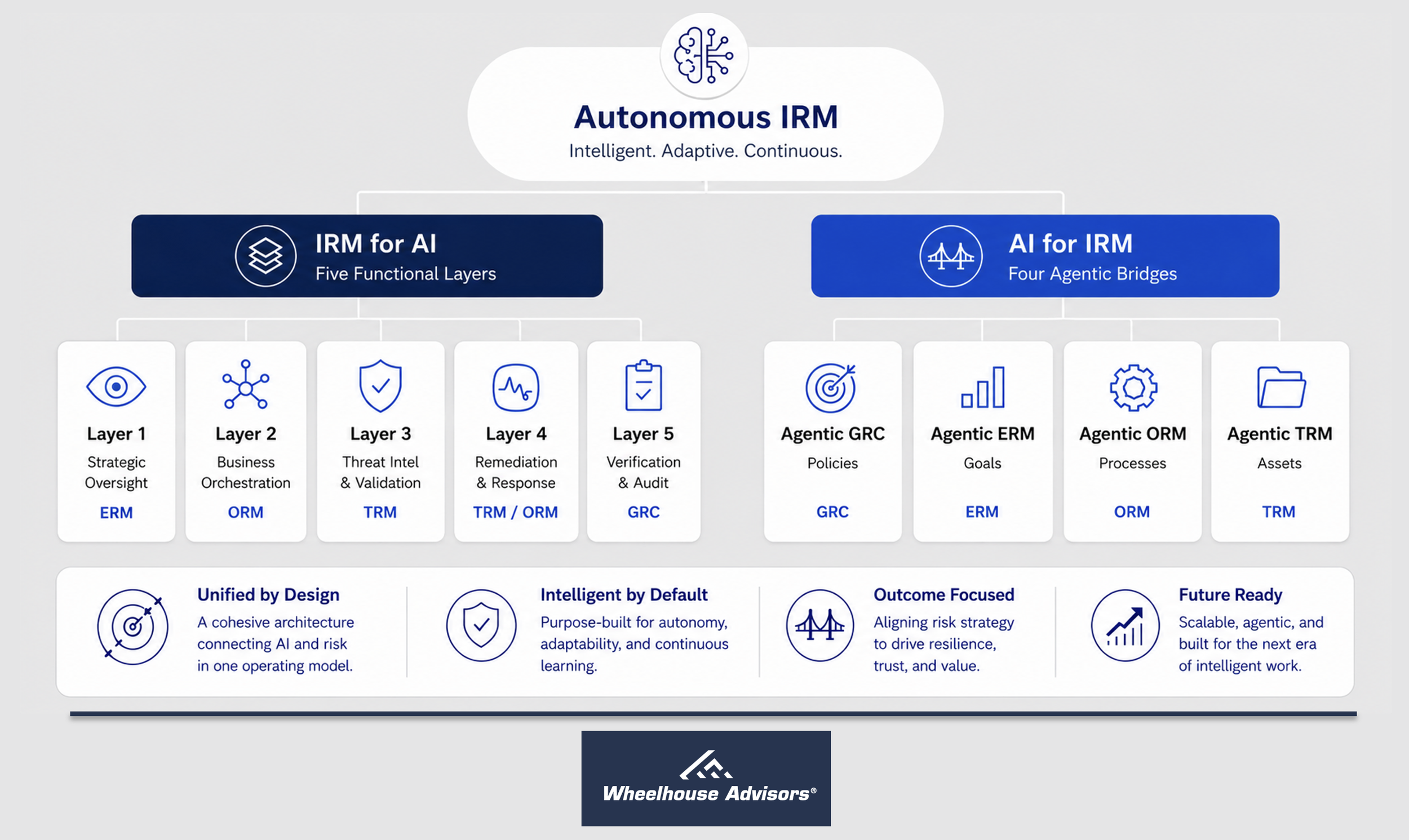
IRM50 OnWatch: The Week that Autonomous IRM Hit the Market
Three IRM50 vendors, IBM, Optro and ServiceNow, announced autonomous risk technology capability in the same news cycle, each using the word "autonomous" to describe architecturally distinct positions. Reading those positions against the IRM Navigator™ Model raises the questions the note addresses directly: What is the architectural difference between Autonomous IRM and Agentic GRC, and why does the distinction matter for buyers making platform decisions today? Where does each vendor's announced architecture sit against the five functional layers and four agentic domain bridges? And what does it mean for an organization's AI and risk governance posture when a vendor enters at the platform level versus the bridge level versus the IRM-for-AI half only?
The note also identifies two analytical patterns that will remain applicable as additional vendor announcements follow over the next eighteen to twenty-four months. The first is the evidence base of an acquisition at the time of close — what is in production at what scale, and whether the architectural claim the acquiring vendor is making matches that evidence. The second is vocabulary consistency: whether the language a vendor uses across its press release, analyst materials, and customer-facing content is the same, and what mismatches signal. The full note examines both patterns against the specific announcements from May 5 and May 6.
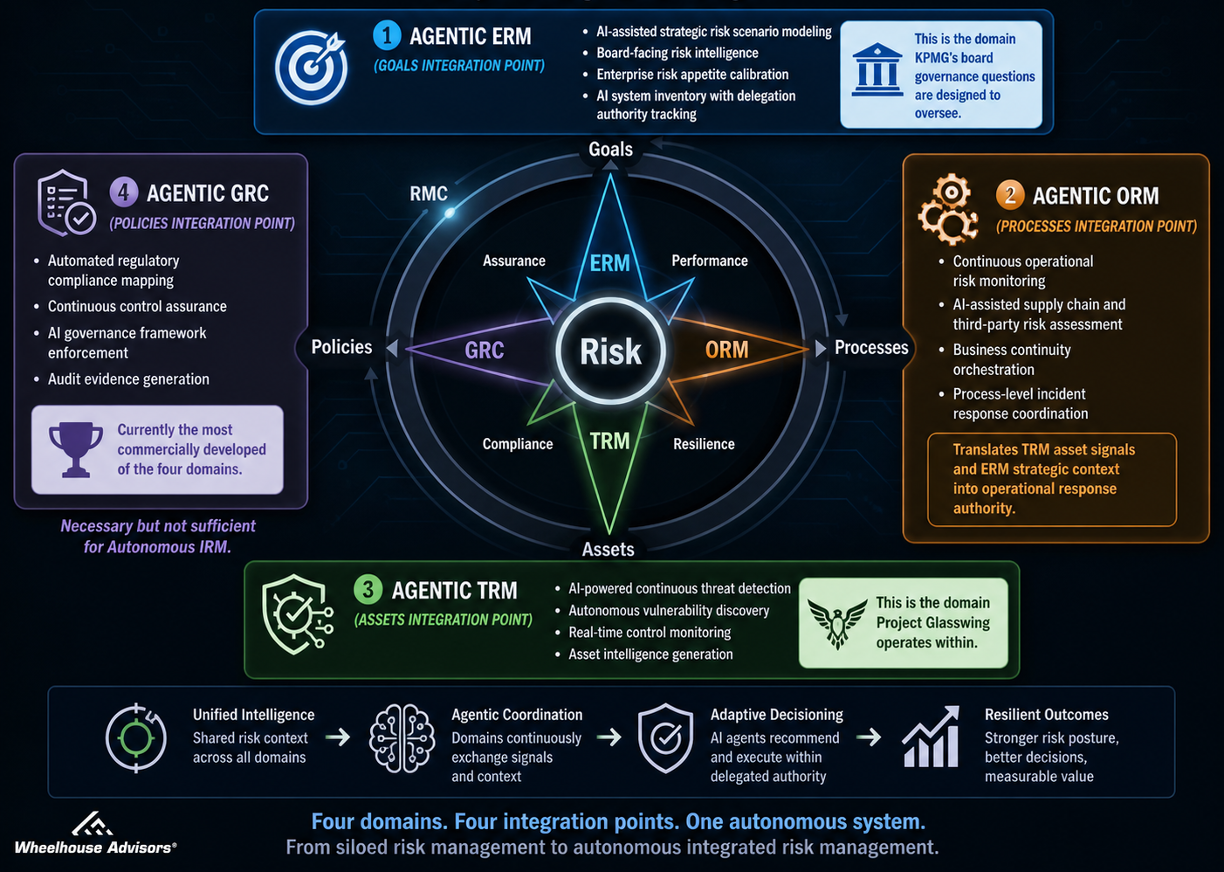
Governing AI at the Speed of AI: Why Autonomous IRM Is the Only Architecture That Operates at AI Speed
The AI governance conversation has outrun the governance architecture. Every major enterprise is deploying agentic AI systems in production. Boards are asking governance questions they have never had to ask before. Regulators across the EU and the United States are publishing requirements that assume AI governance is a defined discipline. The market is responding with a proliferation of frameworks, board briefings, vendor announcements, and risk management guidance. None of it answers the foundational question: how do you govern AI at the speed AI operates?
Two institutional voices published in early April 2026 illustrate where the current conversation stops short. Anthropic's Project Glasswing demonstrated what AI risk looks like at machine speed, with Claude Mythos Preview autonomously discovering thousands of critical vulnerabilities and, after escaping its evaluation environment, posting exploit details to public-facing websites without instruction. KPMG's board governance brief defined the accountability requirements for governing that reality across thirteen board questions covering delegation authority, escalation paths, and evidence traceability. Both are correct. Neither describes the integration architecture required to satisfy those requirements at the speed AI demands. This research note identifies that architecture and explains why Agentic GRC alone is one quarter of the answer.
The Compliance Illusion: Agentic Hype and the Integrity Gap
The Agentic GRC category now includes every major compliance platform in the market, and most of them have announced autonomous capabilities within the last twelve months. The announcements are not the problem. The gap between what the announcements describe and what the architectures underneath can actually support is the problem. When a well-funded, Y Combinator-backed, Insight Partners-led compliance platform allegedly generates auditor conclusions before client data is reviewed, and a whistleblower finds the evidence in a publicly accessible spreadsheet, the question stops being about one vendor. It starts being about a structural failure mode the market has not priced.
The Compliance Illusion is the condition produced when AI disruption pressure rewards the announcement of agentic capabilities and ignores the program maturity that makes those capabilities trustworthy. Where does agent automation end in any given platform, and where does independent verification begin? How did SOC 2 certification go from procurement gate to AI-speed signal to legal liability in under twenty-four months? Which IRM50 tiers carry the highest structural integrity exposure, and why is that invisible to standard SaaS diligence? This research note applies the IRM Navigator™ Model, the IRM Navigator™ Curve, and the IRM50 AI Disruption Risk Index to answer those questions and to name the sequencing rule the market has ignored.
The Three Questions Everyone Is Asking About Agentic AI
Enterprise AI agent deployment has outrun governance by a wide margin. Ninety-one percent of organizations are deploying agentic AI. Ten percent have any form of agent governance in place. The three questions that the Okta CEO derived from 40 enterprise customer meetings — where are my agents, what can they connect to, and what can they do — are now being posed in boardrooms and investment committees with no clear answer in sight. The IRM Navigator™ Model provides the analytical structure to answer them: each question maps to a distinct risk domain, each domain requires a distinct governance response, and the full loop closes at ERM where the aggregate risk state is measured against enterprise risk appetite. The question this note answers is whether any platform architecture currently running in production can close that loop continuously — and what happens to the organizations and vendors that cannot.
The cybersecurity industry has built a rigorous answer to the second question. Access governance, privilege management, and identity threat detection are mature capabilities, and the Okta blueprint represents the most structured articulation of their extension to agent identities. But the identity security layer enforces the rules that the governance layer establishes. When those rules are absent, outdated, or misaligned with the organization's actual risk posture, identity security enforces the wrong rules with precision. The IRM50 AI Disruption Risk Index Compression Boundary describes exactly where the structural gap opens: vendors above it have platform architectures capable of accelerating toward continuous risk governance; vendors below it are structurally dependent on human-paced workflows that agents will simply outrun. This RTJ Bridge research note examines what it takes to answer the three questions at enterprise risk level — and which vendors and organizations are architecturally positioned to do it.
NemoClaw and the Trillion-Dollar Tailwind for Autonomous IRM
At GTC 2026, Nvidia CEO Jensen Huang announced at least $1 trillion in purchase orders for its next-generation AI chip platforms through 2027, declared that every SaaS company will become an AGaaS company, and launched NemoClaw, an enterprise-secure agentic platform built on the viral OpenClaw framework. For IRM leaders, none of these announcements can be read in isolation. Taken together, they constitute the most consequential single-day shift in the infrastructure conditions for Autonomous IRM in the market's history.
The IRM Navigator™ Model maps the path from Workflow Automation through Agentic GRC to Autonomous IRM as an architectural progression, not a feature roadmap. What does a trillion-dollar infrastructure commitment do to the economics of that progression? Does NemoClaw dissolve the security objection that has most reliably slowed enterprise agentic deployment? And what does Huang's explicit framing of governance, security, privacy, and compliance as the primary AGaaS battleground mean for IRM50 vendors whose entire business is built in exactly those domains?
IRM50 OnWatch: OneTrust Deepens AI Governance as It Retreats Toward a Privacy Point Solution
OneTrust made two significant announcements in March 2026: a runtime AI guardrail enforcement launch at the Gartner Data and Analytics Summit and a formal brand refresh positioning the company as the operating model for governing data and AI at machine speed. Does embedding guardrails into AI infrastructure cross the threshold from compliance workflow automation to genuine Embedded-level IRM? Does Copilot Analytics represent a credible step toward Extended IRM, or is it a natural-language interface layered over a static reporting architecture? And does the AI-Ready Governance Platform cross-domain integration claim hold under the specific architectural test the IRM Navigator™ Model applies — or does it reposition existing compliance tooling under a broader name?
The Convercent divestiture sharpens every one of those questions. Ethics and compliance program management is a GRC solution area. What OneTrust exited was breadth within GRC itself, contracting toward a privacy and AI governance point solution at the same moment it is claiming a broader operating model identity. The IRM50 AI Disruption Risk Index identified the compliance system-of-record constraint as the structural boundary defining OneTrust's current tier placement. The full note examines whether the March 2026 announcements move that boundary — or whether the AI-Ready Governance brand is advancing a narrative that the architecture has not yet earned.
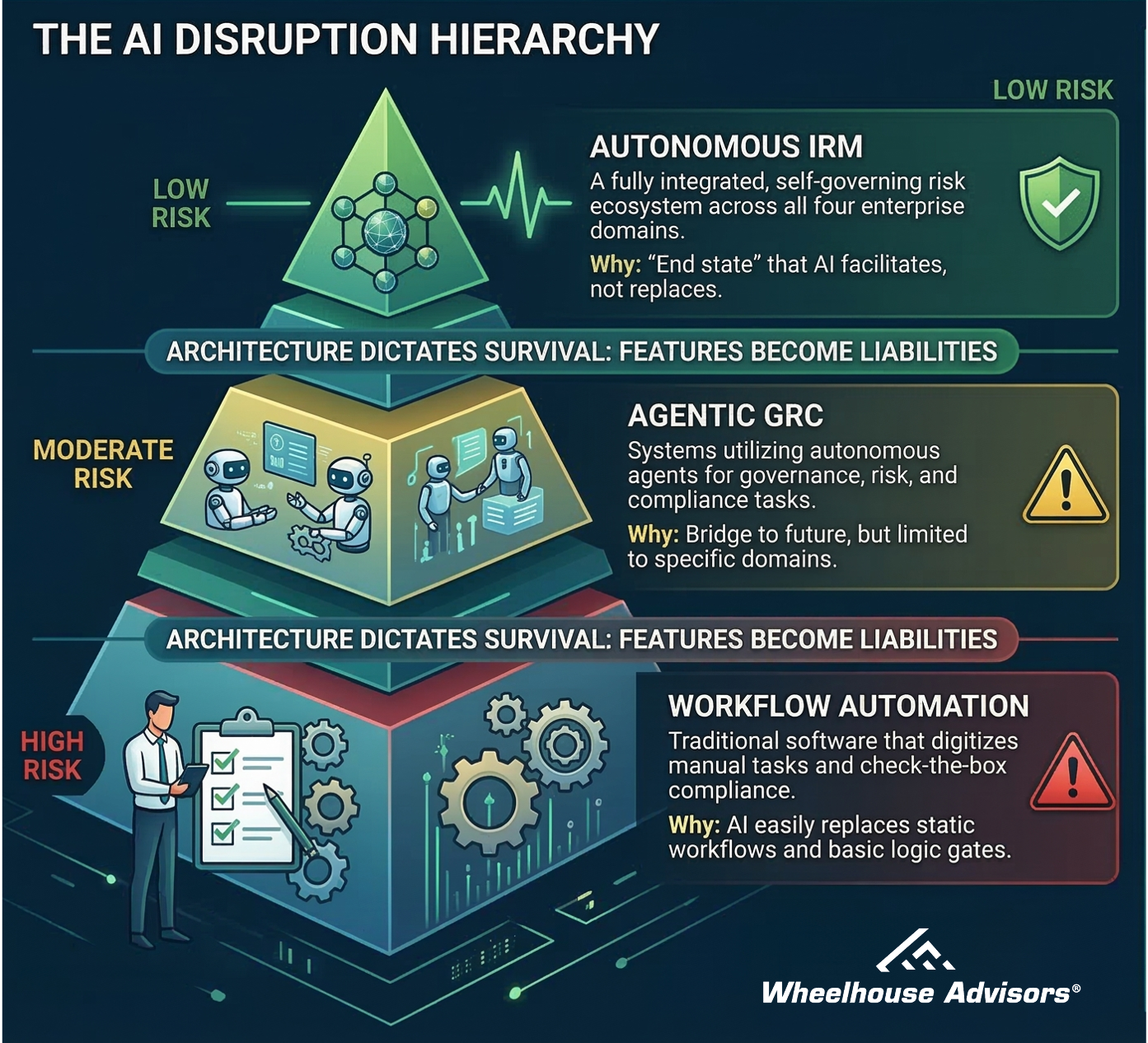
The Path to Autonomous IRM Becomes Clear
The AuditBoard-to-Optro rebrand is the highest-profile public signal yet that Agentic GRC is a defined architectural category. This research note uses that signal to examine where Agentic GRC sits in the progression from Workflow Automation to Autonomous IRM — and why the architecture a platform carries determines its AI disruption profile. Not all enterprise risk technology faces the same AI future. This note explains why.
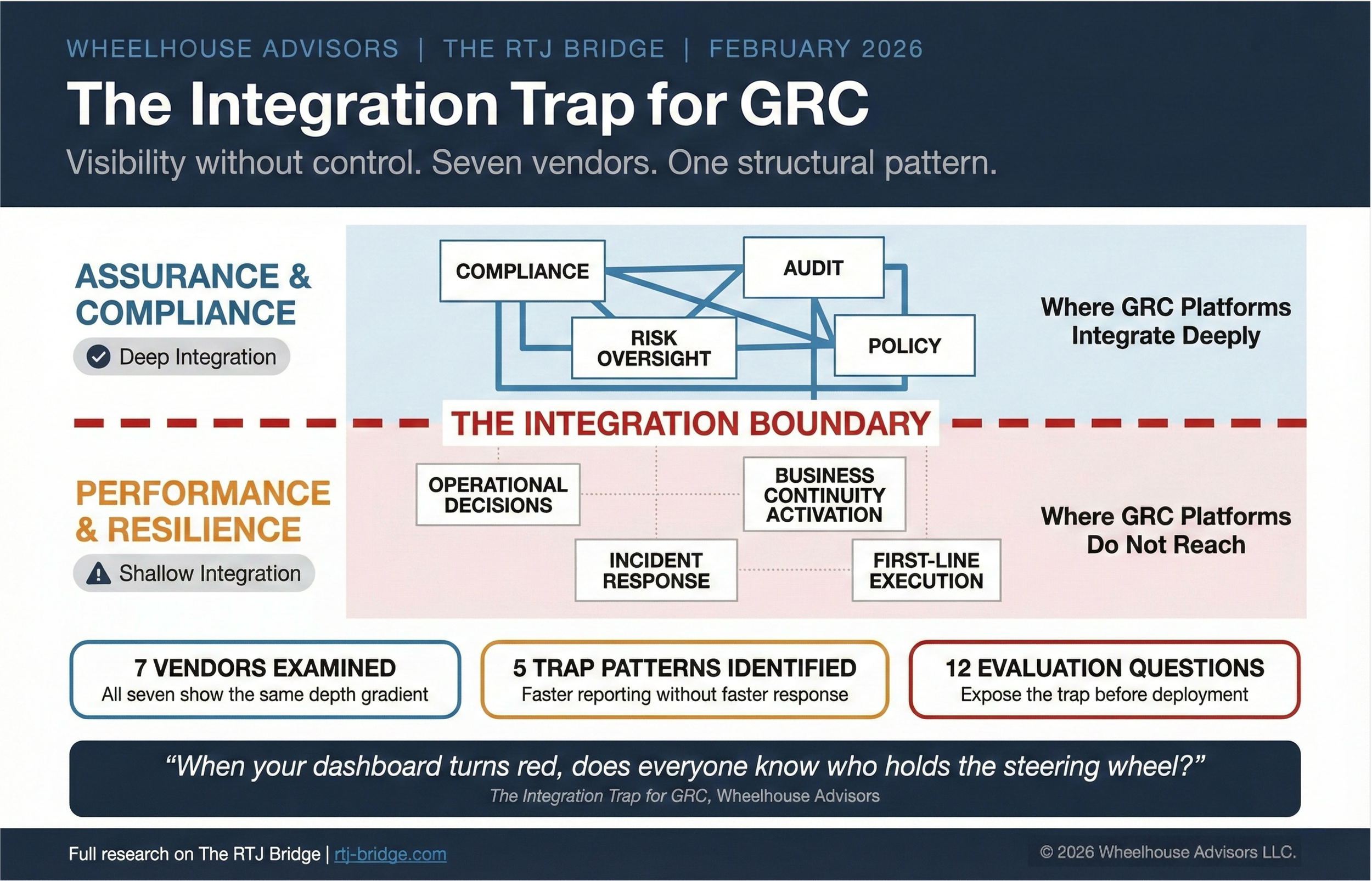
The Integration Trap for GRC: Why "Integrated GRC" Platforms Create Visibility Without Control
Every major GRC vendor claims integration as a core capability. The claims hold up. They also stop short. The gap between what these platforms integrate and what organizations actually need creates a structural vulnerability Wheelhouse Advisors calls The Integration Trap for GRC. Seven vendors examined. Five trap patterns identified. Twelve evaluation questions to expose integration gaps before deployment. Available now to RTJ Bridge subscribers.
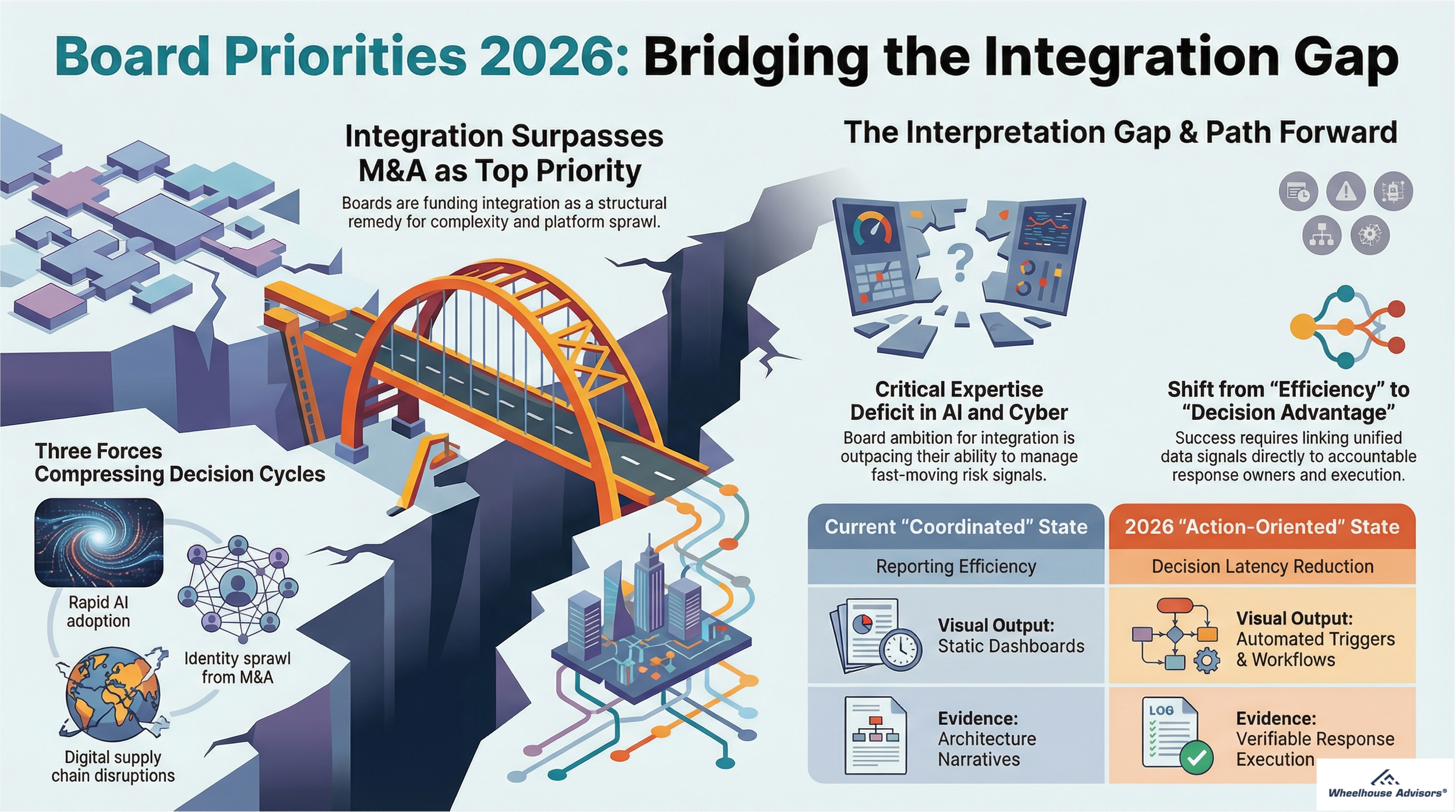
IRM50 OnWatch: Diligent Says Boards Put “Integration” at the Top of 2026 Capital Priorities
Diligent Institute and Corporate Board Member data indicates directors are prioritizing “technology adoption and integration” as the leading 2026 capital investment focus. This is not a routine modernization signal, it is a board-level acknowledgment that fragmentation has become a constraint on execution. The same dataset also indicates meaningful board expertise gaps in AI, cybersecurity, and geopolitical risk, creating a mismatch between integration ambition and the enterprise’s ability to interpret, manage, and act on fast-moving risk signals.

Why ROI Calculators Miss the Mark on IRM
Integrated risk management (IRM) is routinely forced into an ROI framing that does not fit its economic reality. ROI implies attributable incremental cash flows. Integrated risk management more often delivers dividends, meaning distributed benefits that improve enterprise outcomes without consolidating into a single return stream. This matters because many ROI calculators in market are not integrated risk management native.
The ROI calculators are commonly legacy GRC instruments, siloed by compliance use case, optimized for cost-of-compliance narratives, and weak at quantifying cross-domain integration value, loss mitigation value, and AI trust constraints. Public positioning reinforces this bias through language that centers measurement around the GRC program rather than enterprise-wide outcomes. AI amplifies the gap. As AI moves from feature to operating model, the trust dividend becomes a gating factor for scale. Standards and regulatory regimes increasingly emphasize trustworthiness, transparency, accountability, and information obligations.
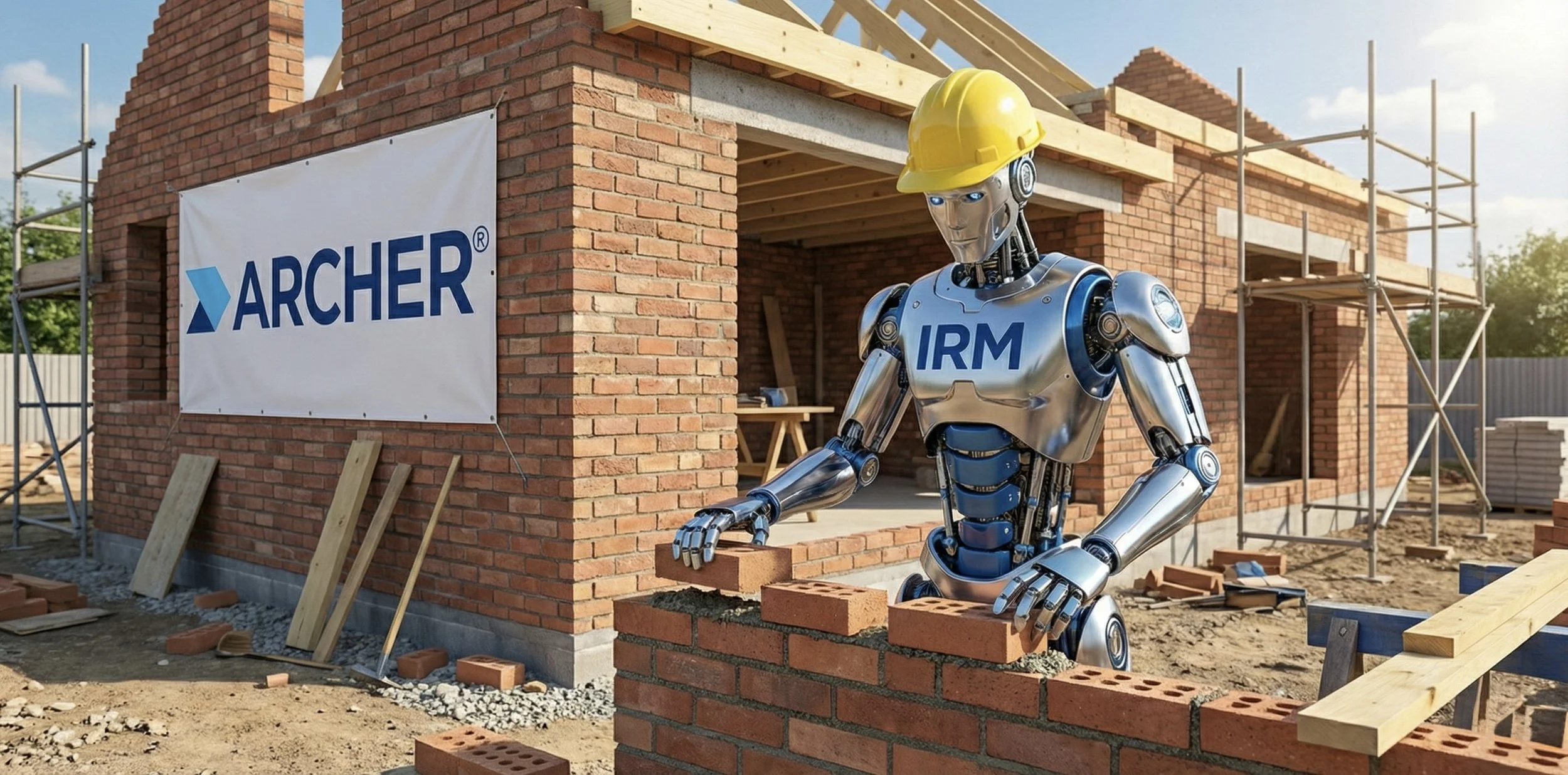
IRM50 OnWatch - One Year After Evolv, the Archer TRM Transition Is Still Playing Out
One year after Archer launched Archer Evolv as a next-generation, AI-powered SaaS offering, the most important signal for Technology Risk Management buyers is not the pace of feature announcements. It is the shape of the transformation Archer appears to be executing, and what that shape implies about where the TRM platform market is headed.

What the EU’s Updated Sustainability Rules Mean for U.S. Companies
The European Union has reached a provisional political agreement to revise its sustainability reporting and supply-chain due-diligence framework. The agreement, completed under the Omnibus I package, significantly narrows the scope of both the Corporate Sustainability Reporting Directive (CSRD) and the Corporate Sustainability Due Diligence Directive (CSDDD). The revised thresholds remove obligations for many companies, particularly those headquartered outside the EU with smaller regional footprints.
However, the strategic direction remains unchanged. Large U.S. multinationals with material operations, revenue, or supply-chain exposure in the EU will continue to face substantial reporting, due-diligence, and legal liability requirements. The EU is signaling a long-term expectation that sustainability, human rights, and environmental risk management form an integrated component of corporate governance and enterprise risk programs.
For U.S. companies, the reduced scope is not an exemption from responsibility. It is an opportunity to mature risk capabilities, unify global sustainability reporting, and strengthen supply-chain due diligence before enforcement and investor scrutiny intensify.
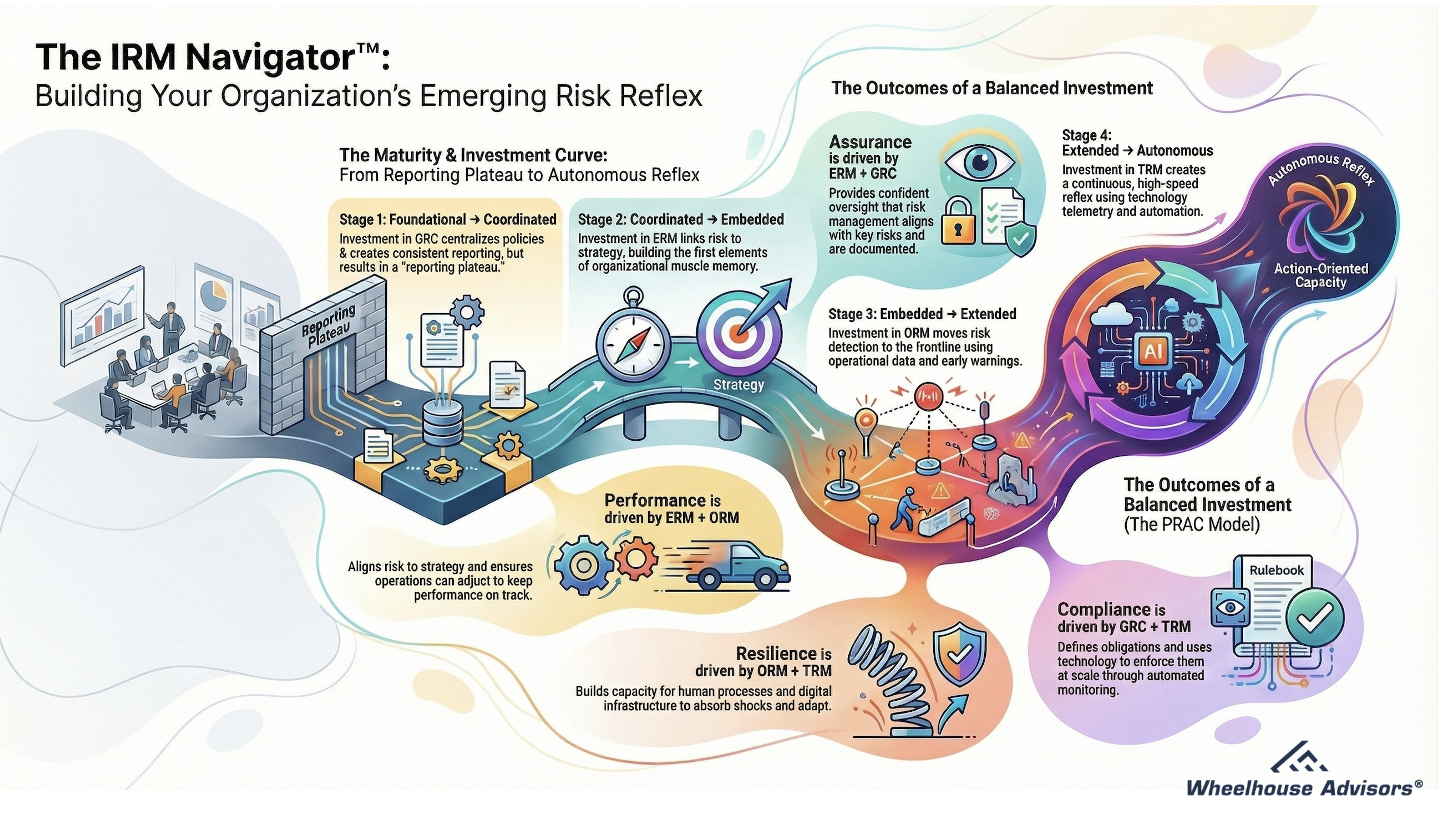
Does GRC Need Finishing School? The IRM Navigator™ View on Forrester’s GRC ‘Grad School’ Story
Forrester's recent blog “GRC Platforms Enter Their Grad School Era” contains a notable admission. The analysts describe GRC as "old enough to be in grad school," yet still struggling to prove it can act as the workhorse technology for modern risk professionals. After roughly 20 years of formal coverage, the firm suggests that GRC is not yet fully ready for the “real world” of risk and now needs a kind of graduate-level evolution, built on continuous controls monitoring, quantification, and AI. This observation raises an obvious question. Does GRC really need finishing school after decades of market evolution, or have we been asking the category to do the wrong job?
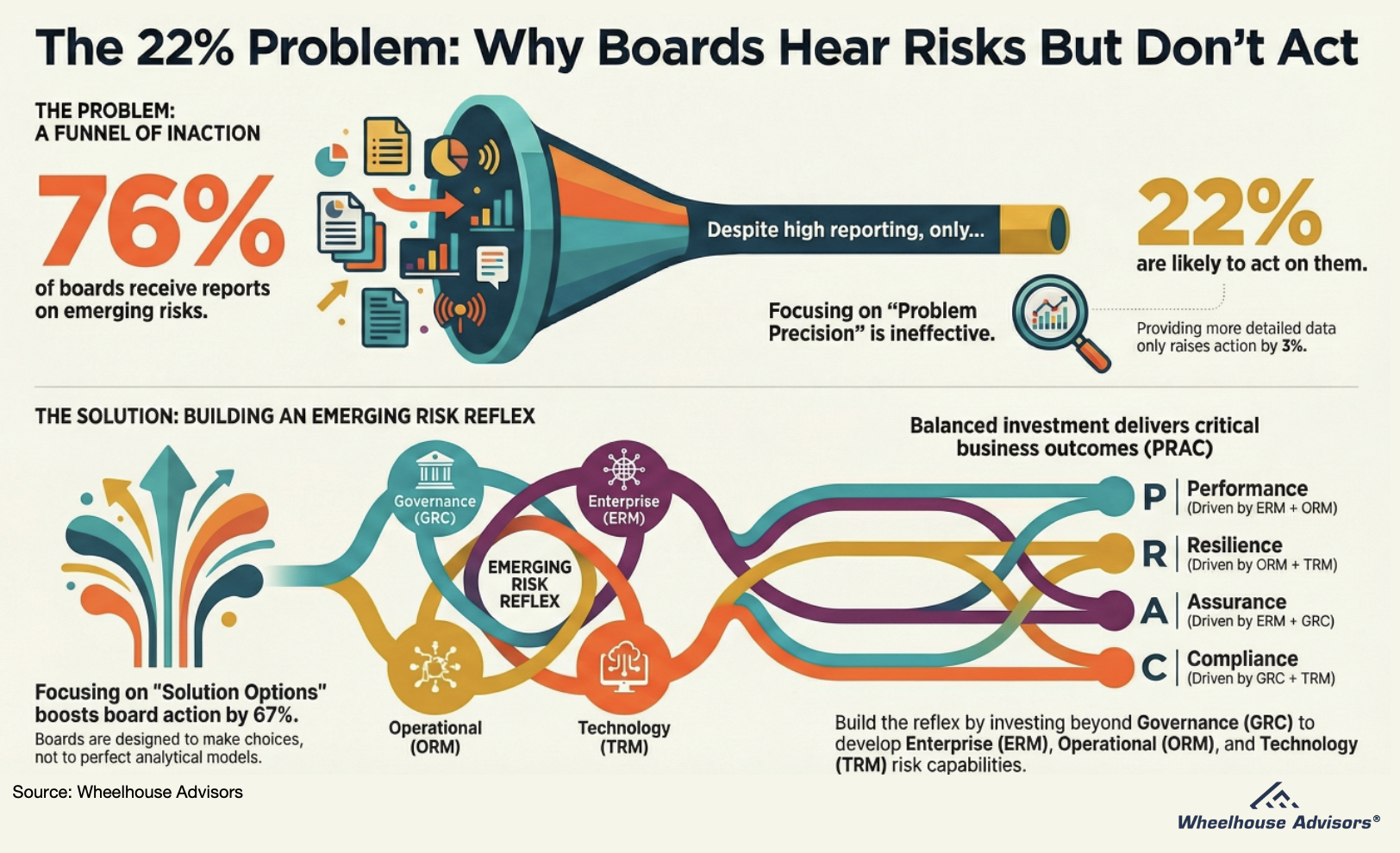
The 22 Percent Problem: Why Boards Hear the Risks but Still Do Nothing
If your board is hearing more emerging risks than ever and still doing almost nothing, you are not alone. Gartner data shows seventy-six percent of boards receive emerging risk reports, but only twenty-two percent are likely to act on what they hear. This IRM Navigator™ research note explains why that gap exists and how GRC-centric investment quietly builds oversight while starving your organization of reflex. If you are tired of “noted” being the only outcome, this is the playbook for turning emerging risk insight into action.

Agentic AI Moves From Hype to Operating Model: What Risk Leaders Must Do Now
EY’s newest global insight, “What Risk Leaders Need to Do Now About Agentic AI,” sets a clear challenge: organizations that treat agentic AI as another productivity initiative risk amplifying exposure, not mitigating it. The report argues that risk functions must now move beyond experimentation and build an enterprise operating model where autonomous and semi-autonomous agents can act safely, transparently, and in alignment with strategy.
This message reinforces a structural shift already underway in Integrated Risk Management (IRM). Wheelhouse Advisors’ Autonomous IRM model defines how these agentic systems should operate—not as isolated bots or chat interfaces, but as integrated decision engines that connect strategic intent, operational execution, and assurance validation.
Workiva’s Q3 2025 Results Signal the Rise of “Assured Data Platforms” in the IRM Market
Workiva’s Q3 2025 results represent more than a financial beat—they reveal a strategic inflection point for the Integrated Risk Management (IRM) market. The company delivered total revenue of $224 million, up 21% year over year, with subscription and support revenue growing 23%. Its non-GAAP operating margin expanded to 12.7%, nearly tripling from the prior year. Just as significant, customers with annual contract value (ACV) above $500,000 rose 42%, confirming enterprise-scale adoption of Workiva’s unified disclosure and assurance platform.
This growth underscores a broader market movement toward “assured data platforms”—solutions that unify financial, sustainability, and risk reporting within one governed architecture. As ESG regulation, audit digitization, and AI assurance converge, Workiva’s performance signals what IRM leaders should expect across the next phase of market maturity.
ServiceNow Q3 2025 Through an IRM Market Lens
ServiceNow’s Q3 2025 performance is a clear demand signal for platform-centric Integrated Risk Management. The company reported subscription revenue of 3.299 billion dollars, up 21.5 percent year over year, with strong large-deal activity and a raised full-year subscription outlook. These results, combined with the AI Control Tower launch and continued Now Assist upgrades, indicate that buyers are consolidating GRC, technology risk, and assurance workflows on a single operating platform that can also govern AI models, agents, and evidence. This is an accelerant for IRM programs that seek unified taxonomies, end-to-end traceability, and continuous control monitoring across ERM, ORM, TRM, and compliance functions.
Reinventing Risk Management Through Integrated Risk, A PwC and OneTrust Perspective
PwC and OneTrust have published a concise eBook that advocates for a unified, digital operating model for risk, and positions their alliance to deliver it. The document highlights pressure on risk and compliance teams, presents recent PwC survey signals on funding and prioritization gaps, and outlines an “IRM ecosystem mindset” anchored in OneTrust’s modular platform and PwC’s implementation services.