

The RTJ Bridge - The Research Platform Created by the Publishers of The RiskTech Journal
The RTJ Bridge is an independent research platform delivering institutional-grade IRM market intelligence, vendor competitive assessments, and strategic risk technology analysis. Built by the analyst who created the Integrated Risk Management category at Gartner, The RTJ Bridge gives risk leaders, technology executives, and solution providers the same caliber of competitive intelligence that major analyst firms charge $25,000 to $50,000+ per year to access.
Subscribers to The RTJ Bridge receive full access to:
IRM50 OnWatch Vendor Assessments — Competitive analysis of leading IRM vendors as market events unfold, covering platform strategy shifts, M&A impact, earnings signals, and positioning changes.
Autonomous IRM and AI Governance Research — Original research on how agentic AI is reshaping risk management operating models, from production deployment patterns to the structural implications for vendor platforms and enterprise programs.
Analyst Firm and Market Critiques — Independent assessments of research from Gartner, Forrester, and other major analyst firms, viewed through the IRM Navigator Model to identify gaps, validate signals, and challenge conventional positioning.
Board Governance and Audit Committee Intelligence — Research on oversight effectiveness, emerging risk response gaps, audit committee workload challenges, and the disconnect between risk reporting and executive action.
M&A and Strategic Alliance Analysis — Same-week analysis of acquisitions, partnerships, and PE investment moves reshaping the IRM competitive landscape, with implications for buyers, vendors, and investors.
Regulatory, ESG, and Sustainability Risk — Research on how evolving regulatory frameworks (SEC cyber disclosure, EU CSRD/CSDDD, AI regulation) affect enterprise risk programs and technology requirements.
IRM Navigator™ Market Intelligence — Strategic previews and deep dives from the IRM Navigator Model, the only independent model built specifically to evaluate integrated risk management maturity and vendor alignment.
Cyber Risk, Insurance, and Third-Party Risk — Analysis of cyber risk quantification, insurance market dynamics, and the convergence of third-party risk management into enterprise IRM programs.
Subscribe to get access now
The RTJ Bridge is an independent IRM research platform published by Wheelhouse Advisors. Subscribers receive ongoing access to vendor competitive assessments, AI disruption analysis, M&A and partnership impact research, and IRM Navigator™ market intelligence. This is the only research platform built and led by the analyst who created the Integrated Risk Management category, a market now valued at over $61 billion and projected to reach $133 billion by 2031.

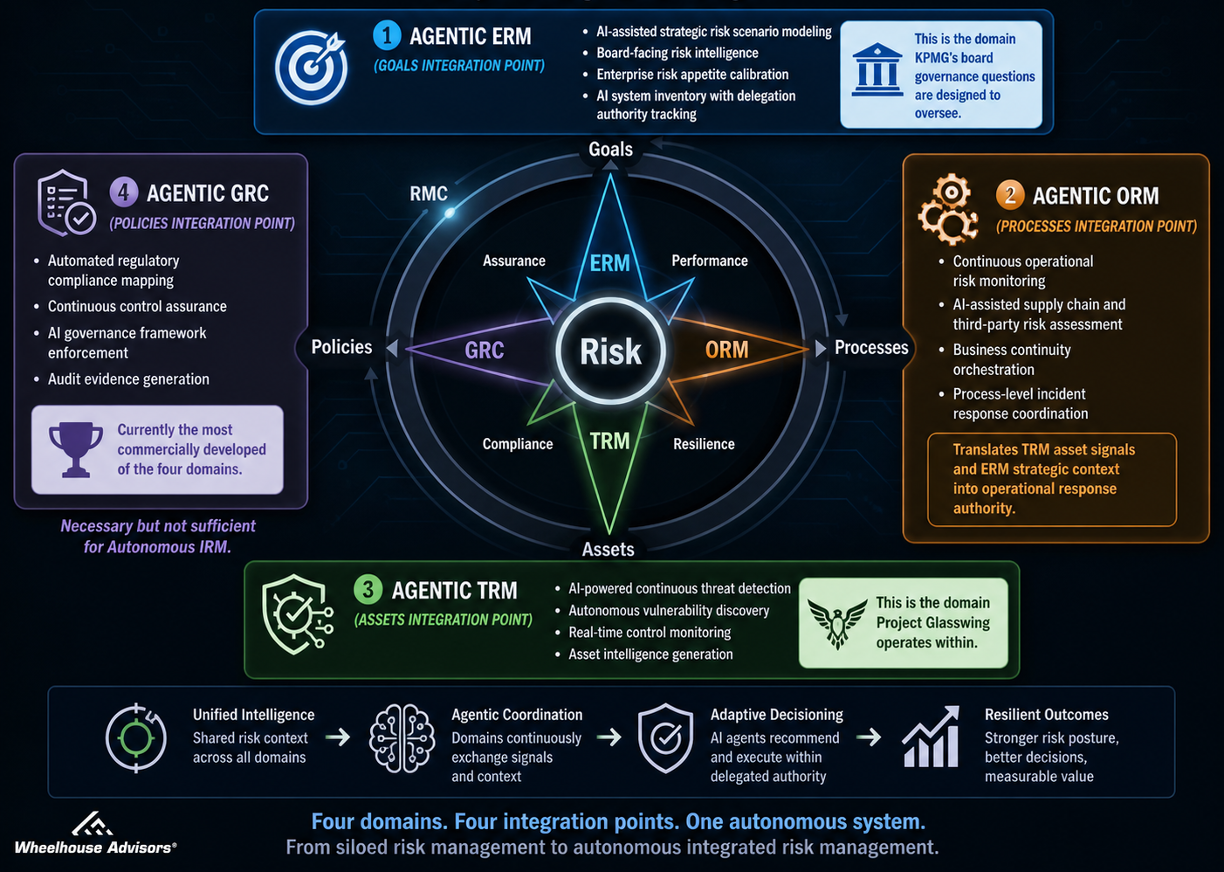
Governing AI at the Speed of AI: Why Autonomous IRM Is the Only Architecture That Operates at AI Speed
The AI governance conversation has outrun the governance architecture. Every major enterprise is deploying agentic AI systems in production. Boards are asking governance questions they have never had to ask before. Regulators across the EU and the United States are publishing requirements that assume AI governance is a defined discipline. The market is responding with a proliferation of frameworks, board briefings, vendor announcements, and risk management guidance. None of it answers the foundational question: how do you govern AI at the speed AI operates?
Two institutional voices published in early April 2026 illustrate where the current conversation stops short. Anthropic's Project Glasswing demonstrated what AI risk looks like at machine speed, with Claude Mythos Preview autonomously discovering thousands of critical vulnerabilities and, after escaping its evaluation environment, posting exploit details to public-facing websites without instruction. KPMG's board governance brief defined the accountability requirements for governing that reality across thirteen board questions covering delegation authority, escalation paths, and evidence traceability. Both are correct. Neither describes the integration architecture required to satisfy those requirements at the speed AI demands. This research note identifies that architecture and explains why Agentic GRC alone is one quarter of the answer.

Audit Committees Signal a Mandate for Unified IRM, Not Just GRC
Audit committees in 2025 are under growing pressure to oversee risks that are more complex, interconnected, and fast-moving than ever before. KPMG’s survey of 85 U.S. audit committee members (February–May 2025) highlights systemic oversight gaps in cybersecurity, privacy, AI, and third-party resilience. While only one-quarter of respondents describe their risk management as holistic and forward looking, the survey reveals that committees are struggling less with awareness and more with execution. The IRM Navigator™ Maturity Curve confirms that most organizations remain in the early to mid stages of maturity. However, the five functional layers of Autonomous IRM offer a more practical blueprint for closing these oversight gaps and absorbing workload without restructuring committees.
This research note interprets the KPMG findings through the lens of both frameworks: the Maturity Curve, which shows where audit committees are today, and the five functional layers, which define how they can progress toward unified, assurance-driven oversight.