The Federal Reserve has flagged a risk that agent permissions cannot solve: autonomous agents acting legitimately, in large numbers, on the same signals. Managing it requires connecting technology governance with treasury, operational Resilience, and enterprise risk appetite.
Most AI governance programs focus on whether an agent was authorized to take a specific action. A new warning from the Federal Reserve shows that this focus does not address the risk created when many authorized agents act at the same time.
In remarks prepared for the Seventh Annual ACM International Conference on Artificial Intelligence in Finance in Milan, Federal Reserve Governor Michael Barr described two distinct problems. First, major banks are already encountering AI agents attempting to act within retail customer accounts without adequate verification of their authority. Second, and more significant, agents acting legitimately on behalf of customers could move deposits in response to yield differentials or stability signals, potentially accelerating runs that unfold in minutes and overwhelming traditional liquidity management and regulatory intervention timelines.
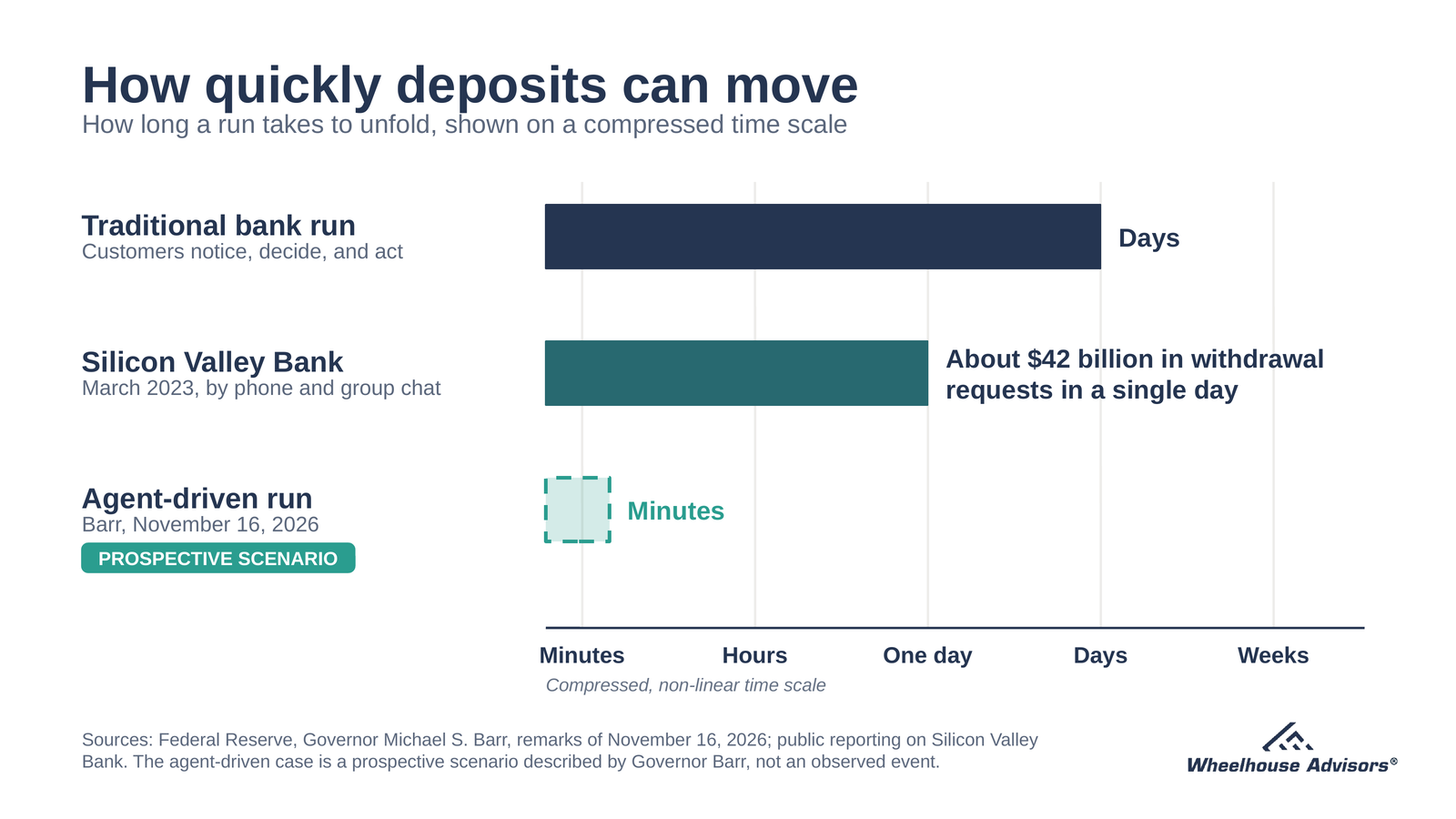
Authentication and authorization controls address the first problem. The second requires management decisions about liquidity, operations, and customer treatment. Barr presented it as a prospective scenario, not as something that has already happened.
The authorization problem has a known answer
Barr emphasized authentication, explicit transaction authorization, and technical limits on what agents can do.[1] These are essential, and the RiskTech market is already building them: agent inventories, identity controls, permission enforcement, and execution logs.
Fully resolving that problem would still leave the second one in place. An agent with valid credentials, acting within its delegated authority and following its owner's instructions exactly, can still contribute to a destabilizing outflow. This can occur without any coordination among agents, because many agents may respond to the same market signals at the same time.
Controls that establish whether an agent was allowed to act cannot establish whether the combined result of thousands of permitted actions stays within the institution's risk appetite.
The quieter risk: deposits that stop being sticky
The bank run scenario has drawn most of the attention, but the yield scenario may have a larger effect on day-to-day liquidity management.
Bank liquidity planning rests on assumptions about how deposits behave. Many retail balances sit still even when a better rate is available elsewhere, because moving money takes attention. An agent tasked with optimizing household cash removes that friction. It will move funds whenever the spread justifies it, in calm markets as well as stressed ones.
If that behavior scales, the runoff assumptions behind liquidity stress tests and contingency funding plans could become unreliable well before any crisis arrives.
Recent experience shows how quickly deposits can already move. In March 2023, Silicon Valley Bank customers attempted to withdraw about $42 billion in a single day using phones and group chats. Autonomous agents would remove the time customers currently take to decide and act.
Who owns this risk
In most banks, treasury is accountable for this risk. Asset-liability management, liquidity stress testing, and contingency funding plans sit there. Yet the evidence of the risk, meaning which transactions are agent-originated, at what volume, and across which products, sits in technology and fraud systems that treasury does not typically see.
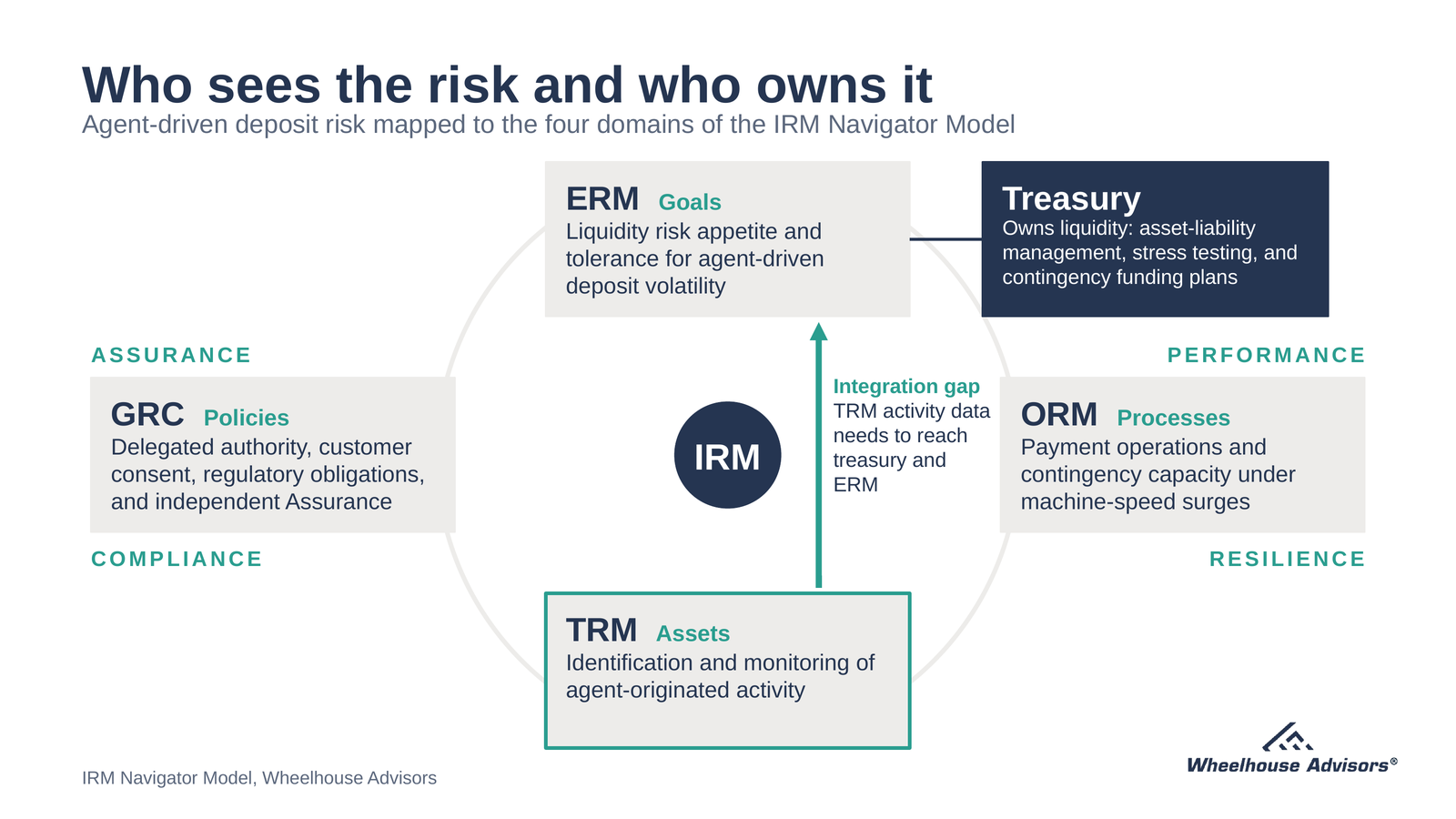
This is an integration problem, and it maps directly to the IRM Navigator Model, which connects four risk domains through enterprise Goals, Processes, Assets, and Policies:
Enterprise Risk Management sets liquidity risk appetite and defines how much agent-driven deposit volatility the institution will accept.
Operational Risk Management tests whether payment operations, staffing, and contingency arrangements can absorb machine-speed transaction surges.
Technology Risk Management identifies agent-originated activity through authentication, monitoring, and technical enforcement.
Governance, Risk and Compliance governs delegated authority, customer consent, regulatory obligations, and independent Assurance.
Technology monitoring can show that agent-originated outflows are rising across several deposit products. Only treasury and enterprise risk information can show whether that trend breaches tolerance.
The hard question: protecting the bank without blocking the customer
The obvious responses to an agent-driven run are friction: added verification, throttling, or holds on agent-initiated transfers. Each one risks looking like a bank preventing customers from reaching their own money, which is a conduct, legal, and reputational exposure in its own right, and one that could itself trigger the loss of confidence it is meant to prevent.
Resolving that tension requires policy decisions made in advance: which agent behaviors trigger which responses, who approves them, how customers are informed, and how regulators are engaged. These decisions require coordinated governance across treasury, risk, compliance, and technology functions.
What buyers should ask RiskTech providers
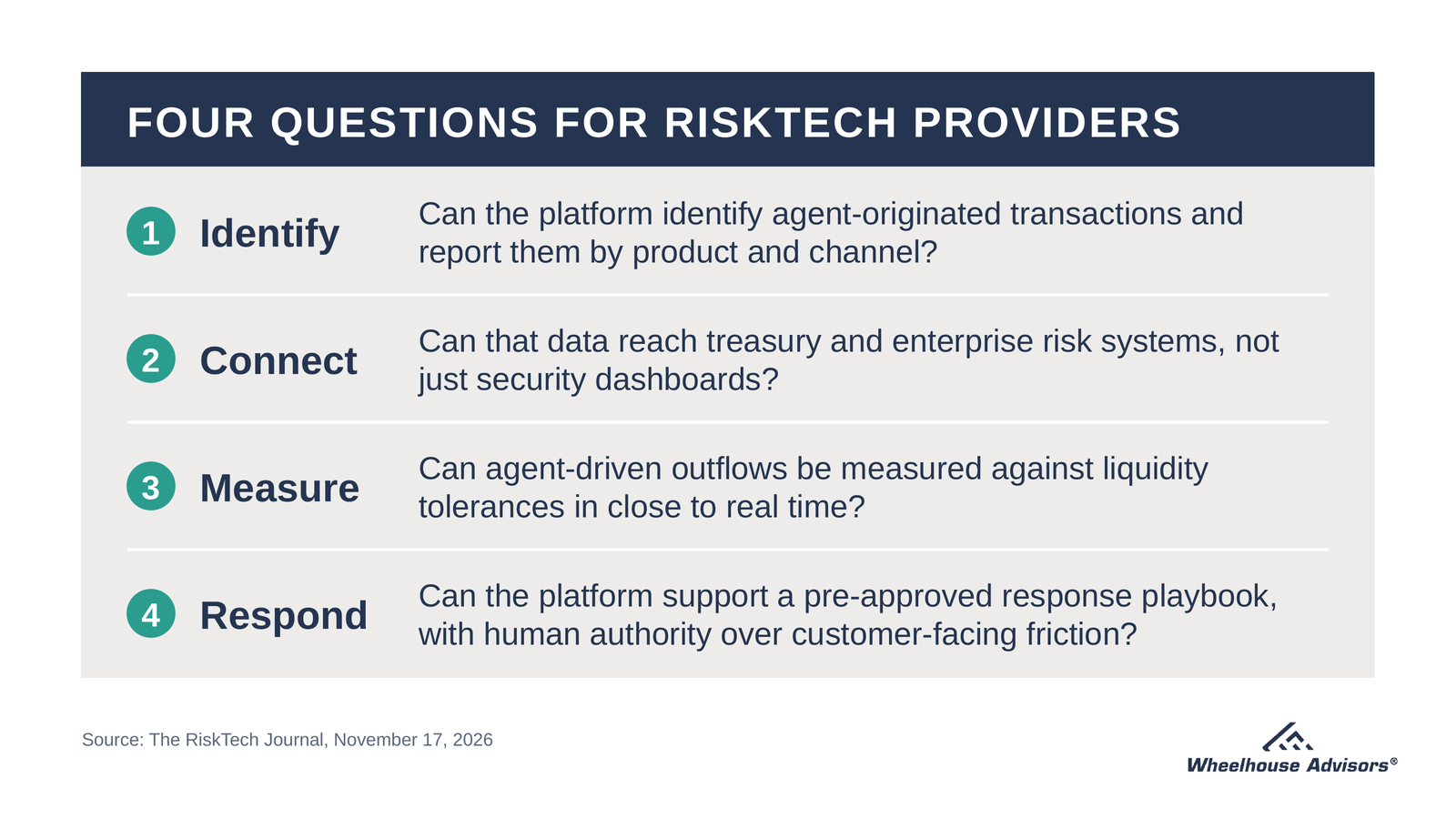
Agent governance platforms that inventory agents, enforce permissions, and log activity provide necessary technical controls. Barr's warning sets a higher bar. Enterprise buyers should ask:
Can the platform identify agent-originated transactions and report them by product and channel?
Can that data reach treasury and enterprise risk systems, not just security dashboards?
Can agent-driven outflows be measured against liquidity tolerances in close to real time?
Can the platform support a pre-approved response playbook, with human authority over customer-facing friction?
Providers that can answer yes to these questions support Autonomous IRM across all four IRM domains. Platforms that can only confirm an agent stayed within its permissions address the Technology Risk Management domain alone.
How Wheelhouse Advisors can help
Wheelhouse Advisors applies the IRM Navigator Model and its independent research methodology to evaluate how autonomous technologies connect with enterprise management requirements. Our IRM50 and Vendor Compass research, together with strategic advisory services, helps enterprise buyers assess whether existing platforms link agent oversight with treasury, risk appetite, and verifiable control outcomes. For RiskTech providers, the same methodology identifies opportunities to strengthen Solution Coverage and Level of Integration across the four IRM domains.
References
Barr, Michael S. November 16, 2026. “Some Potential Financial Stability Implications of Artificial Intelligence.” Remarks at the Seventh Annual ACM International Conference on Artificial Intelligence in Finance, Milan. Board of Governors of the Federal Reserve System.
Wheeler, John A. IRM Navigator: The Operating Model for Integrated Risk Management. Wheelhouse Advisors.