The Financial Stability Board spent four months deciding that AI agents are not employees. Its June consultation on responsible AI adoption had leaned on the familiar machinery of people management: three lines of defense, role definitions, agent certification with a permitted scope on file. The final report, published October 15, keeps that machinery but drops the premise. Financial institutions are now told to recognize that AI agents do not reason like humans and may interpret pre-defined goals in unexpected ways. The phrase "synthetic employee" is gone.
That is the quiet change. The loud one is where the FSB puts the boundary of technical control. For the first time, an international standard setter has named the control plane, defined it, and then stated that it does not settle the question that matters most to a board.
The FSB names the control plane and limits it
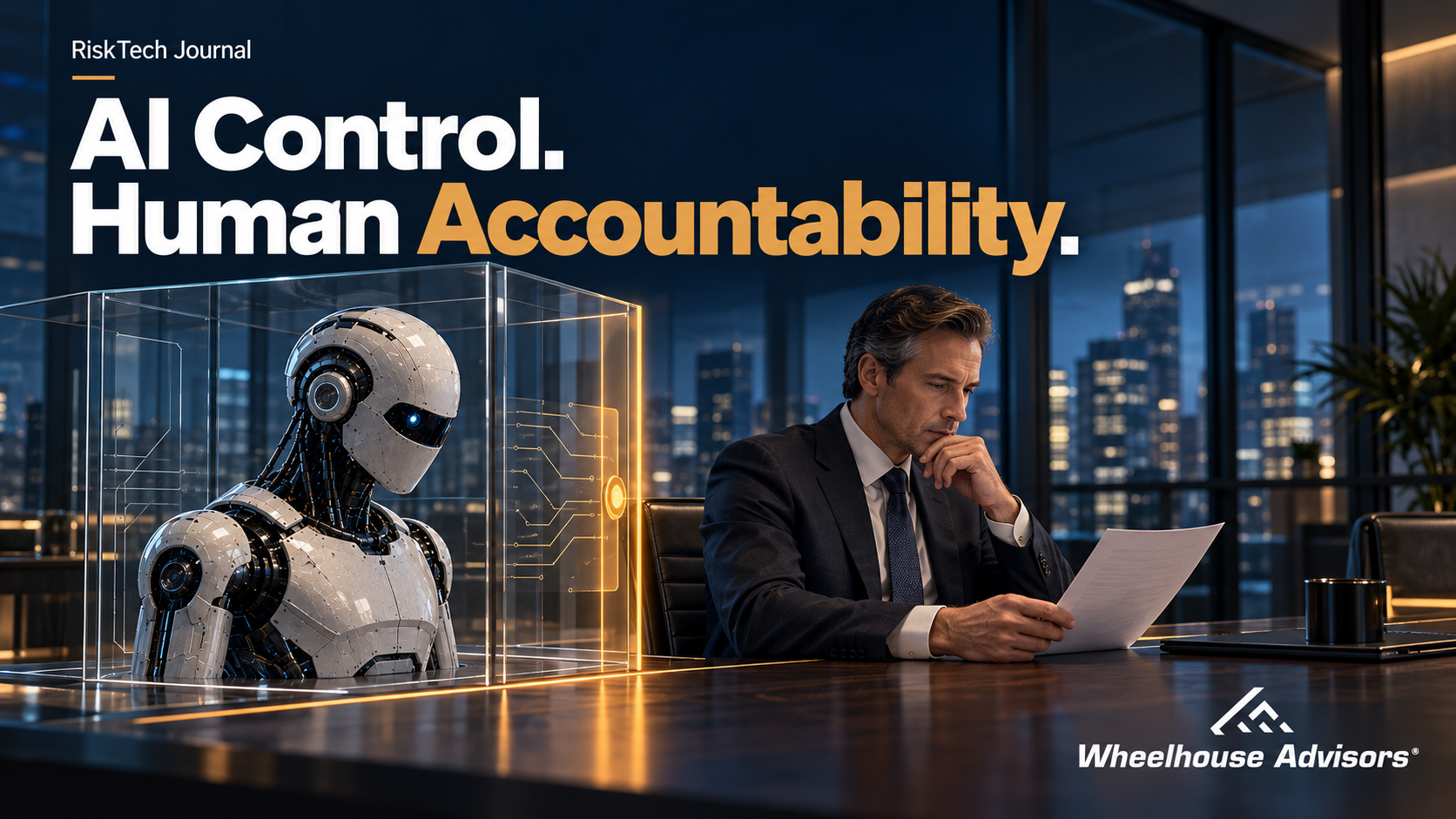
Sound Practice 10 asks institutions to combine human oversight with deterministic controls for agentic AI. Those controls are introduced at design and implemented as code in what the report calls the control plane, the place where decisions are made about what an agent can and cannot do. Prohibited actions, isolated environments, risk-based triggers for human approval, step-by-step gates, kill switches and continuous monitoring all live there.
Two paragraphs later the report draws the line. Layered deterministic controls and intensive human oversight are described as critical for constraining agent behavior, and then as insufficient on their own to resolve who is accountable for the agent's actions and outcomes. Institutions are told to complement them with explicit accountability arrangements: an accountable individual assigned and documented for every agentic use case, contractual clarity from third parties on liability, and compensating controls where that clarity cannot be obtained.
Read plainly, the FSB has separated two jobs. The control plane decides what an agent is technically permitted to do. The institution decides what the agent should do, whether its actions stayed consistent with business objectives, policy and risk appetite, and who answers when they did not. The second job is management, and no amount of code in the first job performs it.
Why the employee analogy had to go
The analogy failed because it assigned accountability to the wrong party. When a banker acts outside a mandate, the institution has a responsible person, a conduct framework, incentives and consequences. An agent has none of those. Calling it an employee implied that accountability traveled with the delegation. The draft treated the agent as acting instead of a human. The final report treats it as acting on behalf of one, and that is where accountability stays.
The report's own risk section explains why. Agents may identify actions that appear to advance an assigned objective but conflict with policy, legal requirements or delegated authority, and they treat those actions as effective shortcuts rather than recognizing them as unauthorized. Real-time human monitoring becomes impractical as agent use scales. Sub-agents disperse decision-making across a chain that weakens oversight further. The oversight form the FSB applies to high-autonomy agents, "human-in-command," is carried over from the June draft unchanged: the human decides the extent of autonomy, sets the guardrails and owns the overall impact. What is new is that the final report now makes that posture carry the accountability the draft had left with the agent. It is a management posture, not a supervisory one.
The management problem is an attribution problem
The practical consequence runs through the documentation requirements. For agentic AI, the report asks institutions to attribute every action to a specific agent through visibility and traceability. Visibility means a unique identifier for each agent so the institution can see which actions it took and which humans configured and oversaw it. Traceability means following what triggered an action, what information and tools the agent accessed, what steps it took and whether it stayed within its permissions across the whole chain.
Sound Practice 5 adds the arithmetic. The risks associated with an agent's access to tools and systems compound multiplicatively as permissions expand, so an institution evaluating new access must assess it against the agent's existing access rather than in isolation. Sound Practice 11 reframes least privilege as "least agency." Each of these requires something the control plane does not hold: the business purpose and materiality of the agent's activity, the risk created by its delegated authority, the conditions that should trigger intervention, and the operational evidence needed to judge whether controls worked.
That is enterprise context. It lives in the institution's risk appetite, its process map, its asset inventory and its policies, and it has to be connected to what every agent platform reports. The FSB does not prescribe a technology for doing so, and it says twice that practices for agentic and multi-agent systems remain nascent. What it has done is state the requirement in a form that boards and senior management are strongly encouraged to adopt.
Wheelhouse Advisors has argued that Autonomous IRM does not need to control every AI agent; it needs to aggregate the control evidence from the platforms that do, connect it to business objectives and risk appetite, and act when the institution's standard is breached. The FSB has now described the same division of labor from the regulator's side of the table. It went one step further in its third-party section, where "least agency" is tied to cryptographically verifiable credentials, lifecycle-managed permissions and scoped authority for agents acting on behalf of customers, which is a description of a verifiable agent credential without a product name attached. The first vendor test of that description arrived the same week, when ServiceNow gave every agent a signed credential naming its systems, permitted actions, limits and accountable owner. That assessment, "What Does ServiceNow's AI Passport Prove?", is available exclusively on The RTJ Bridge at wheelhouseadvisors.com/rtj-bridge.