Why Data Streaming Is the Hidden Backbone of Autonomous IRM
Data streaming has become a foundational capability for modern enterprises. As organizations move away from periodic reporting and manual control cycles, the emphasis has shifted to continuous sensing, real time telemetry, and rapid mitigation. These operational patterns depend on data in motion, not data at rest. Streaming architectures now sit at the center of this shift.
The acquisition of Confluent announced today by IBM reinforces this point. Confluent is the leading commercial platform built on Apache Kafka, one of the most widely adopted streaming technologies worldwide. The acquisition signals that streaming has moved from a niche data engineering function to a strategic capability that enables AI operations, continuous controls, and integrated risk programs. Enterprises are recognizing that autonomous risk management depends on steady, reliable streams of operational signals that can be sensed, analyzed, and acted upon in real time.
From Data at Rest to Data in Motion
Traditional risk reporting relies on batch processing. Data is collected, stored, and analyzed at fixed intervals. Although this approach supports governance level oversight, it offers little help when risks evolve faster than reporting cycles. Operational and technology environments now generate signals continuously. These signals come from cloud workloads, collaboration tools, identity platforms, network logs, operational systems, and customer interactions. Treating these events as a steady flow rather than a static dataset is the core idea behind data streaming.
Data streaming pipelines transport events as they happen. Producers generate the events, pipelines route them, processors analyze them, and consumers apply insights. This architecture supports immediate visibility into abnormal patterns and allows organizations to embed risk intelligence directly into business and technology workflows. For risk leaders, the value is clear. Streaming enables mitigation before incidents spread, rather than after the damage is complete.
The Strategic Link to Autonomous IRM
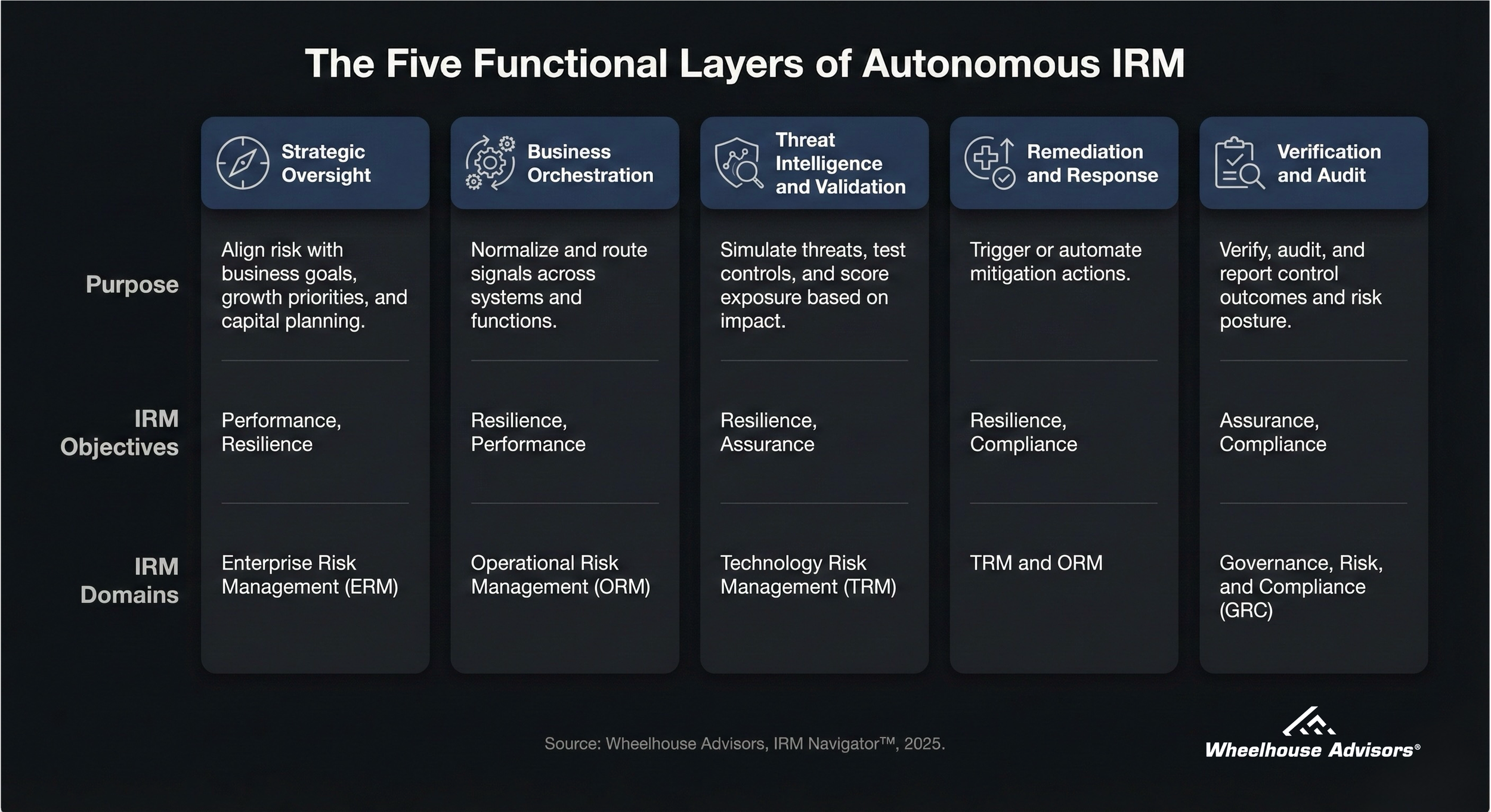
Autonomous IRM requires four conditions: continuous data collection, real time signal correlation, automated risk assessment, and rapid mitigation. These conditions align with the five functional layers of autonomous IRM that Wheelhouse Advisors has defined. Each layer depends on timely and reliable streams of data. Without streaming, AI agents cannot detect anomalies, automate evidence collection, validate controls, or recommend alerts.
Data streaming has become the real time substrate that allows autonomous IRM to function. It is the source of immediate telemetry that powers preventative actions and continuous monitoring. It bridges the gap between risk identification and risk management by shifting the enterprise from manual review cycles to living systems that sense and adapt on their own.
Why the IBM–Confluent Announcement Matters
The IBM–Confluent acquisition illustrates the increasing importance of streaming architectures to enterprise scale AI and risk programs. IBM already participates in the risk technology landscape through its OpenPages platform, which is included in the 2025 IRM50. The addition of Confluent significantly expands IBM’s strategic positioning by combining established GRC capabilities with real time data streaming infrastructure that supports AI enabled risk programs.
IBM is integrating data streaming into its broader AI and automation portfolio, a clear signal that streaming will anchor next generation business operations. For risk leaders, this reinforces that streaming platforms are no longer limited to engineering teams. They are now essential infrastructure for operational resilience, cyber detection, third party visibility, and performance monitoring.
This acquisition also reflects a broader pattern across the market. Technology providers are repositioning themselves around continuous intelligence. AI systems consume vast volumes of real time data, not monthly or quarterly batches. Control environments work best when signals are validated continuously. Supply chain and third party risks escalate quickly without timely visibility. By bringing Confluent’s platform under its portfolio, IBM is aligning with this strategic shift.
Implications for Risk Leaders
Data streaming changes the way organizations think about risk. It shortens the time between signal and action. It reduces the uncertainty that results from fragmented data stores and delayed reporting. It supports integrated workflows across enterprise risk, operational risk, technology risk, and compliance. Most importantly, data streaming provides the real time foundation that allows AI enabled risk agents to operate effectively.
Risk leaders should evaluate their streaming maturity and consider whether their organizations have the infrastructure needed to support autonomous IRM. This includes understanding event sources, defining routing paths, establishing governance over schemas, and integrating streaming pipelines with modern risk analytics. Organizations that invest early will position themselves to achieve faster insight, more reliable controls, and stronger resilience.
Conclusion
IBM’s acquisition of Confluent marks a significant moment in the evolution of enterprise data strategies. It affirms that data streaming is now a strategic asset that supports AI, automation, and continuous risk sensing across the enterprise. Combined with IBM’s position in the 2025 IRM50 through OpenPages, the move highlights the convergence of data engineering, AI infrastructure, and integrated risk capabilities. For risk leaders, the message is clear. Autonomous IRM cannot function without real time data. Streaming has become the hidden backbone that advances risk from a periodic reporting process to a continuous, integrated capability.
References
IBM, corporate news announcements, https://newsroom.ibm.com/2025-12-08-ibm-to-acquire-confluent-to-create-smart-data-platform-for-enterprise-generative-ai.
Confluent, product and platform documentation, https://www.confluent.io.
Apache Software Foundation, Apache Kafka documentation, https://kafka.apache.org.
Wheelhouse Advisors, IRM Navigator Research Series, https://www.wheelhouseadvisors.com/irm-navigator-research.