Not All SaaS Is Equal: IRM50 AI Disruption Risk Index
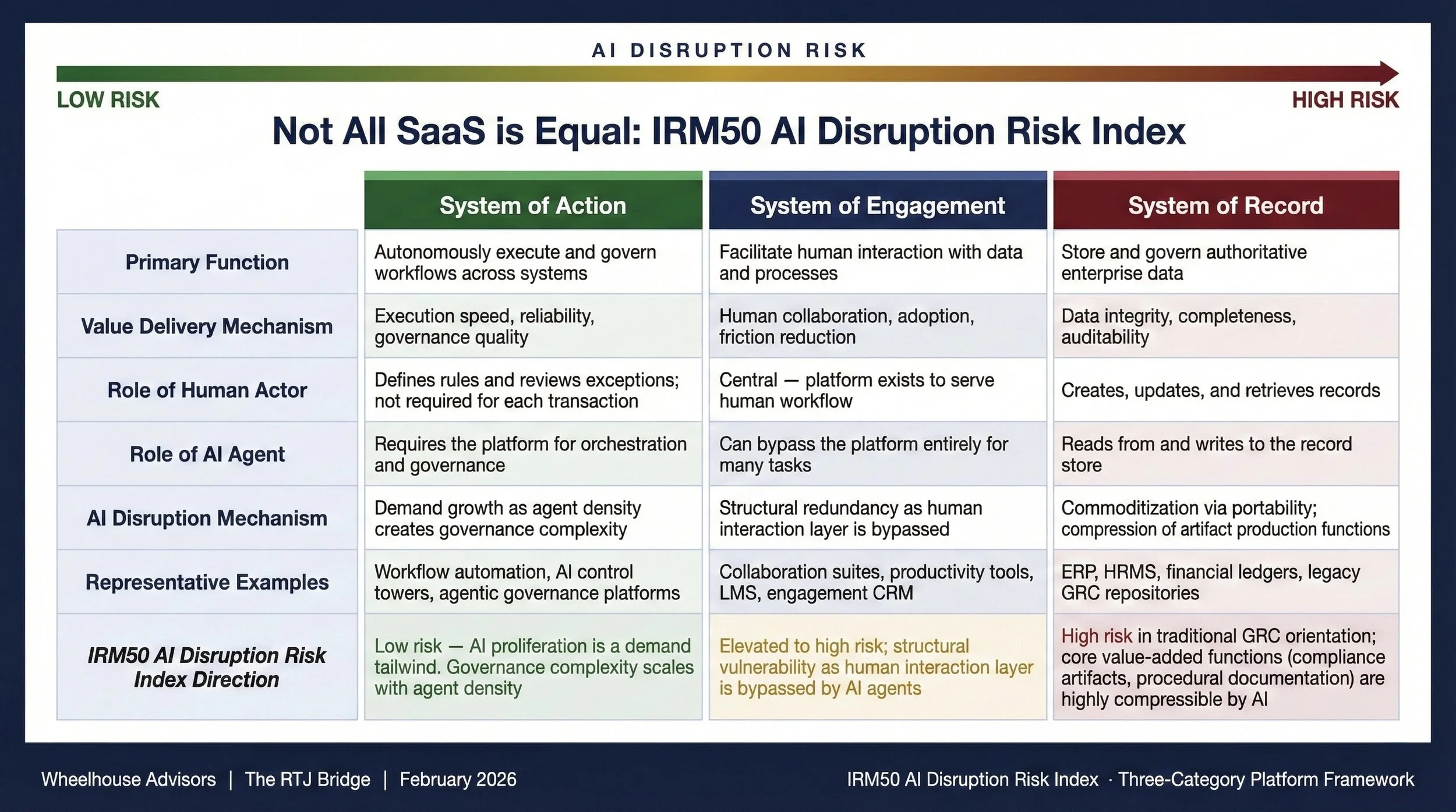
The prevailing market narrative applies a single disruption framework to all enterprise software platforms. That is the analytical error. AI disruption risk is not uniform across the enterprise software landscape. It varies fundamentally based on the architectural role a platform plays. The IRM50 AI Disruption Risk Index is built on this premise. This note makes the underlying framework explicit.
The enterprise software industry has operated for three decades with a two-category vocabulary: System of Record and System of Engagement. That taxonomy was adequate for a world where humans interacted with software to accomplish work. It is inadequate for a world where AI agents interact with software to accomplish work autonomously. The IRM50 AI Disruption Risk Index extends that taxonomy by introducing a third category, System of Action, which carries a structurally different and inverse disruption risk profile. Applying a single disruption narrative across all three categories produces the analytical errors currently driving equity market volatility in enterprise software.
© 2026 Wheelhouse Advisors
Key Findings
The traditional two-category framework (System of Record / System of Engagement) is insufficient for an agentic AI environment. A third category, System of Action, carries a structurally different and inverse disruption risk profile.
System of Action platforms face the lowest AI disruption risk. Agent proliferation increases demand for orchestration and governance infrastructure rather than displacing it.
System of Engagement platforms face elevated to high disruption risk. AI agents can bypass the human interaction layer entirely, rendering engagement interfaces structurally redundant.
System of Record platforms in traditional GRC orientation face high disruption risk. Compliance artifact production, procedural documentation, and audit facilitation are among the first functions AI automates.
Current enterprise software market volatility reflects a genuine repricing of AI disruption risk, but applies it with insufficient granularity. Applying a System of Engagement discount to a System of Action platform is the analytical error driving material mispricing.
Institutional capital is now developing its own AI disruption frameworks. PE firms are declining software deals and demanding valuation discounts. The IRM50 AI Disruption Risk Index provides the structured analytical lens the market is seeking.