

The RTJ Bridge - The Research Platform Created by the Publishers of The RiskTech Journal
The RTJ Bridge is an independent research platform delivering institutional-grade IRM market intelligence, vendor competitive assessments, and strategic risk technology analysis. Built by the analyst who created the Integrated Risk Management category at Gartner, The RTJ Bridge gives risk leaders, technology executives, and solution providers the same caliber of competitive intelligence that major analyst firms charge $25,000 to $50,000+ per year to access.
Subscribers to The RTJ Bridge receive full access to:
IRM50 OnWatch Vendor Assessments — Competitive analysis of leading IRM vendors as market events unfold, covering platform strategy shifts, M&A impact, earnings signals, and positioning changes.
Autonomous IRM and AI Governance Research — Original research on how agentic AI is reshaping risk management operating models, from production deployment patterns to the structural implications for vendor platforms and enterprise programs.
Analyst Firm and Market Critiques — Independent assessments of research from Gartner, Forrester, and other major analyst firms, viewed through the IRM Navigator Model to identify gaps, validate signals, and challenge conventional positioning.
Board Governance and Audit Committee Intelligence — Research on oversight effectiveness, emerging risk response gaps, audit committee workload challenges, and the disconnect between risk reporting and executive action.
M&A and Strategic Alliance Analysis — Same-week analysis of acquisitions, partnerships, and PE investment moves reshaping the IRM competitive landscape, with implications for buyers, vendors, and investors.
Regulatory, ESG, and Sustainability Risk — Research on how evolving regulatory frameworks (SEC cyber disclosure, EU CSRD/CSDDD, AI regulation) affect enterprise risk programs and technology requirements.
IRM Navigator™ Market Intelligence — Strategic previews and deep dives from the IRM Navigator Model, the only independent model built specifically to evaluate integrated risk management maturity and vendor alignment.
Cyber Risk, Insurance, and Third-Party Risk — Analysis of cyber risk quantification, insurance market dynamics, and the convergence of third-party risk management into enterprise IRM programs.
Subscribe to get access now
The RTJ Bridge is an independent IRM research platform published by Wheelhouse Advisors. Subscribers receive ongoing access to vendor competitive assessments, AI disruption analysis, M&A and partnership impact research, and IRM Navigator™ market intelligence. This is the only research platform built and led by the analyst who created the Integrated Risk Management category, a market now valued at over $61 billion and projected to reach $133 billion by 2031.

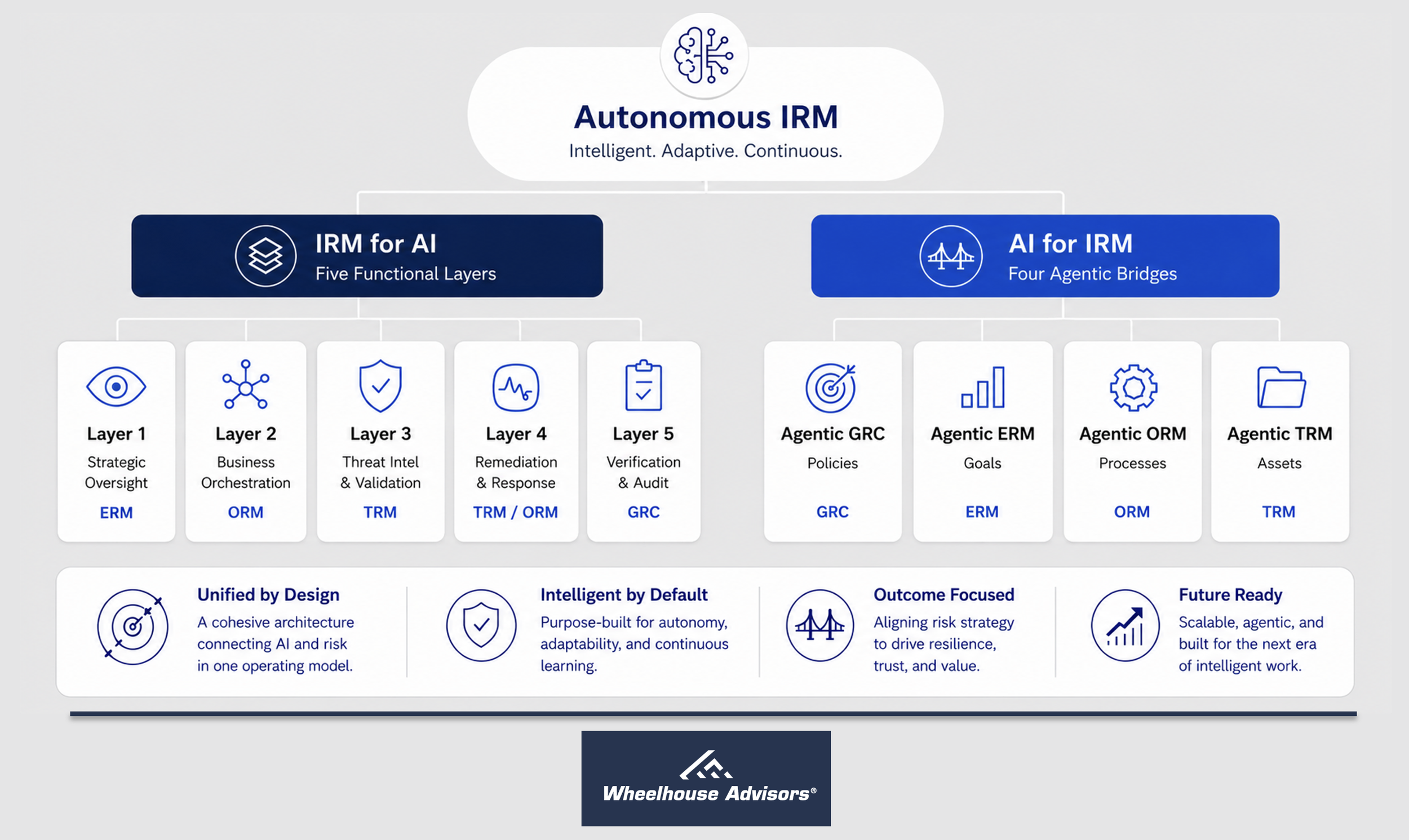
IRM50 OnWatch: The Week that Autonomous IRM Hit the Market
Three IRM50 vendors, IBM, Optro and ServiceNow, announced autonomous risk technology capability in the same news cycle, each using the word "autonomous" to describe architecturally distinct positions. Reading those positions against the IRM Navigator™ Model raises the questions the note addresses directly: What is the architectural difference between Autonomous IRM and Agentic GRC, and why does the distinction matter for buyers making platform decisions today? Where does each vendor's announced architecture sit against the five functional layers and four agentic domain bridges? And what does it mean for an organization's AI and risk governance posture when a vendor enters at the platform level versus the bridge level versus the IRM-for-AI half only?
The note also identifies two analytical patterns that will remain applicable as additional vendor announcements follow over the next eighteen to twenty-four months. The first is the evidence base of an acquisition at the time of close — what is in production at what scale, and whether the architectural claim the acquiring vendor is making matches that evidence. The second is vocabulary consistency: whether the language a vendor uses across its press release, analyst materials, and customer-facing content is the same, and what mismatches signal. The full note examines both patterns against the specific announcements from May 5 and May 6.
IRM50 OnWatch: OneTrust Deepens AI Governance as It Retreats Toward a Privacy Point Solution
OneTrust made two significant announcements in March 2026: a runtime AI guardrail enforcement launch at the Gartner Data and Analytics Summit and a formal brand refresh positioning the company as the operating model for governing data and AI at machine speed. Does embedding guardrails into AI infrastructure cross the threshold from compliance workflow automation to genuine Embedded-level IRM? Does Copilot Analytics represent a credible step toward Extended IRM, or is it a natural-language interface layered over a static reporting architecture? And does the AI-Ready Governance Platform cross-domain integration claim hold under the specific architectural test the IRM Navigator™ Model applies — or does it reposition existing compliance tooling under a broader name?
The Convercent divestiture sharpens every one of those questions. Ethics and compliance program management is a GRC solution area. What OneTrust exited was breadth within GRC itself, contracting toward a privacy and AI governance point solution at the same moment it is claiming a broader operating model identity. The IRM50 AI Disruption Risk Index identified the compliance system-of-record constraint as the structural boundary defining OneTrust's current tier placement. The full note examines whether the March 2026 announcements move that boundary — or whether the AI-Ready Governance brand is advancing a narrative that the architecture has not yet earned.
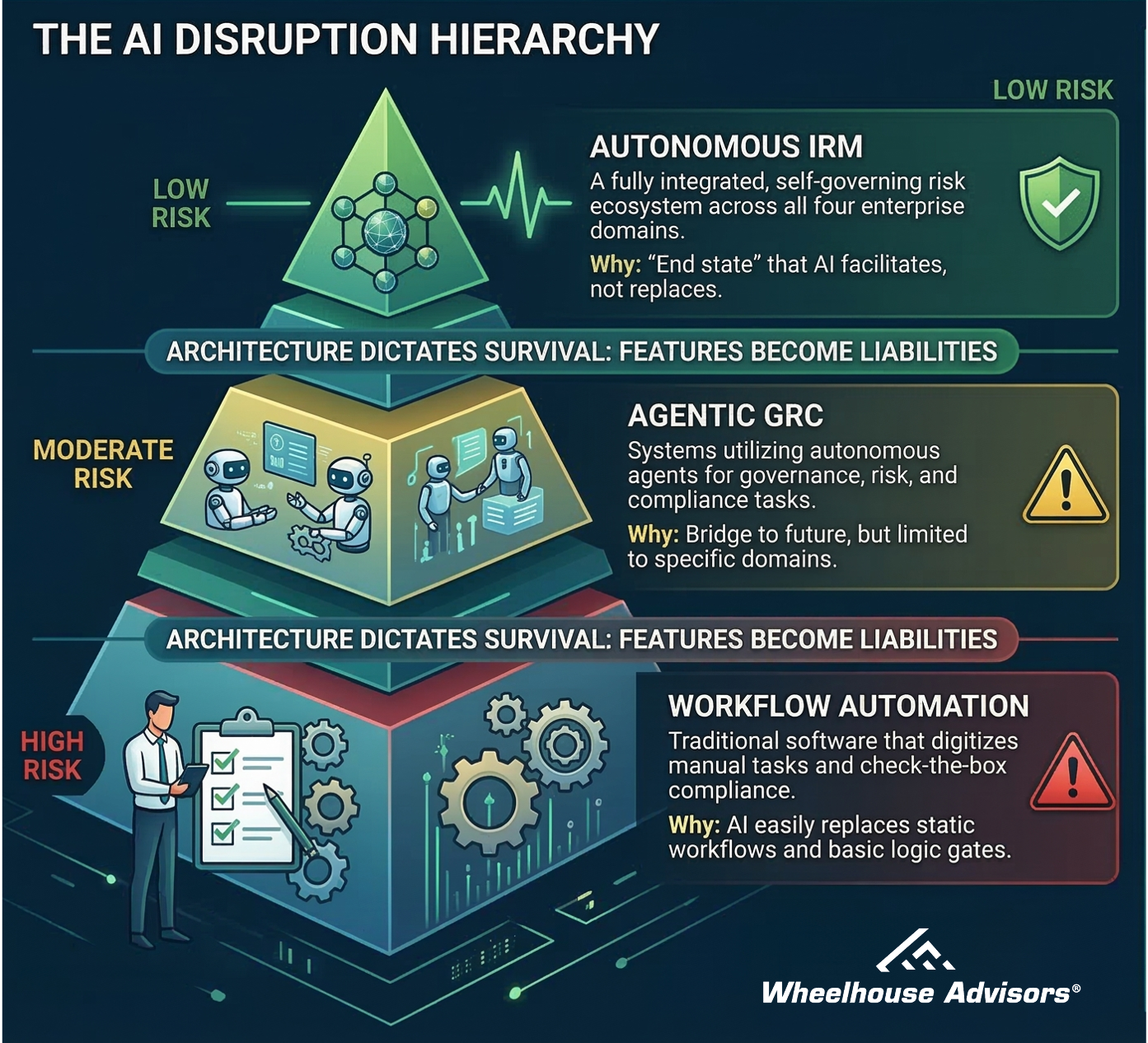
The Path to Autonomous IRM Becomes Clear
The AuditBoard-to-Optro rebrand is the highest-profile public signal yet that Agentic GRC is a defined architectural category. This research note uses that signal to examine where Agentic GRC sits in the progression from Workflow Automation to Autonomous IRM — and why the architecture a platform carries determines its AI disruption profile. Not all enterprise risk technology faces the same AI future. This note explains why.
IRM50 OnWatch: AuditBoard Becomes Optro – A Rebrand or a Real Pivot?
On March 9, 2026, AuditBoard announced it is rebranding as Optro, citing a $300M ARR milestone, the acquisition of AI governance platform FairNow, and a new identity as an agentic system of action for modern risk practitioners. This IRM50 OnWatch note applies the IRM Navigator™ Model to assess what the rebrand signals about Optro’s structural position in the IRM market, whether the capability architecture supports the narrative, and what the FairNow acquisition actually reveals about the platform’s AI roadmap. RTJ Bridge subscribers receive the full analysis, IRM50 tier status, ADRI score update, and What to Watch guidance for IRM leaders evaluating this announcement.
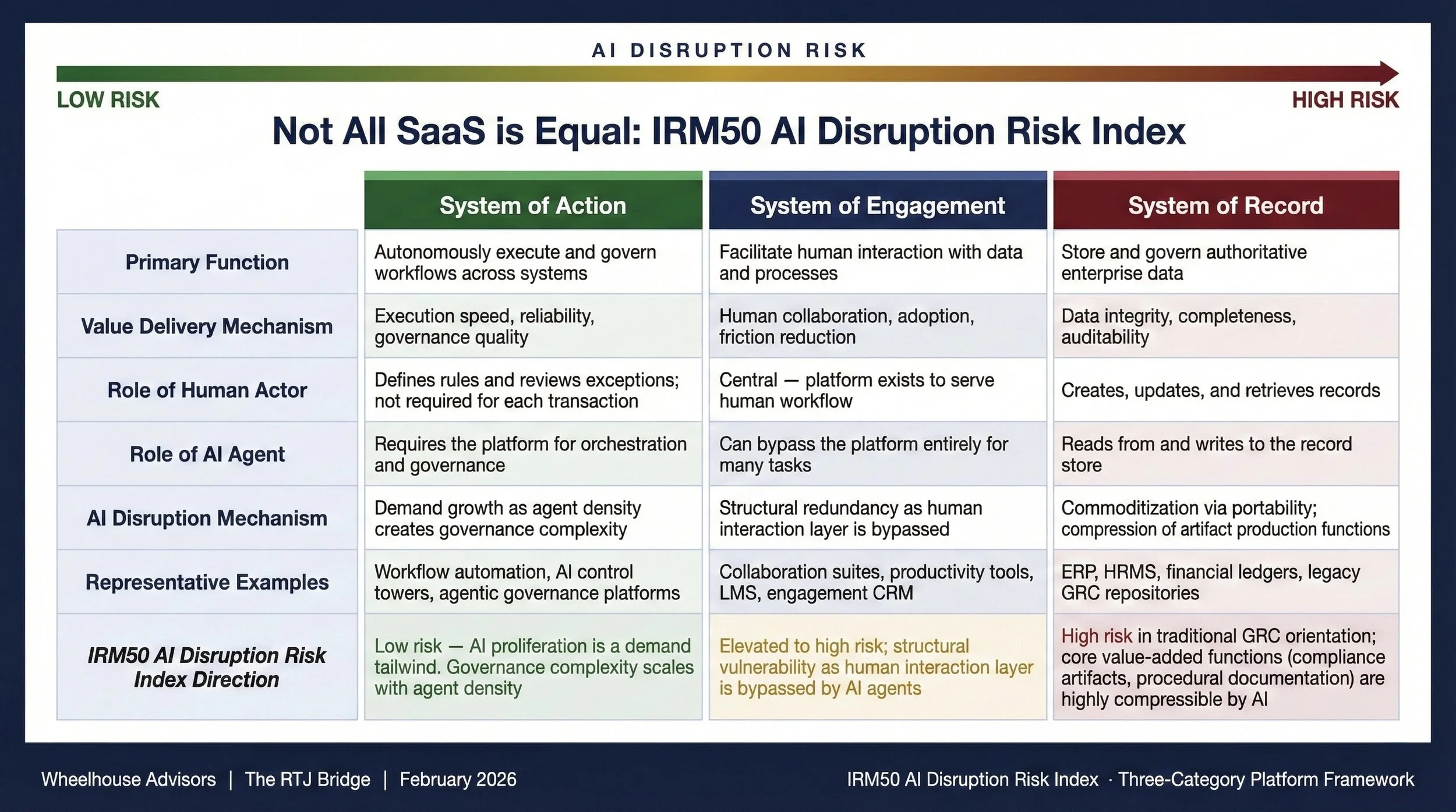
Not All SaaS Is Equal: IRM50 AI Disruption Risk Index
The enterprise software market is pricing AI disruption risk as if all SaaS platforms face the same structural threat. They do not. AI disruption risk varies fundamentally across platform categories based on architectural role, and the market's failure to distinguish between them is producing systematic mispricing. The IRM50 AI Disruption Risk Index introduces a three-category framework that makes those distinctions explicit, and the implications for capital allocation are significant.
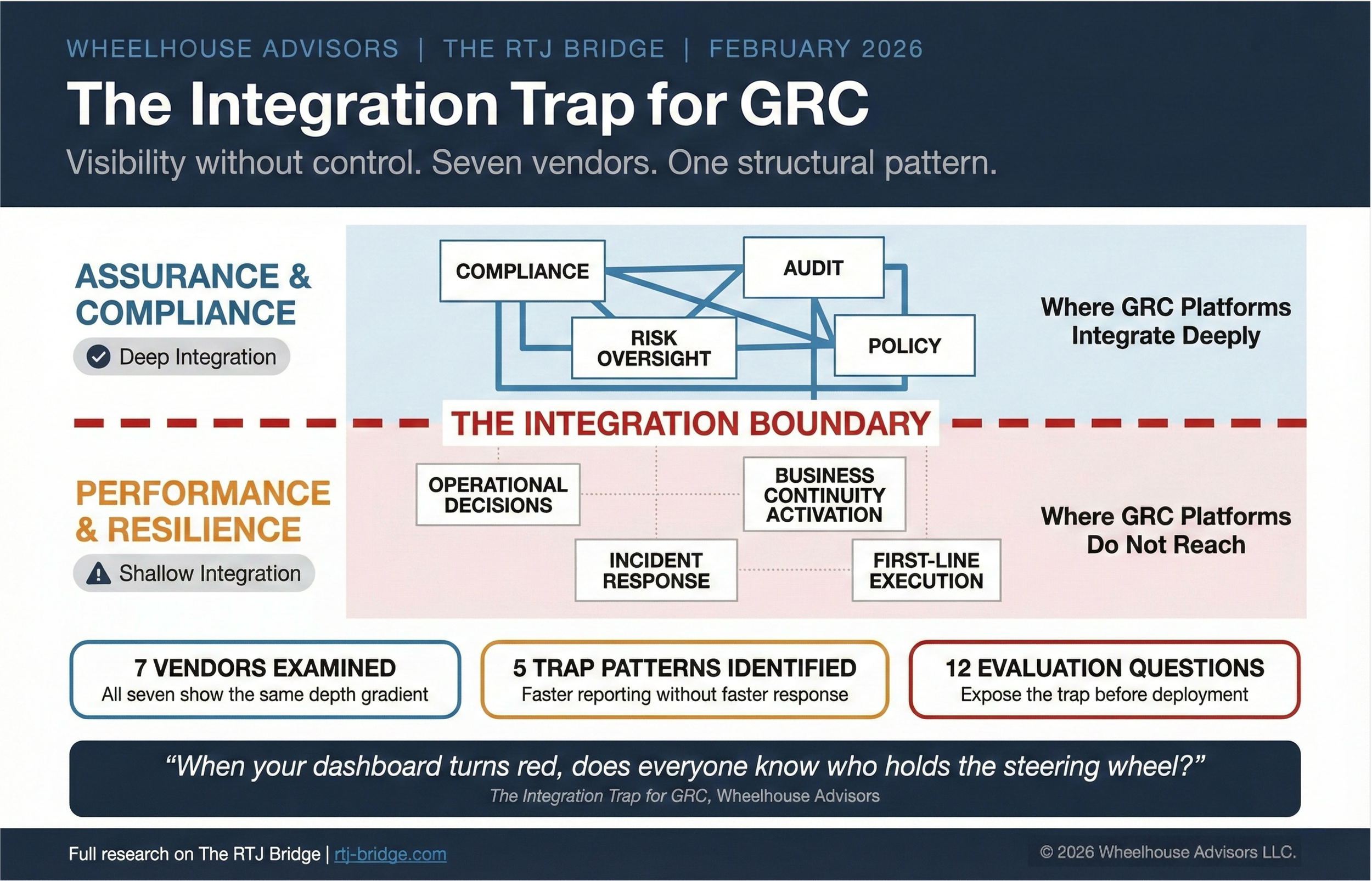
The Integration Trap for GRC: Why "Integrated GRC" Platforms Create Visibility Without Control
Every major GRC vendor claims integration as a core capability. The claims hold up. They also stop short. The gap between what these platforms integrate and what organizations actually need creates a structural vulnerability Wheelhouse Advisors calls The Integration Trap for GRC. Seven vendors examined. Five trap patterns identified. Twelve evaluation questions to expose integration gaps before deployment. Available now to RTJ Bridge subscribers.

Why ROI Calculators Miss the Mark on IRM
Integrated risk management (IRM) is routinely forced into an ROI framing that does not fit its economic reality. ROI implies attributable incremental cash flows. Integrated risk management more often delivers dividends, meaning distributed benefits that improve enterprise outcomes without consolidating into a single return stream. This matters because many ROI calculators in market are not integrated risk management native.
The ROI calculators are commonly legacy GRC instruments, siloed by compliance use case, optimized for cost-of-compliance narratives, and weak at quantifying cross-domain integration value, loss mitigation value, and AI trust constraints. Public positioning reinforces this bias through language that centers measurement around the GRC program rather than enterprise-wide outcomes. AI amplifies the gap. As AI moves from feature to operating model, the trust dividend becomes a gating factor for scale. Standards and regulatory regimes increasingly emphasize trustworthiness, transparency, accountability, and information obligations.
IRM50 OnWatch - Wolters Kluwer Acquires StandardFusion and Signals Audit Plus GRC Convergence Trend
Wolters Kluwer Corporate Performance & ESG (CP and ESG) signed and completed the acquisition of StandardFusion on January 9, 2026 for approximately €32 million in cash. StandardFusion is a Vancouver-based provider of cloud GRC software, and Wolters Kluwer states it will be integrated into TeamMate to create a more unified audit plus GRC offering.
IRM50 OnWatch - Diligent Acquires 3rdRisk, Signaling a Faster IRM Convergence of GRC and AI-Native Third-Party Risk
On January 14, 2026, Diligent announced its acquisition of 3rdRisk, a Netherlands-based, AI-native third-party risk management (TPRM) platform. Diligent positioned the deal as an expansion of its Diligent One Platform toward “AI-native third-party risk management at scale,” emphasizing automated vendor profiling, assessment workflows, and AI-driven document analysis to compress audit readiness timelines.
This transaction is not simply module expansion. It is a strategic signal that TPRM has moved from being a compliance-adjacent workflow into a board-visible risk domain that must operate continuously, particularly as regulatory expectations for supply chain and digital dependency oversight intensify.
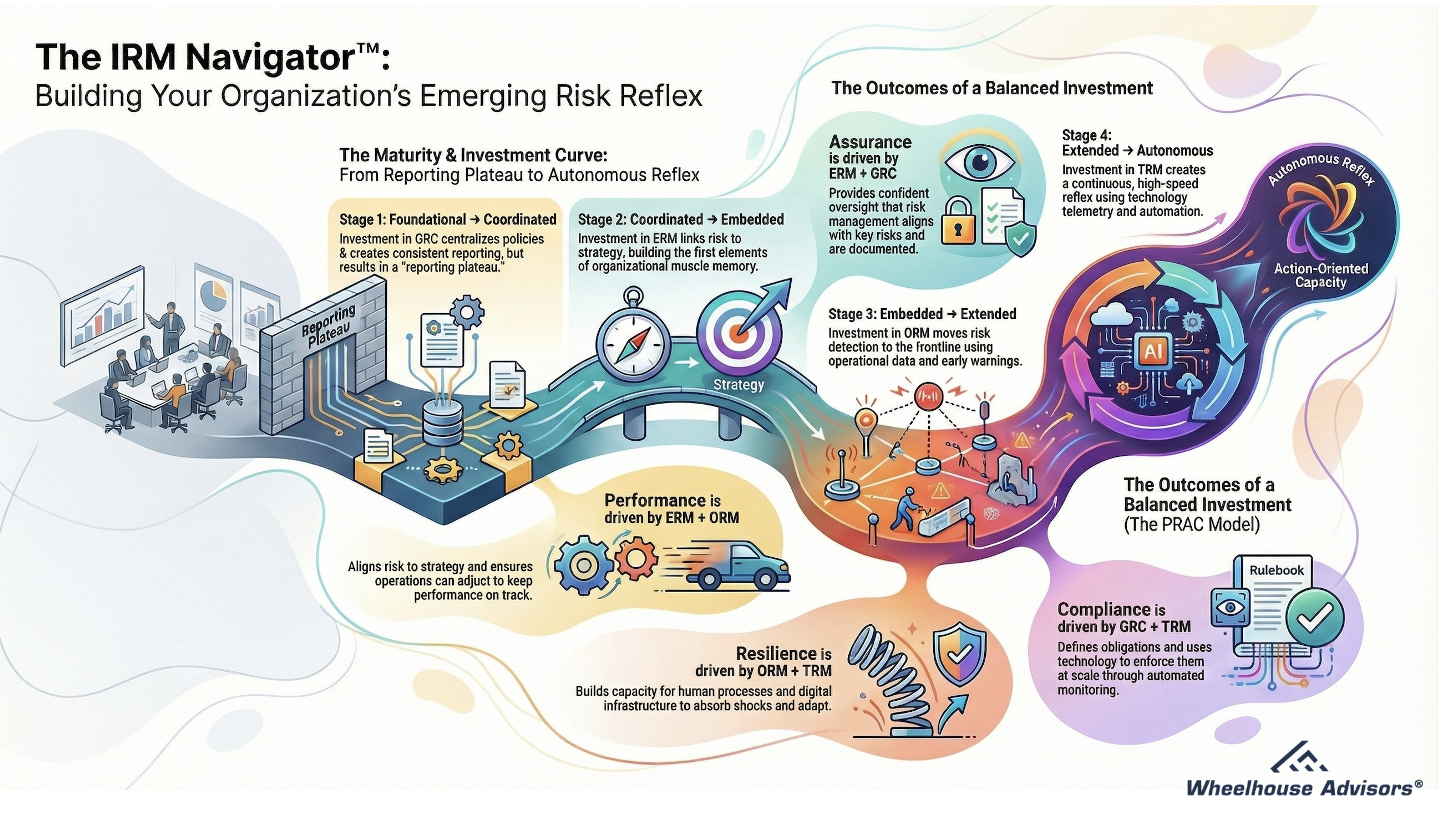
Does GRC Need Finishing School? The IRM Navigator™ View on Forrester’s GRC ‘Grad School’ Story
Forrester's recent blog “GRC Platforms Enter Their Grad School Era” contains a notable admission. The analysts describe GRC as "old enough to be in grad school," yet still struggling to prove it can act as the workhorse technology for modern risk professionals. After roughly 20 years of formal coverage, the firm suggests that GRC is not yet fully ready for the “real world” of risk and now needs a kind of graduate-level evolution, built on continuous controls monitoring, quantification, and AI. This observation raises an obvious question. Does GRC really need finishing school after decades of market evolution, or have we been asking the category to do the wrong job?
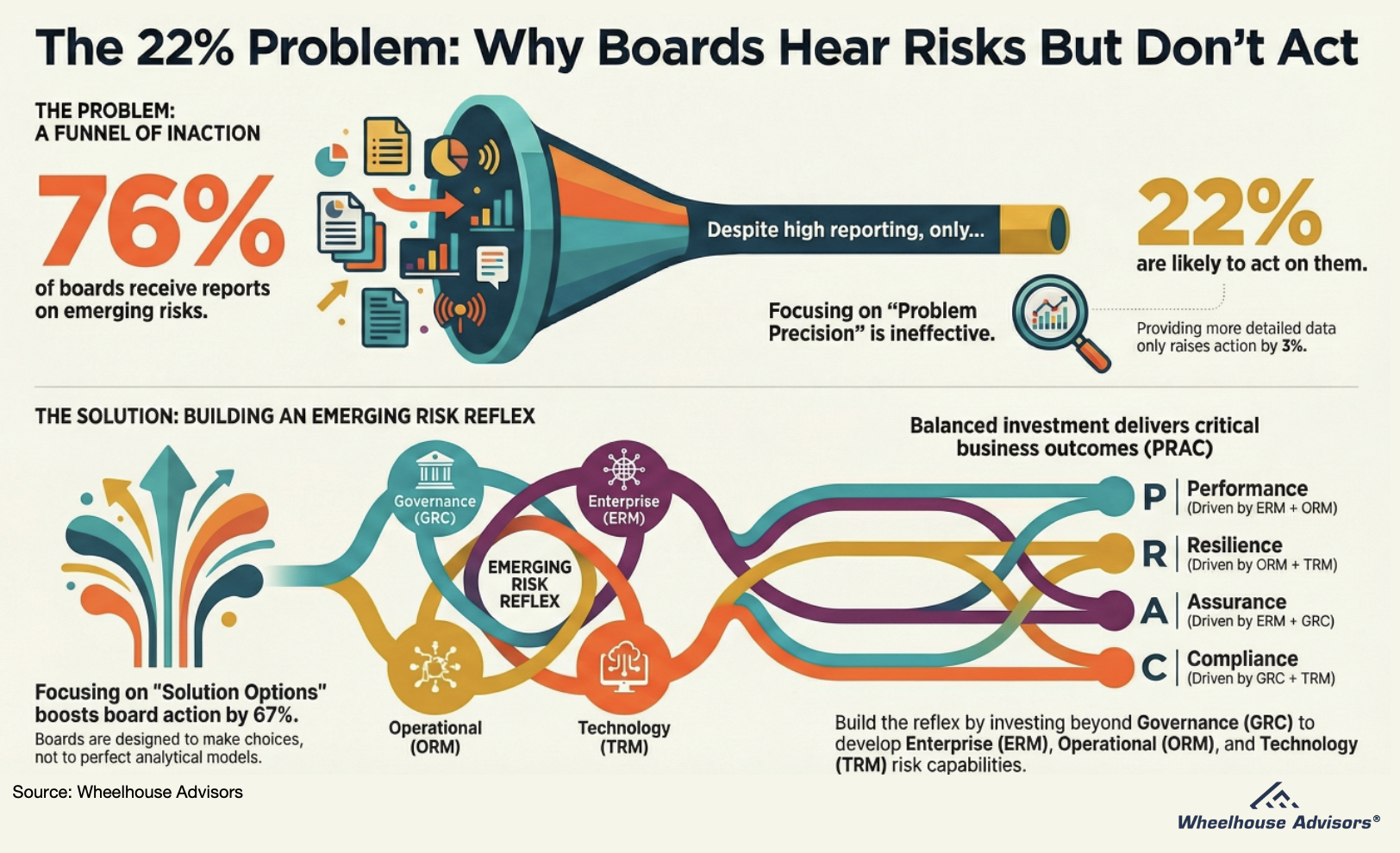
The 22 Percent Problem: Why Boards Hear the Risks but Still Do Nothing
If your board is hearing more emerging risks than ever and still doing almost nothing, you are not alone. Gartner data shows seventy-six percent of boards receive emerging risk reports, but only twenty-two percent are likely to act on what they hear. This IRM Navigator™ research note explains why that gap exists and how GRC-centric investment quietly builds oversight while starving your organization of reflex. If you are tired of “noted” being the only outcome, this is the playbook for turning emerging risk insight into action.

The Static Quadrant: Why GRC Stopped Moving
The “2025 Gartner® Magic Quadrant™ for Governance, Risk and Compliance (GRC) Tools, Assurance Leaders” offers more than an update on vendor positioning. It captures a defining moment in the evolution of enterprise risk management technology. For the first time since Gartner began coverage of this market in 2008, the Visionaries quadrant is completely empty.
This absence is not an error or a symptom of decline. It is a reflection of structural maturity and the point at which a technology category stops expanding outward and begins to integrate inward. The GRC segment has stabilized around its purpose: to deliver reliable assurance, compliance automation, and control verification at scale.
This research note is a follow-up to the recent RiskTech Journal article, GRC Without Visionaries: What the 2025 Gartner® Magic Quadrant™ Reveals About the Future of Risk. It further examines why the quadrant has gone static, why that matters, and how the integration of GRC within the broader Integrated Risk Management (IRM) model marks a necessary and healthy progression. It concludes that the current stillness in GRC represents not the end of innovation, but the beginning of Assurance Intelligence. It is the fusion of compliance evidence, operational data, and AI-enabled assurance that will define risk management by 2032.
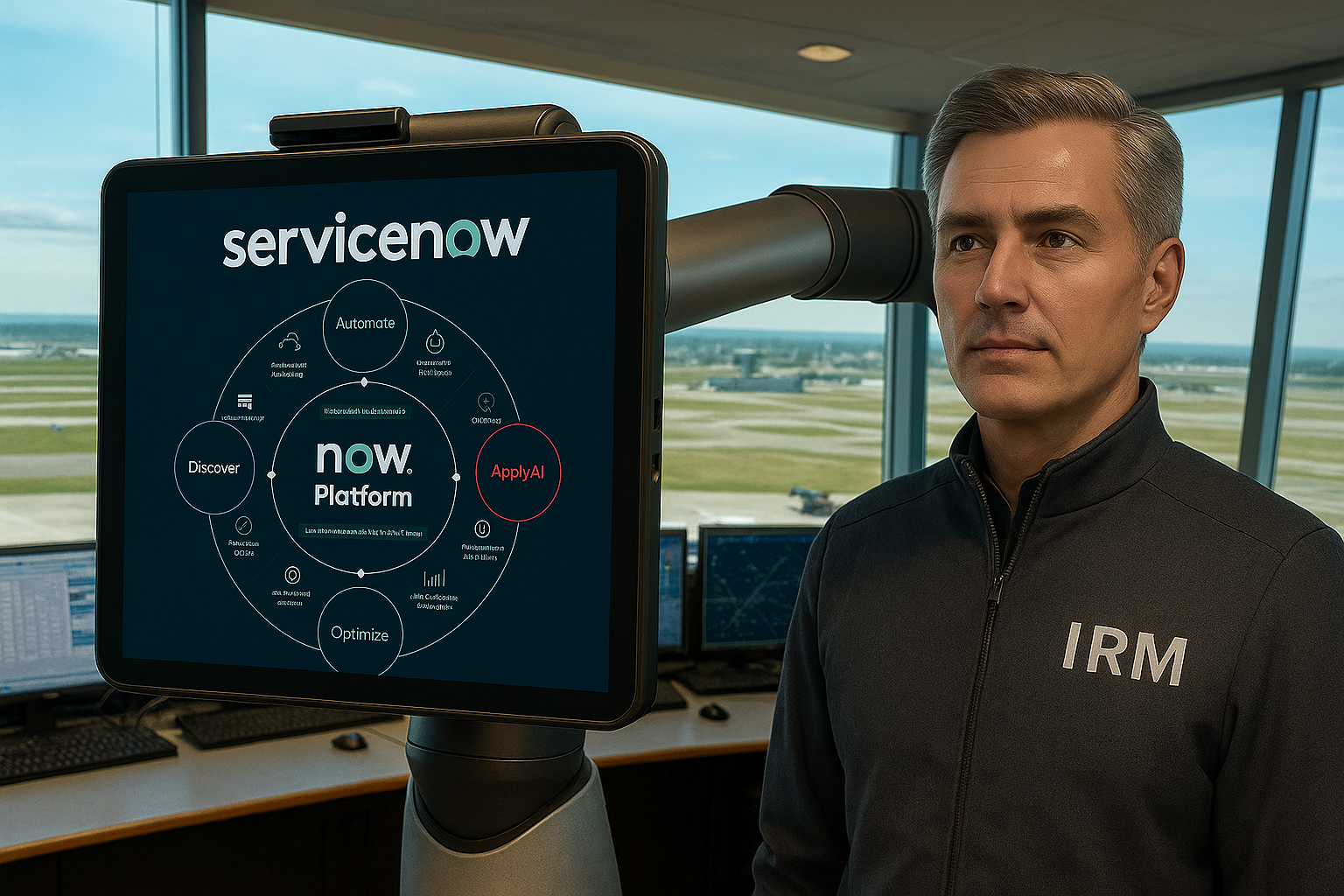
ServiceNow and the Autonomous IRM Era: IRM50 Market Leader Signals a Legacy GRC Extinction
ServiceNow is emerging as a flagship IRM50 Market Leader in the 2025 Integrated Risk Management (IRM) landscape, exemplifying the cross-domain orchestration and AI-native capabilities that define the shift toward Autonomous IRM. This research note draws on the 2025 IRM Navigator™ Viewpoint Report to profile how ServiceNow’s approach – integrating risks across enterprise silos with intelligent automation – is setting the pace in an industry undergoing transformative change . Recent statements by ServiceNow CEO Bill McDermott underscore this seismic shift: he warns that advanced AI platforms will spur an “extinction-level event” for legacy software vendors stuck in siloed, compliance-centric models. This analysis connects those remarks to broader industry signals, arguing that traditional Governance, Risk, and Compliance (GRC) providers face accelerated obsolescence absent urgent innovation.

When Everyone’s a Leader, No One Is: Why IDC’s Latest GRC Report Misses the Mark
Analyst reports, such as IDC’s MarketScape, have long promised clarity in crowded software markets. But clarity requires more than graphics. It requires relevance. It requires structure. And most importantly, it requires alignment with how risk is managed in today’s enterprise. The newly released IDC MarketScape: Worldwide Governance, Risk, and Compliance Software Vendor Assessment 2025 falls short on all three fronts. It presents a visually familiar layout, but surrounds it with inconsistent definitions, outdated assumptions, and scoring criteria that obscure more than they illuminate.

From Scripting to Studio: Diligent’s ACL AI Bet
Diligent’s launch of ACL AI Studio—an AI-powered extension to its long-standing audit analytics suite—comes at a time of increasing scrutiny over the practical value of artificial intelligence in risk and compliance software. Unveiled during this week’s IIA International Conference, the product promises to empower audit, compliance, and risk professionals to run advanced analytics through natural language rather than traditional scripting. But beneath the surface-level innovation lies a more complex story about legacy adaptation, GRC market pressures, and the widening gap between analytics potential and real-world IRM needs.

Ideagen Acquires ConvergePoint, Advancing Policy-Centric Compliance Within Microsoft 365 Ecosystems
Ideagen’s latest acquisition of ConvergePoint reflects more than just another M&A milestone—it underscores a deeper shift in how organizations are operationalizing risk and compliance. Based in Texas, ConvergePoint delivers policy, contract, and incident management capabilities natively within Microsoft 365 and SharePoint Online. This acquisition not only expands Ideagen’s North American presence but also strengthens its ability to meet growing demand for embedded, user-centric compliance solutions.

The Risk Ignored – Part I, Chapter 4. The Irony of Risk Intelligence: When GRC’s Founders Became IRM’s Followers
When Risk Culture Meets Rocket Fuel
In early 2007, SunTrust’s board appointed a new CEO. The new CEO had been waiting in the wings since SunTrust acquired his bank that was heavily weighted toward mortgage banking. Unlike his predecessor, he saw risk not as a discipline but as a throttle—something to push forward, not manage. His first strategic move was aggressive: set a Big Hairy Audacious Goal (BHAG) – a term ironically made famous by Jim Collins’ book “Built to Last”. The SunTrust BHAG, as defined by the new CEO, was to more than double the mortgage portfolio within twelve months to compete head-on with Wall Street’s securitization giants.
To hit that target, underwriting controls were systematically dismantled. Incentives for mortgage originators surged dramatically, creating an environment ripe for aggressive lending and shortcuts. When I saw these changes, I foresaw the inevitable crash. As the senior executive overseeing Internal Audit, Compliance, and Risk Management, I confronted both the CEO and his protégé—the head of mortgage banking—in a tense meeting. The mortgage head literally writhed in his seat with anger; I had never seen anything like it.

The Risk Ignored – Part I, Chapter 3. The Acronym That Built a Market and the One That Rescued It
As many industry shifts do, it began in a quiet room with a big idea. One conversation was with a Big Four consulting firm eager to formalize its newest offering. Another was with a risk software vendor in search of identity and traction. Sitting across the table from both in 2002 was Michael Rasmussen, then an analyst at Giga Information Group.
What he encountered in those two briefings wasn't just a common theme but a shared phrase. The software vendor and PwC had already begun using "Governance, Risk, and Compliance" to describe their offerings. Rasmussen helped bring it to life—not as a framework, not as an architecture, but as a market category. And almost overnight, that name became an industry.

Why Q1 2025 Was a Wake Up Call for Compliance-Centric IRM Vendors
Despite beating earnings estimates, a surprise sell-off in Workiva stock on May 2 sent a jolt through the Integrated Risk Management (IRM) technology market. The trigger wasn't financial underperformance but political indecision: Germany and France signaled their intent to water down or delay the European Union's Corporate Sustainability Reporting Directive (CSRD) application. In addition, the European Parliament formally agreed to postpone the enforcement of new sustainability and due diligence rules.
The reaction was swift and severe for Workiva, a leading compliance-first vendor built around ESG reporting and assurance workflows. However, this moment revealed a more systemic truth for the broader IRM market: IRM's trajectory is now shaped as much by the pace of regulatory implementation as by the innovation of its technology platforms.
The market's reaction reflects a correction in growth expectations for compliance-oriented vendors and an inflection point in how investors, boards, and buyers view risk management software. As regulation stalls, the IRM market is fragmenting into more clearly defined value segments—each responding differently to volatility. These are the market realities shaping Q1 2025.

The Risk Ignored – Part I, Chapter 2. The Risk That Created the Category
It didn't take long. The software market found its opportunity once the Sarbanes-Oxley Act was signed into law. Vendors who had once built their businesses on knowledge management—rooted in workflow automation, document control, and internal collaboration—suddenly had something they'd never had before: urgency.
SOX 404 didn't just create a mandate. It created a narrative.
By late 2003, PwC—a global audit and consulting firm—had appointed a Governance, Risk & Compliance (GRC) Practice Leader, becoming the first major firm to formalize GRC as a branded consulting offering. OpenPages, an enterprise software vendor specializing in compliance and risk management, issued a press release marketing its platform as a "GRC solution." Analysts took the bait. And seemingly overnight, what had been a faltering product category now had a fresh label, a growing audience, and a new group of buyers scrambling to meet audit requirements.
The acronym spread faster than the architecture.
And the risk, ironically, wasn't what these platforms were solving—it was what they were failing to acknowledge.