

The RiskTech Journal
The RiskTech Journal is your premier source for insights on cutting-edge risk management technologies. We deliver expert analysis, industry trends, and practical solutions to help professionals stay ahead in an ever-changing risk landscape. Join us to explore the innovations shaping the future of risk management.

IRM Market Brief: Grant Thornton Survey Points to Rising IRM Demand
Two thirds of business leaders say integrated risk management is a top priority. Fewer than half have built it. That is the headline of Grant Thornton's 2026 Cyber & Risk Survey of 1,100 senior leaders, published October 13. The first number is the demand, stated by buyers in their own words. The second is how much of it has been met.
The survey landed six days after Wheelhouse Advisors published the 2026-2027 IRM Navigator Vendor Compass for GRC, the first of four reports covering the segments on the IRM Navigator Curve's investment path: GRC, ERM, ORM, and TRM. The Vendor Compass asks the same question from the supply side: how far does the evidence a GRC provider produces travel into enterprise, operational, and technology risk decisions? This edition reads the two documents as a pair. The answer comes first; the evidence follows.
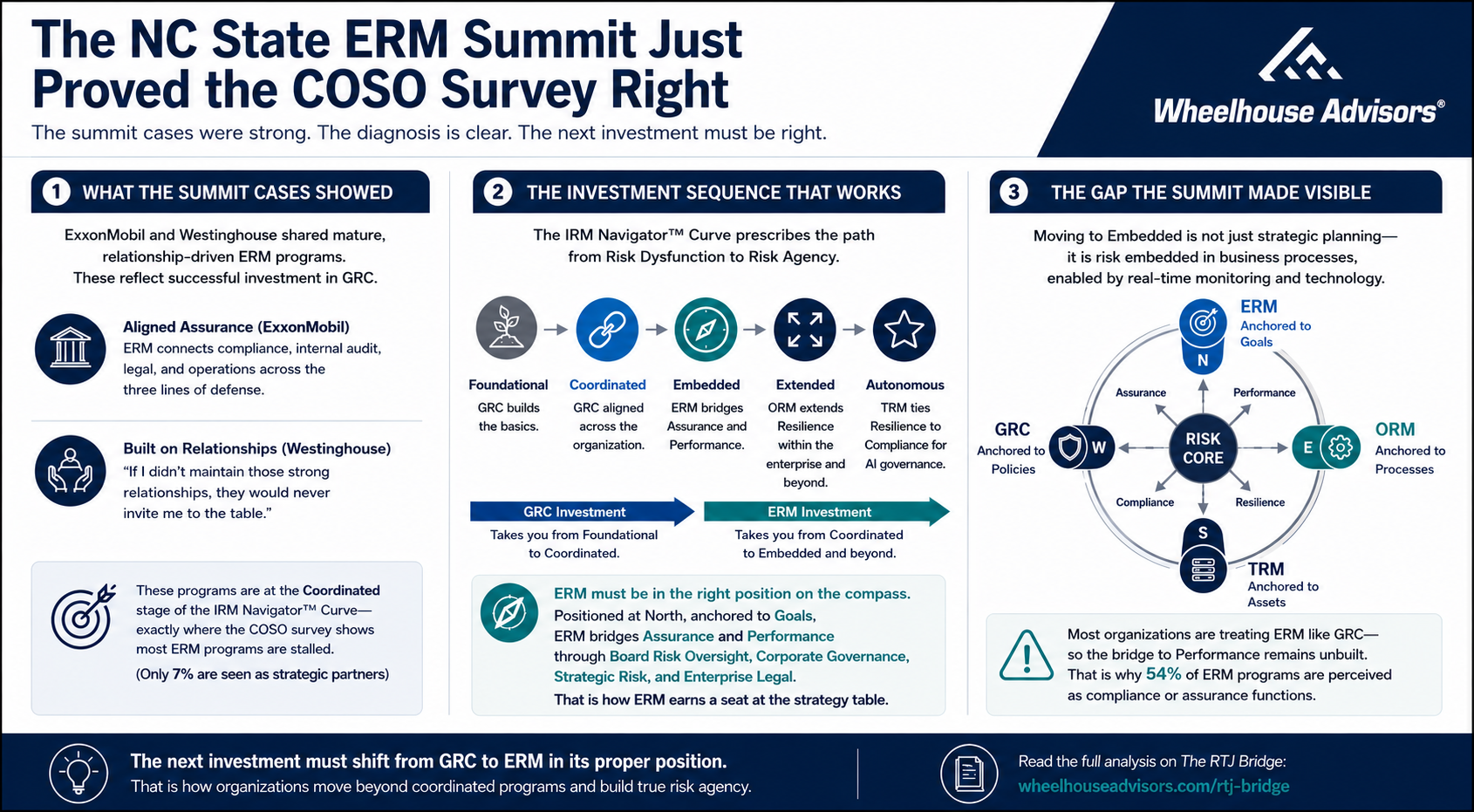
The NC State ERM Summit Just Proved the COSO Survey Right
Last week, more than 110 enterprise risk management practitioners gathered at NC State's Poole College for the 2026 ERM Roundtable Summit. The case studies they shared were compelling. The programs they described were mature, relationship-driven, and genuinely effective at connecting risk functions across large, complex organizations. They also illustrated, with striking precision, exactly why the COSO/Crowe survey published earlier this year found that only 7 percent of ERM programs are seen as strategic partners by the business.
That is not a criticism of the practitioners. It is a diagnosis of where most ERM programs sit on the maturity curve, and what the next investment must accomplish to move beyond it.
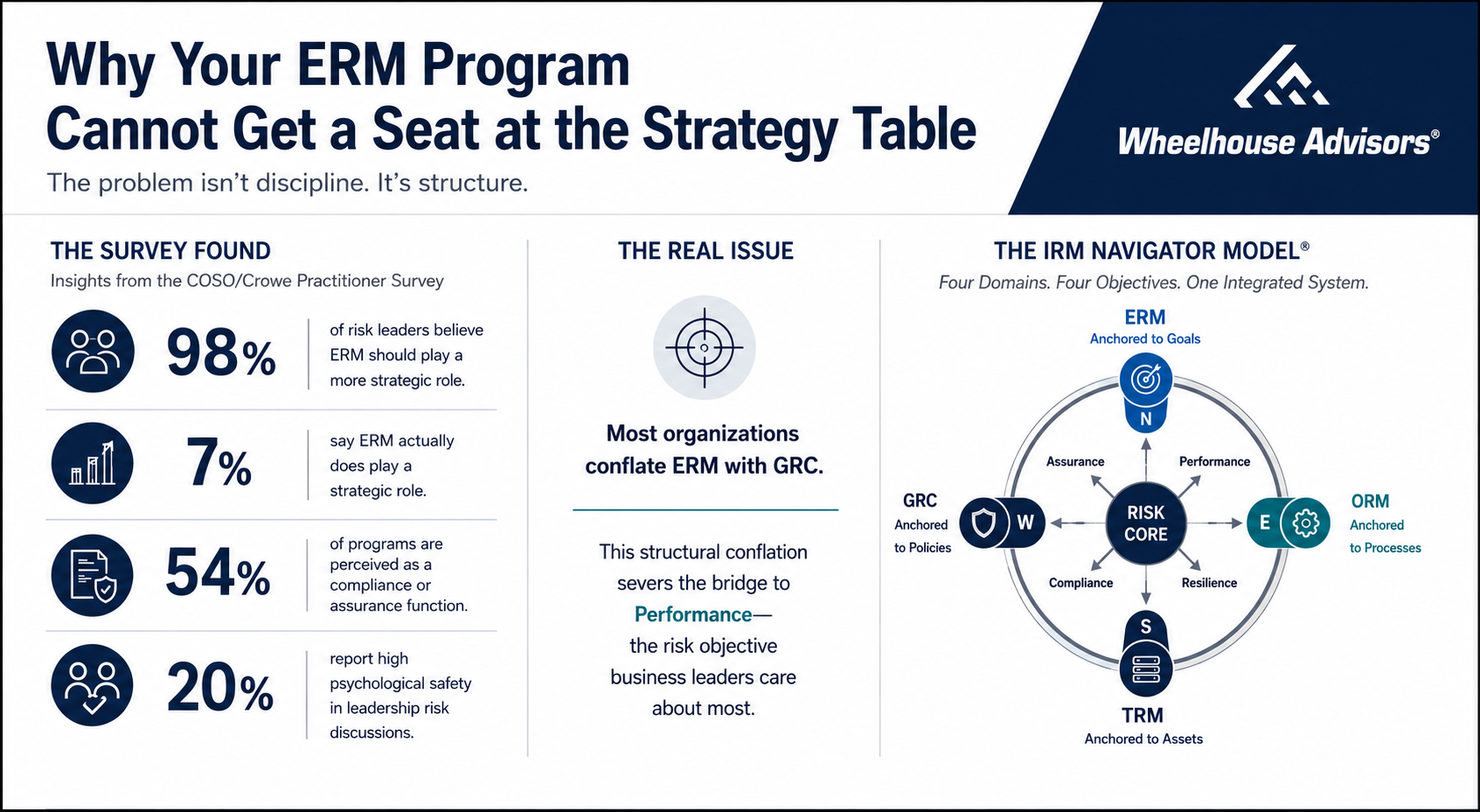
Why Your ERM Program Cannot Get a Seat at the Strategy Table
Every chief risk officer reading this knows the conversation. The CEO asks what the top three strategic risks are this quarter. The answer comes from a quarterly risk register refresh and a heat map. The CEO nods, thanks the CRO, and moves on. Nothing changes.
The new COSO/Crowe practitioner guide, From Guidance to Action: Exploring Practical Enterprise Risk Management, just put a number on how widespread this pattern is. Ninety-three percent of enterprise risk management programs are stuck on the wrong side of the strategy conversation, and the reason is not what most risk leaders have been told.
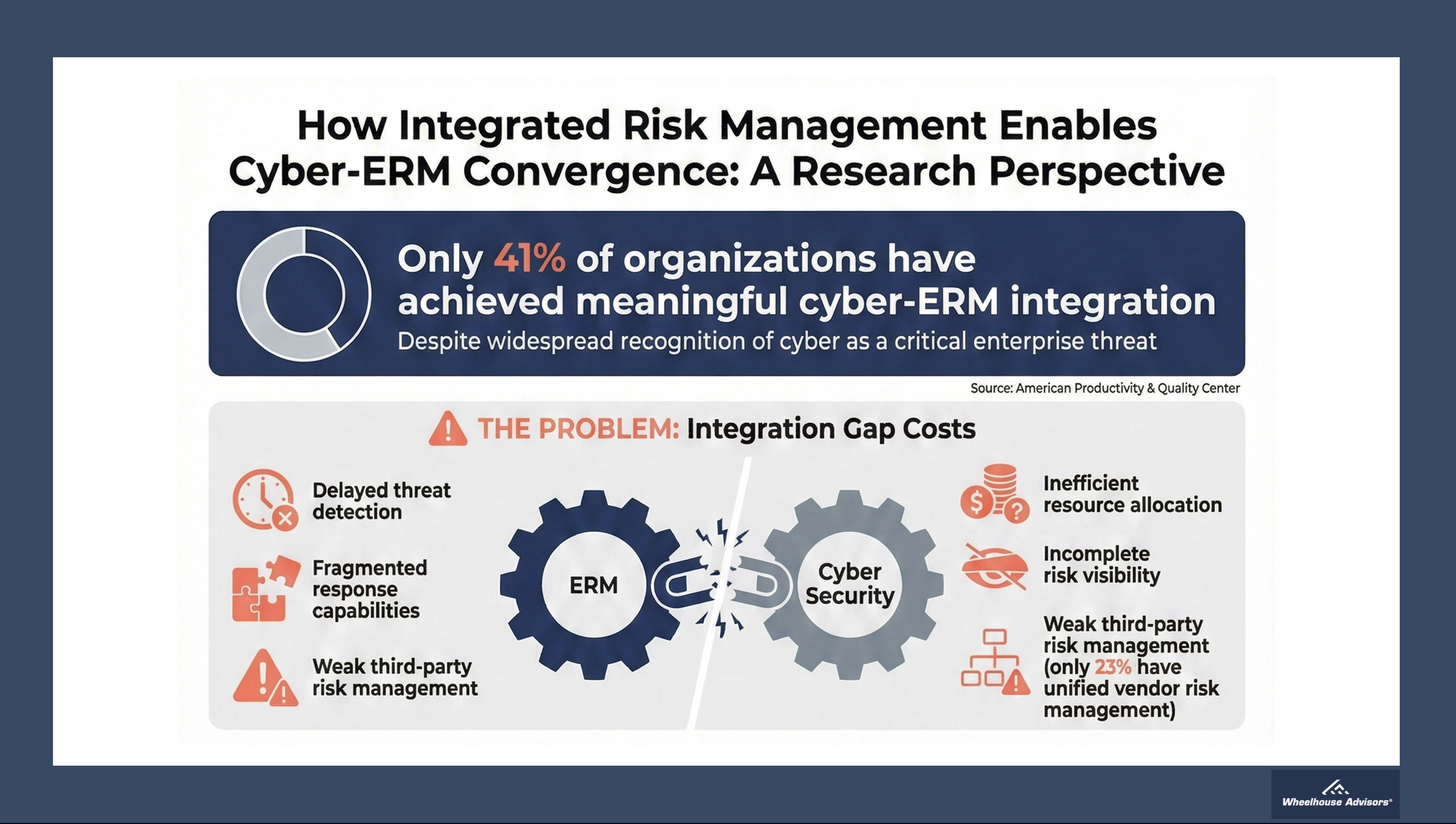
How Integrated Risk Management Enables Cyber-ERM Convergence
Recent research from the American Productivity & Quality Center reveals a sobering reality: only 41% of organizations have achieved meaningful integration between cybersecurity and enterprise risk management, and just 23% have unified third-party risk management. This gap persists despite widespread GRC platform adoption, revealing that compliance-first architectures cannot deliver the risk-first integration that cyber-ERM convergence requires. Integrated Risk Management provides the essential infrastructure to bridge this divide through its four-pillar framework: Performance, Resilience, Assurance, and Compliance.

No Manager, No Strategy—Why GRC Alone Can’t Win the Risk Game
If Governance, Risk, and Compliance (GRC) is like a team without a manager, IRM is the system that brings structure, alignment, and leadership to the field. Without a manager, even talented players operate in silos—doing what they think is best individually but without strategic coordination or shared purpose. That’s the reality in many organizations today: siloed compliance, governance, and risk functions acting without integration.
IRM provides the playbook and the leadership. It integrates GRC with Enterprise Risk Management (ERM), Operational Risk Management (ORM), and Technology Risk Management (TRM) to form a unified team—managed strategically, guided by data, and aligned around shared enterprise objectives.

Security Complexity Is Strangling Your Bottom Line—IRM Platforms Can Save It
By now, it’s obvious: complexity has become the Achilles’ heel of cybersecurity and enterprise risk management (ERM). In a recent study from the IBM Institute for Business Value—Capturing the Cybersecurity Dividend: How Security Platforms Generate Business Value—researchers found that companies juggle an average of 83 different security solutions, sourced from 29 distinct vendors. Beyond the technology overload lies a crucial lesson for risk leaders: more point solutions do not necessarily translate into better protection.