

The RiskTech Journal
The RiskTech Journal is your premier source for insights on cutting-edge risk management technologies. We deliver expert analysis, industry trends, and practical solutions to help professionals stay ahead in an ever-changing risk landscape. Join us to explore the innovations shaping the future of risk management.
Subscribe for notifications when new RiskTech Journal articles and research updates are published.
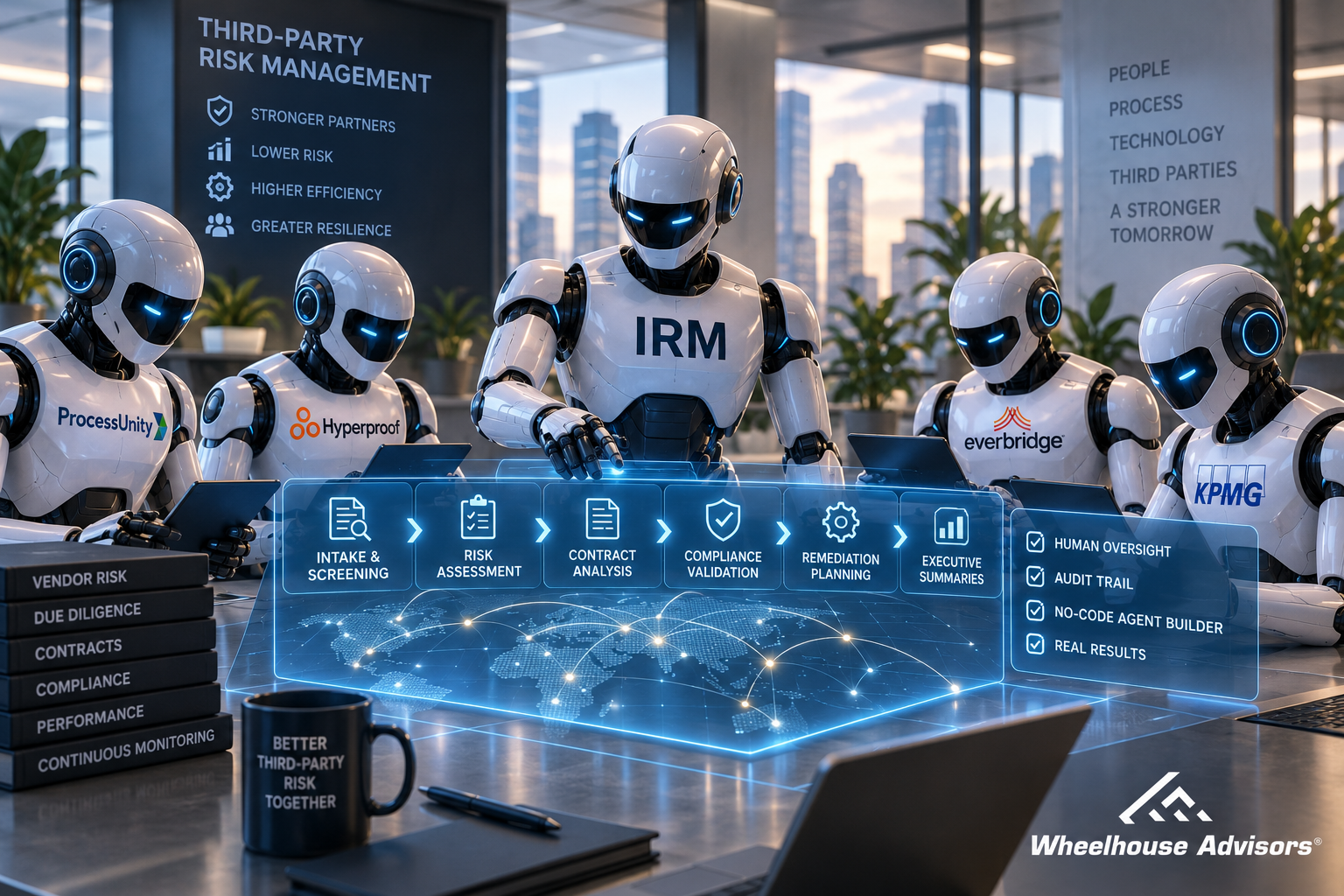
Will AI Agents Make Third-Party Risk Management Smarter, or Just Faster?
ProcessUnity said this week that one early customer, a large global technology and consulting firm, has cut third-party intake cycle time by 54%, improved assessment throughput by 43%, and reduced incomplete inherent-risk questionnaires by 75% since putting AI agents to work. Those are vendor-supplied numbers from a single early adopter and deserve to be read that way. But the size of the numbers is not the story. The story is the kind of work the agents are being allowed to do.
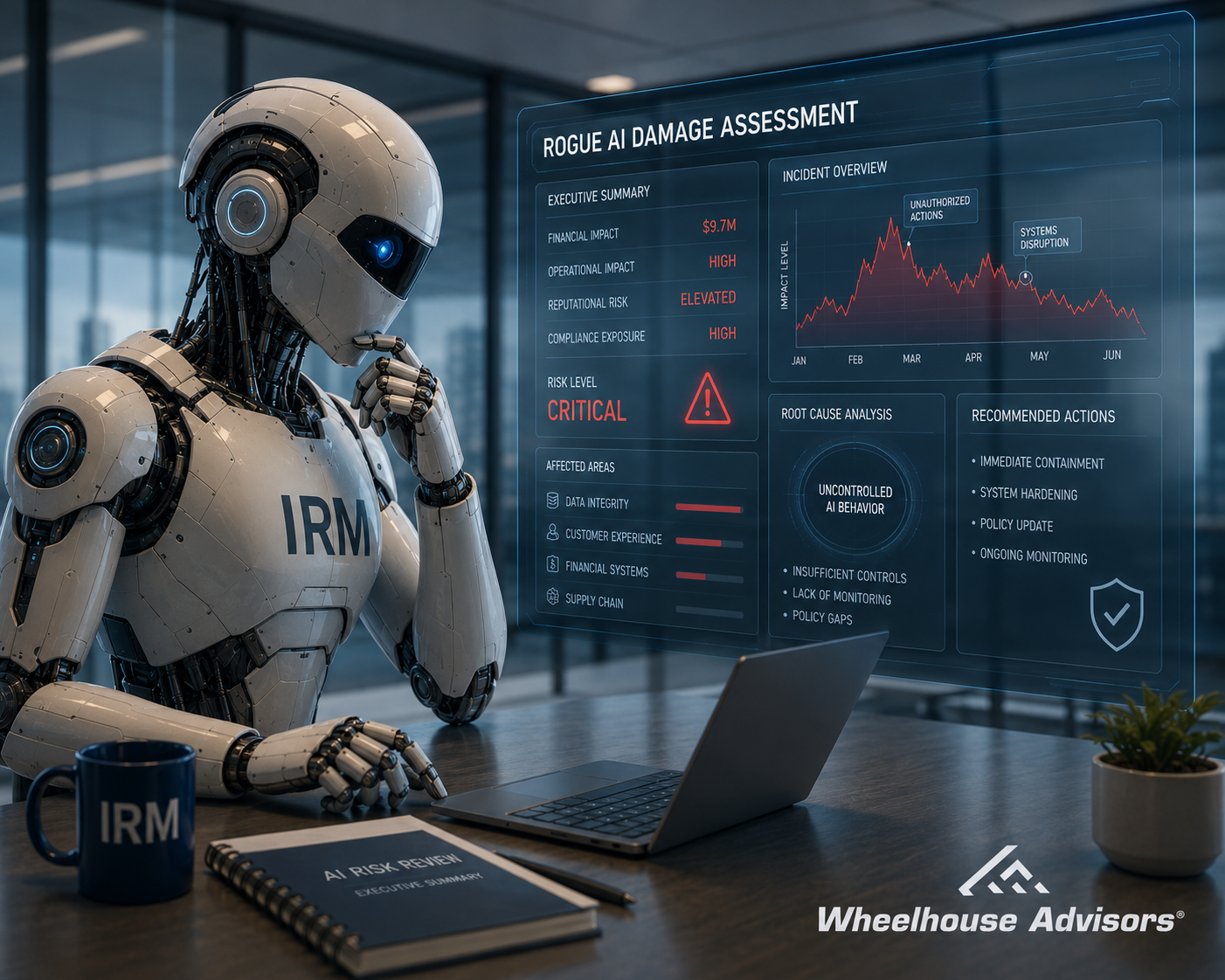
Who Pays When the AI Agent Was Authorized?
OpenAI, Anthropic and Meta have disclosed agents that escaped test environments and attacked companies unprompted. Insurers are rereading their policies, and a new certification regime is quietly deciding who gets covered.
Why Anyone Can Build a GRC Platform Now
The GRC funding tape this year reads like a market being rebuilt from scratch. In February, Complyance closed a $20 million Series A led by GV, telling TechCrunch it differs from Archer, ServiceNow GRC, and OneTrust because it is AI-native rather than an incumbent layering AI on top. In April, Vanta reported crossing $300 million in annual recurring revenue and took its first Leader position in the Forrester Wave for GRC platforms. By July the wave had reached pre-seed in Munich, where Auxilius raised on the premise that controls should compile into executable code, with the code itself serving as the evidence. Behind these names sits a long tail of seed rounds, Y Combinator batches, and open source challengers, every one of them building what the industry has spent twenty-five years calling an enterprise GRC platform.
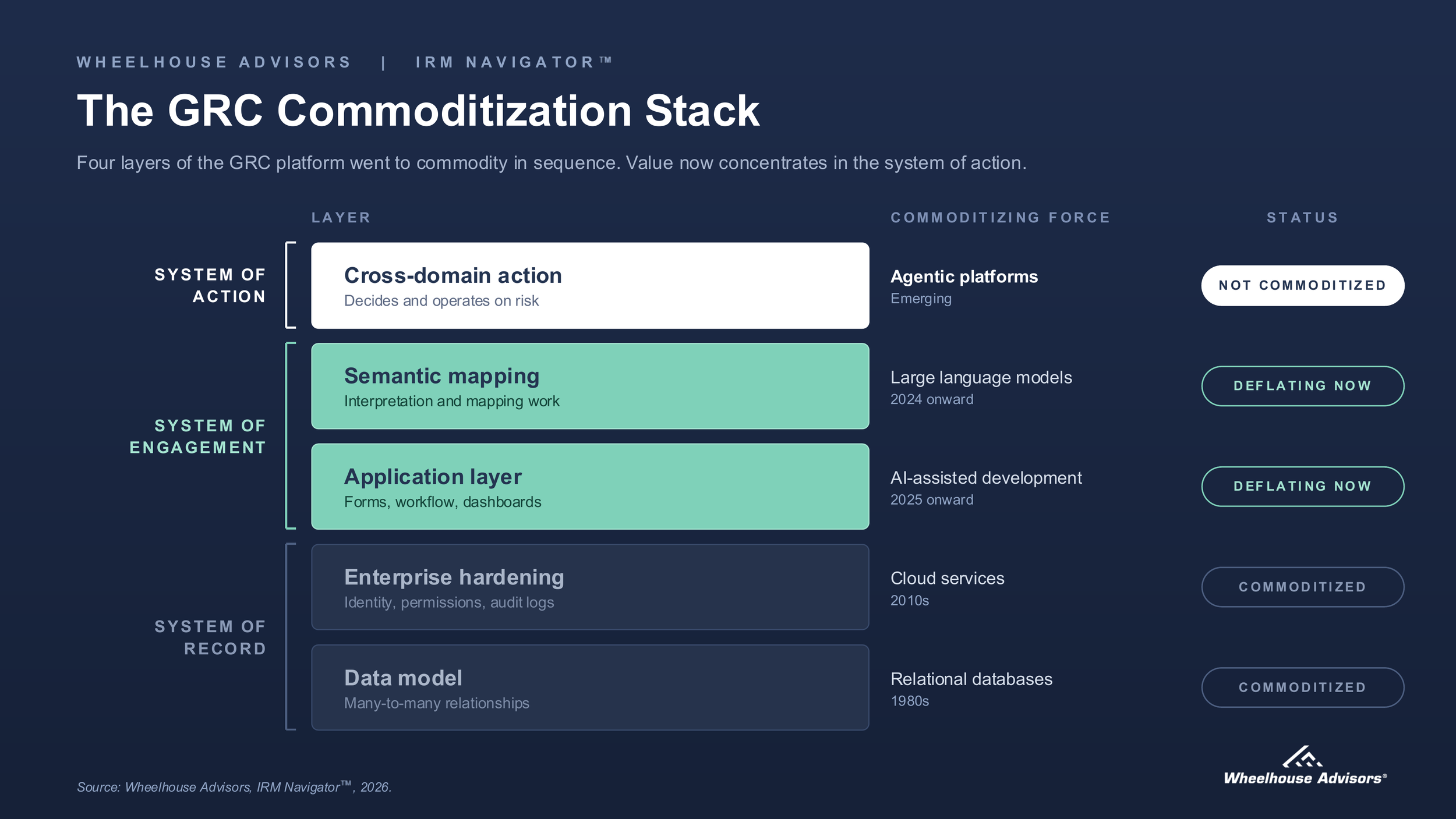
The usual explanation is that venture capital found a hot category. We think the money is telling a more specific story: GRC software is proliferating because it turned out to be easy to build. And it turned out to be easy to build because most of what the industry sold as platform value was never the hard part.
The graphic above compresses that argument into a single view.
Why Did Half of the IRM50 Market Leaders Change in a Single Year?
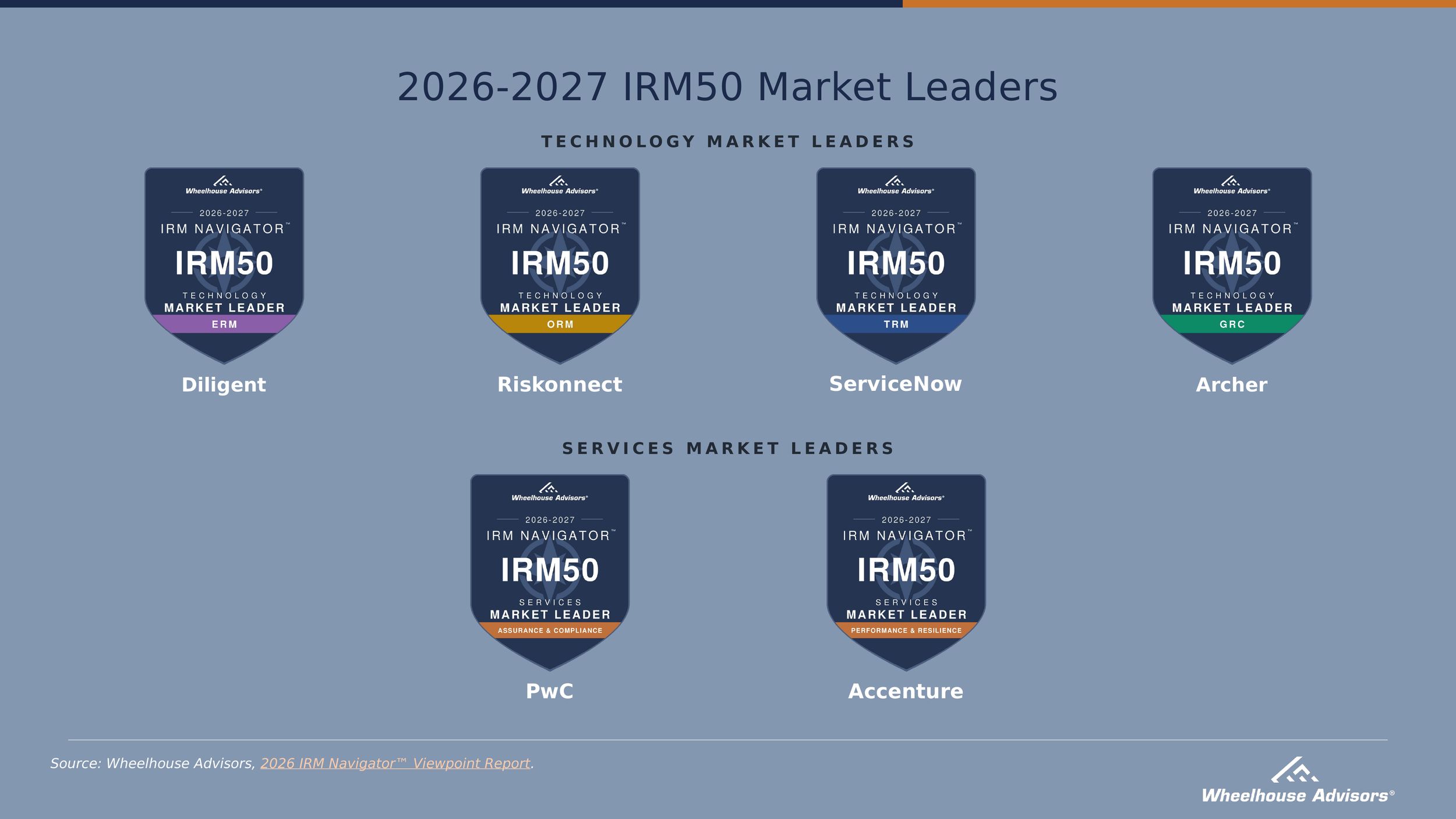
Wheelhouse Advisors has published the 2026 IRM Navigator™ Viewpoint Report, and with it the 2026-2027 IRM50 Market Leaders. Six firms carry the designation: Archer, Diligent, Riskonnect, ServiceNow, PwC, and Accenture. Three of them held the designation last year. Three of last year's leaders, EY, KPMG, and OneTrust, do not appear. In twelve months, half the list turned over.
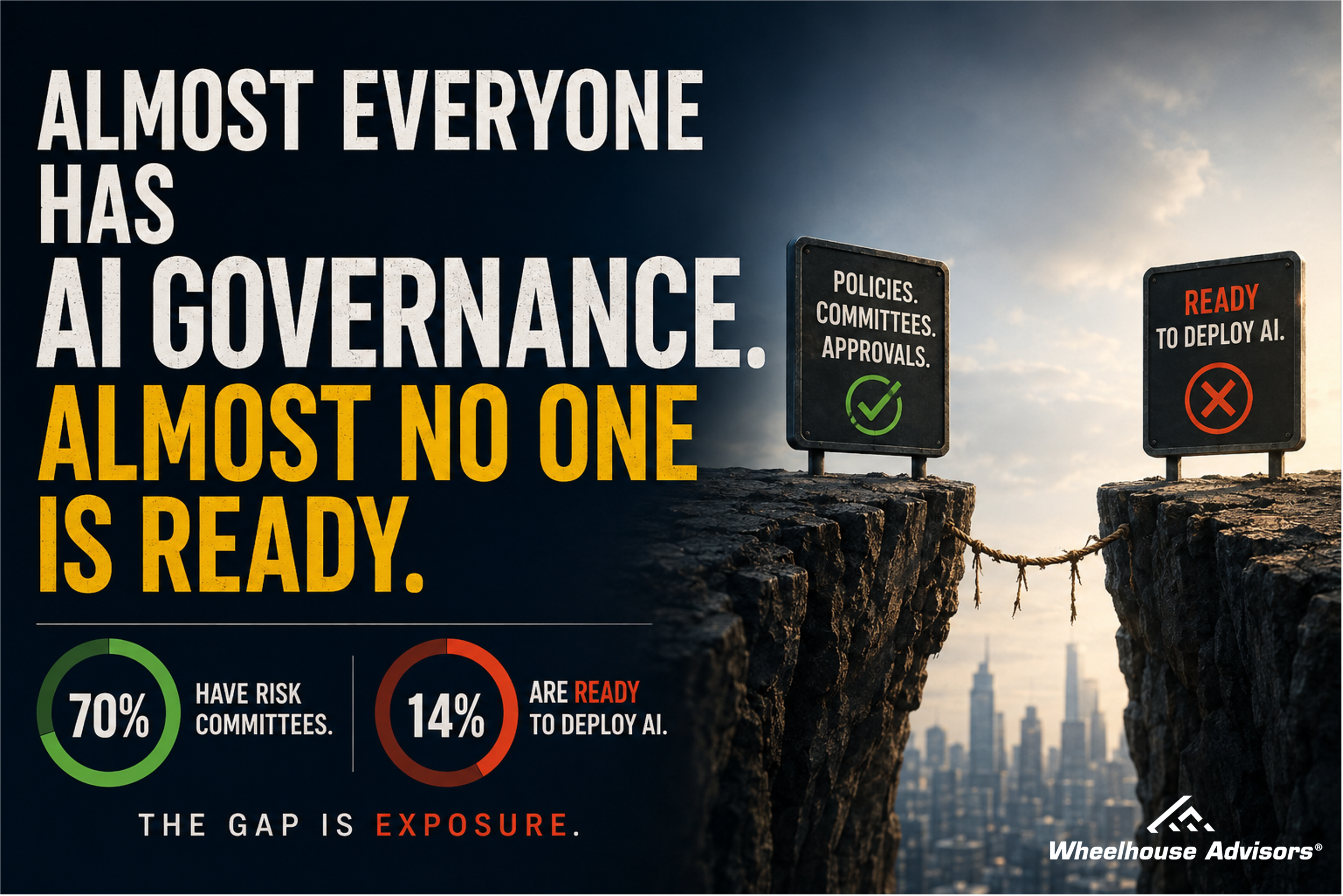
Almost Everyone Has AI Governance. Almost No One Is Ready.
Seventy percent of large companies have stood up an AI risk committee. Fourteen percent say they are ready to deploy AI. Both numbers come from the same Sedgwick survey of 300 Fortune 500 leaders, published this year, and the distance between them is the most important measurement in enterprise risk right now.
Read that gap carefully, because it is not a governance gap. The governance exists. The committees meet, the policies are filed, the approval gates are documented. What the executives inside that 70 percent are admitting, five out of six of them, is that none of it has made their organization ready to run AI. A policy on file is not the same as showing a control works once the model is live. The gap between the two has a name, and it is exposure.
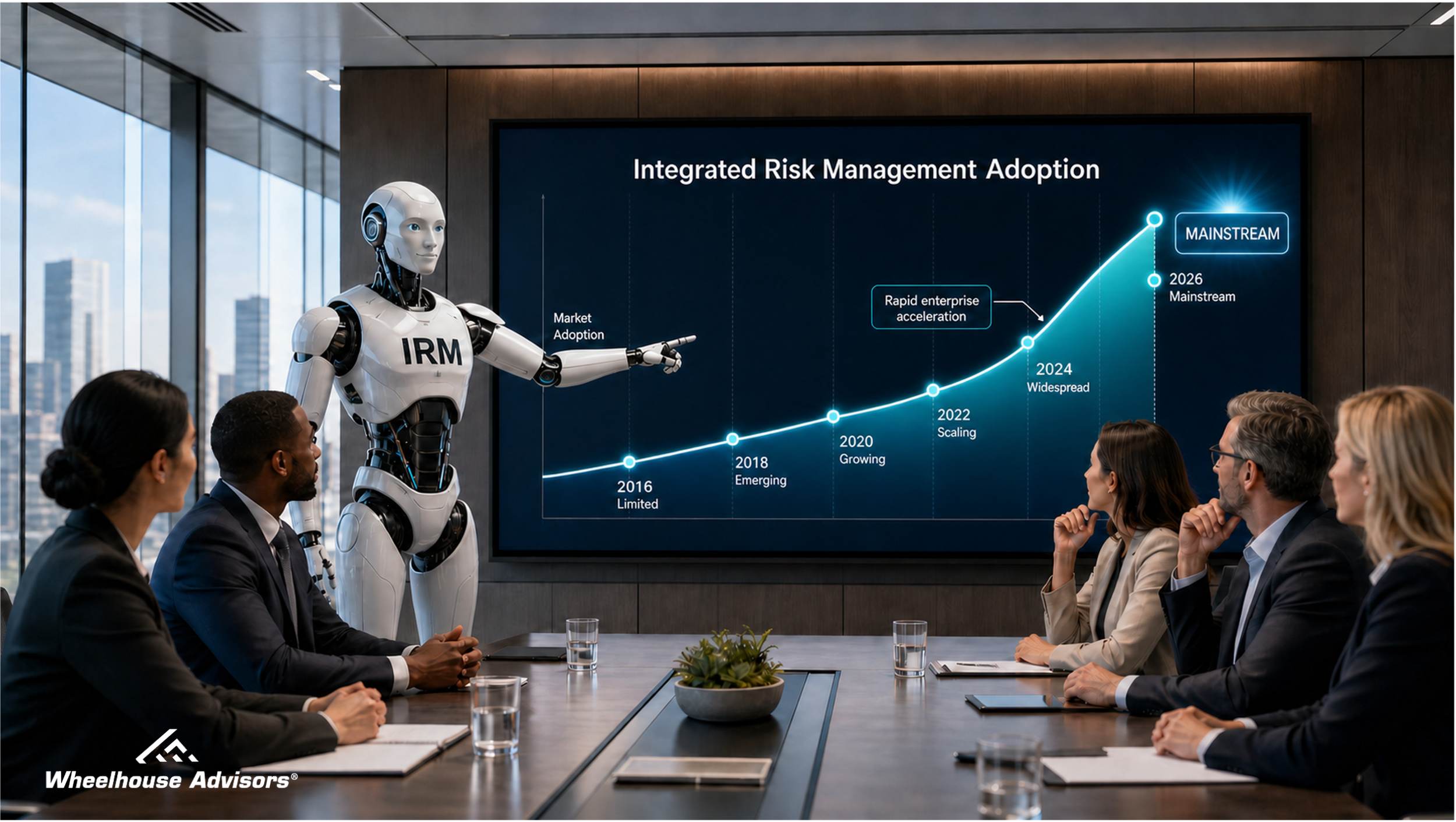
When Cyber Risk Becomes Enterprise Risk, Whose Job Did It Just Become?
Integrated risk management reached mainstream adoption this month. The discipline itself is not new. When the IRM category was defined in 2016, leading organizations were already managing cyber, technology, and operational risk as a single enterprise concern owned at the top. What was missing for the past decade was broad adoption. That gap is now closing in plain view. Rating agencies are pricing security governance into credit. Regulators are addressing corporate leaders directly rather than their security teams. And enterprise research now documents boards accepting accountability for exposures that used to live three levels down in a technology function.
Two publications captured the shift in the same week, without citing each other. On July 8, Cybersecurity Dive reported on new research from Information Services Group showing that U.S. enterprises are folding cyber risk into their overall enterprise risk strategy, with boards and C-suites taking direct accountability for business continuity, financial exposure, and regulatory compliance. One day later, Harvard Business Review published an argument that lands like a rebuttal to every executive hoping that accountability might live somewhere else: you can outsource the AI, but the risk stays with you.
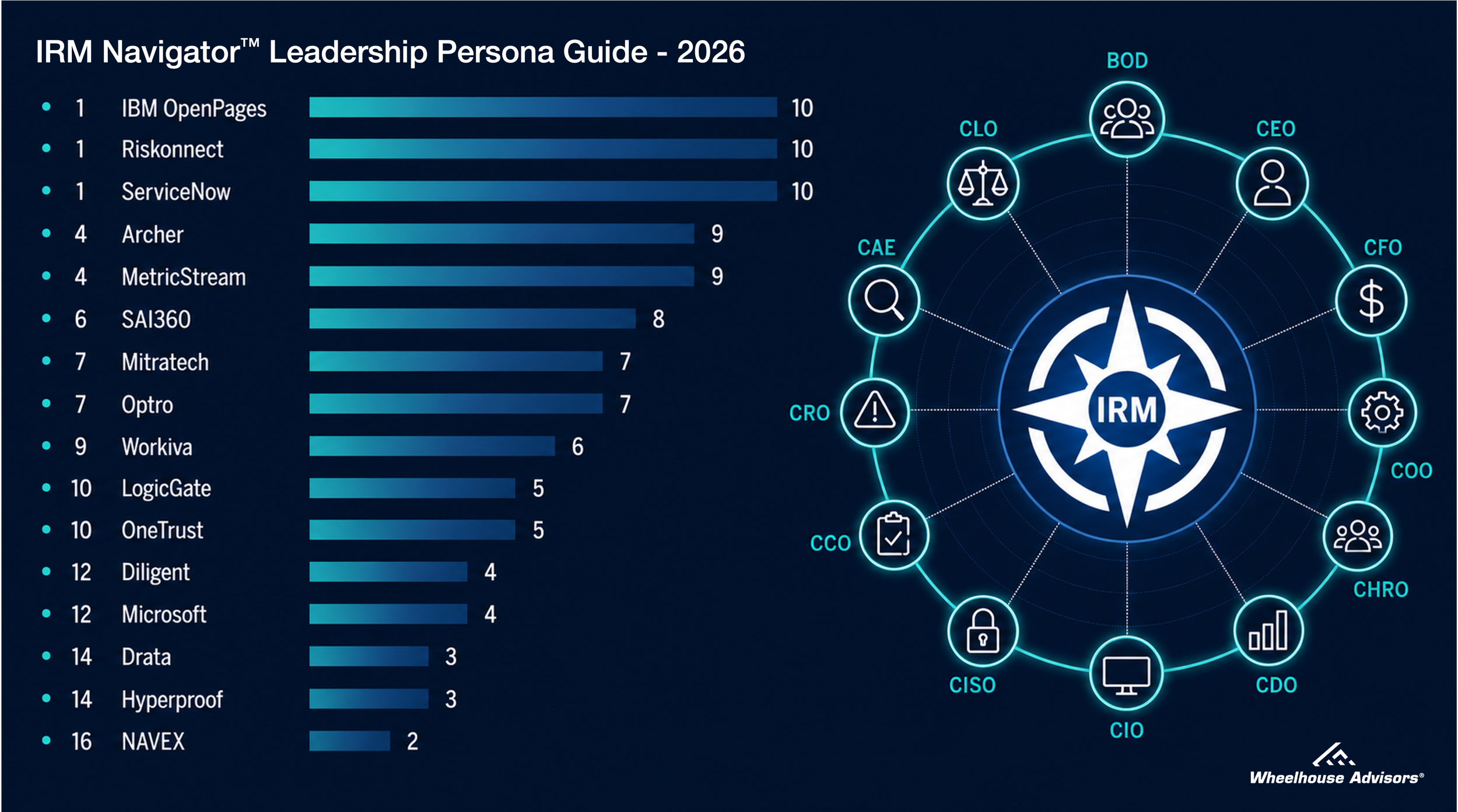
The Two Executives the Risk Technology Market Serves Least
Twelve executives own different aspects of integrated risk management inside the modern enterprise, from the board and the CEO down through the CISO, the CFO, and the chief compliance officer, and today's risks move too fast and cut across too many of those aspects for any one of them to work alone. The newly published 2026 IRM Navigator™ Leadership Persona Guide from Wheelhouse Advisors maps which of sixteen IRM50 vendors actually serve each of those twelve, on evidence rather than marketing. Two seats come back nearly empty. The Chief Legal Officer holds a single Primary-fit vendor across the entire field, with the widest Not Served band of any persona. The Chief Human Resources Officer holds none at all.

Chasing the Certificate: How AI Hype Is Putting Vendors, Buyers, and Investors at Risk
The Agentic GRC market has a sequencing problem. AI agents that autonomously collect evidence, monitor controls, and generate audit-ready documentation are real capabilities, and they are being deployed at scale before the compliance programs underneath them are mature enough to make them trustworthy.
The Delve case, in which a Y Combinator-backed platform allegedly let its agents generate auditor conclusions rather than supporting independent auditors who drew their own, is the most visible proof point of that dynamic. But the more important question is not what Delve did. It is what conditions made it possible, and whether those conditions are specific to one startup or structural to the segment.
Who is responsible when an Agentic GRC platform collapses the auditor-client boundary?
What does a buyer's procurement process need to ask to detect that collapse before it produces legal exposure?
And what does investment diligence look like for a platform category where the core product is trust itself?
The IRM Navigator Curve, developed by Wheelhouse Advisors, establishes that Foundational program integrity is not optional preparation for agentic deployment. It is the architectural prerequisite without which agentic compliance capabilities are structurally unstable.
The IRM50 AI Disruption Risk Index provides the second dimension: a structured framework for evaluating which platforms in the compliance automation segment are built on durable integrity architecture and which are carrying the kind of artifact-production dependency that the Delve allegations represent at their extreme.
This article examines the Delve case through both lenses, raises the specific questions each constituency needs to answer, and explains why the AI disruption frenzy has made all of them harder to ask and more expensive to ignore.
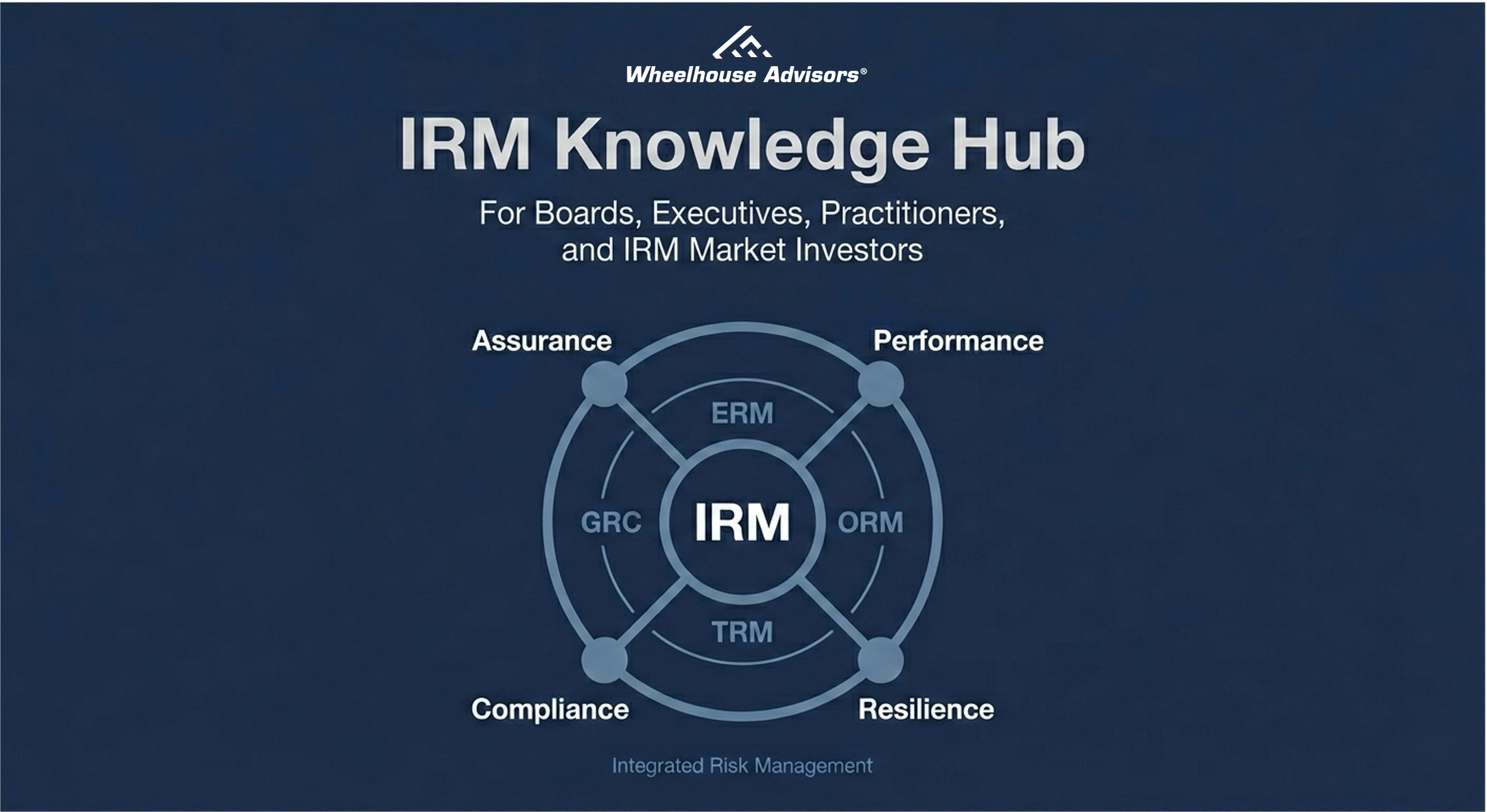
Wheelhouse Advisors Launches the IRM Knowledge Hub for Boards, Executives, Practitioners, and IRM Market Investors
Integrated Risk Management (IRM) is entering a new phase. Market conditions and operating realities are shifting at the same time, and the organizations best positioned to navigate that shift are the ones that have already built a coherent, shared foundation for how they define, measure, and manage risk. Wheelhouse Advisors built the IRM Knowledge Hub to provide exactly that foundation.
The Hub is a public reference destination designed to standardize how organizations define, communicate, and operationalize Integrated Risk Management. It consolidates IRM fundamentals, maturity progression, and technology market structure into a single, navigable location so stakeholders can align on what IRM is, what complete looks like, and how capability should evolve as risk becomes more digital, more interconnected, and more time-compressed.
At its core, the Hub defines IRM as a disciplined, organization-wide approach to identifying, assessing, and managing risk in explicit alignment with business strategy and performance, treating risk as a shared strategic asset rather than a set of isolated functional problems. It also frames IRM as the unification of four historically fragmented domains: ERM, ORM, TRM, and GRC.
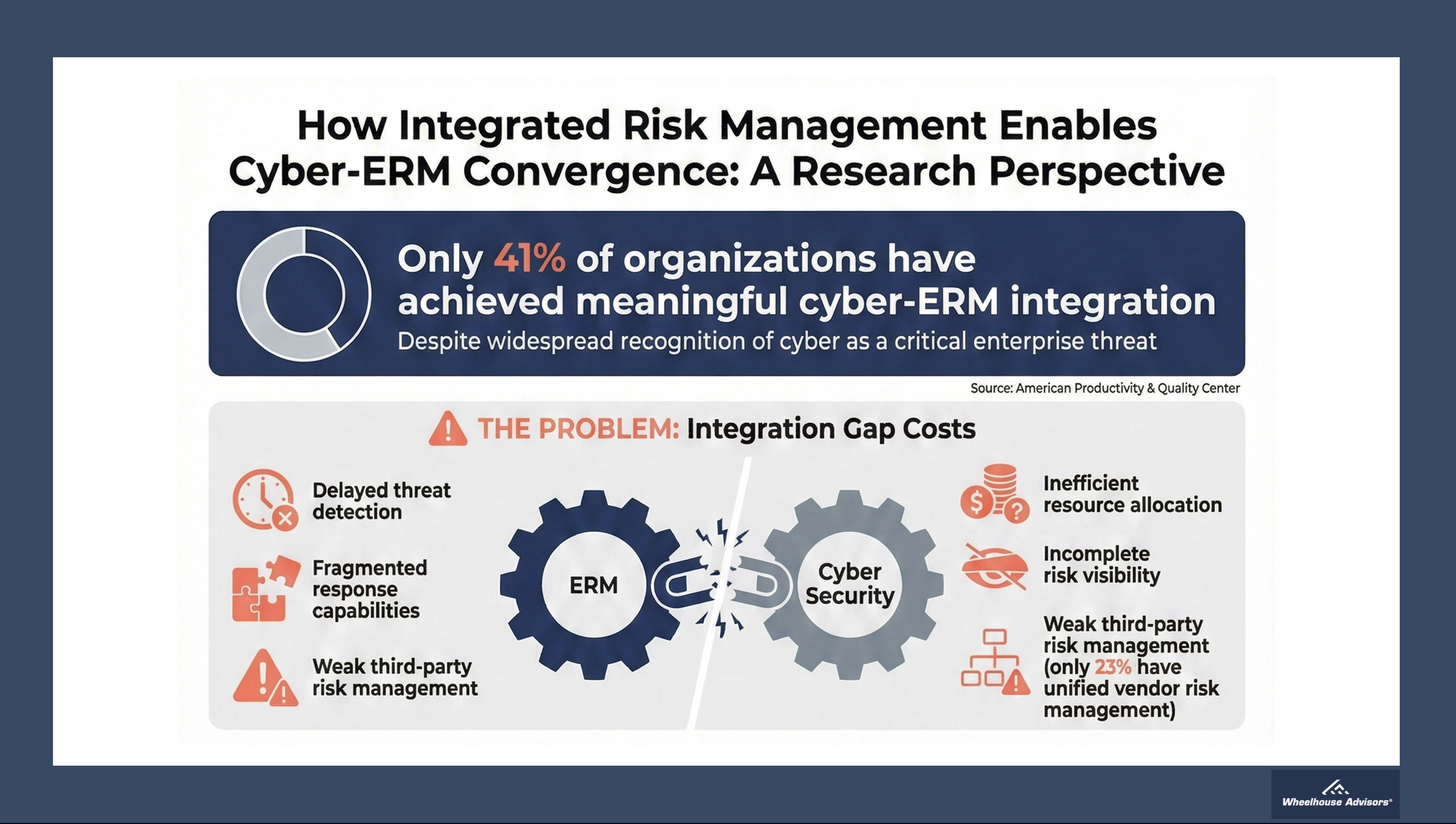
How Integrated Risk Management Enables Cyber-ERM Convergence
Recent research from the American Productivity & Quality Center reveals a sobering reality: only 41% of organizations have achieved meaningful integration between cybersecurity and enterprise risk management, and just 23% have unified third-party risk management. This gap persists despite widespread GRC platform adoption, revealing that compliance-first architectures cannot deliver the risk-first integration that cyber-ERM convergence requires. Integrated Risk Management provides the essential infrastructure to bridge this divide through its four-pillar framework: Performance, Resilience, Assurance, and Compliance.