Wheelhouse Advisors Launches the IRM Knowledge Hub for Boards, Executives, Practitioners, and IRM Market Investors
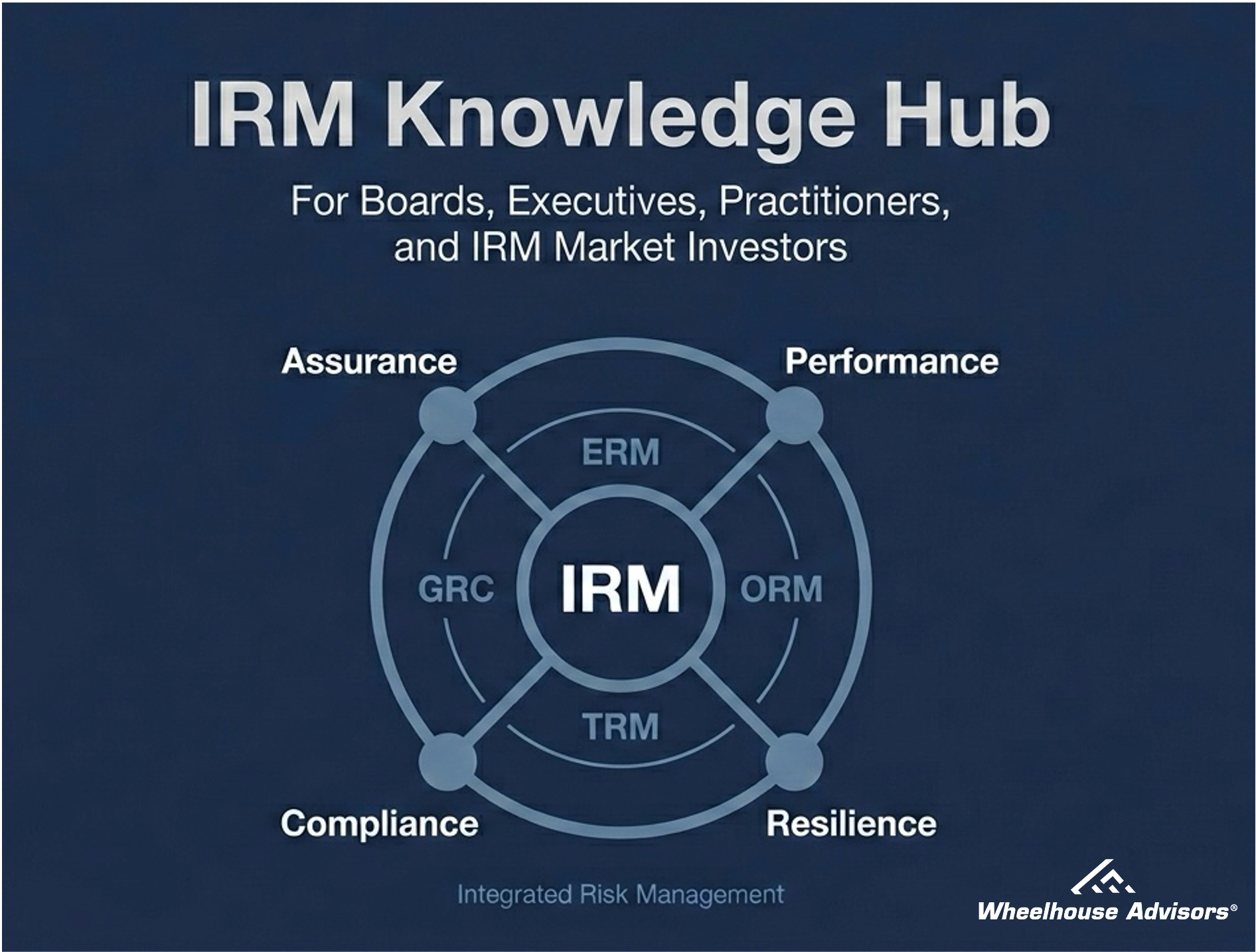
Integrated Risk Management (IRM) is entering a new phase. Market conditions and operating realities are shifting at the same time, and the organizations best positioned to navigate that shift are the ones that have already built a coherent, shared foundation for how they define, measure, and manage risk. Wheelhouse Advisors built the IRM Knowledge Hub to provide exactly that foundation.
The Hub is a public reference destination designed to standardize how organizations define, communicate, and operationalize Integrated Risk Management. It consolidates IRM fundamentals, maturity progression, and technology market structure into a single, navigable location so stakeholders can align on what IRM is, what complete looks like, and how capability should evolve as risk becomes more digital, more interconnected, and more time-compressed.
At its core, the Hub defines IRM as a disciplined, organization-wide approach to identifying, assessing, and managing risk in explicit alignment with business strategy and performance, treating risk as a shared strategic asset rather than a set of isolated functional problems. It also frames IRM as the unification of four historically fragmented domains: ERM, ORM, TRM, and GRC.
Why It Matters Now
Four market signals define the moment the Hub is entering.
AI is forcing a durability reset in the enterprise software market. In February 2026, Reuters reported a sharp selloff in U.S. software and data services stocks, with approximately $1 trillion in market value erased amid concerns that rapidly evolving AI could disrupt traditional software economics.¹ That signal matters for IRM stakeholders because many risk platforms monetize work that AI compresses early, including documentation-heavy compliance, audit preparation, and assurance workflows.
Regulated institutions are moving beyond pilots into production-grade automation. Reuters reported Goldman Sachs working with Anthropic to develop AI agents aimed at automating internal banking functions such as trade and transaction accounting, client due diligence, and onboarding.² Whether or not every enterprise follows Goldman's model, the direction is clear: work once performed through manual or workflow-based oversight is being redesigned for automation, and risk, compliance, and assurance functions sit directly in that path.
Dependency risk is increasingly systemic and externally visible. Cloudflare's February 20, 2026 post-mortem described how roughly 1,100 BYOIP prefixes were withdrawn from its network before engineers reverted the change, with downstream customer impact.³ Events like this are no longer IT problems that remain inside a technology team's incident queue. They become operational continuity issues, customer trust issues, and board-level scrutiny issues rapidly.
Market leader is no longer a sufficient proxy for structural durability. Wheelhouse's new IRM50 AI Disruption Risk Index was developed specifically to separate brand leadership from structural positioning as IRM moves toward Autonomous execution. The Index argues that boards, executives, and investors who treat leadership and durability as interchangeable are taking on risk they have not measured, then provides a measurement model.⁴
The Hub is designed to be the shared baseline for this moment, when IRM is shifting from integrated visibility toward integrated execution, and when AI is accelerating both the pace of disruption and the pace of market repricing.
What the IRM Knowledge Hub Includes
The Hub is organized around six decision-oriented sections that map to how leaders evaluate risk capability.
What is Integrated Risk Management provides a clear definition of IRM as an organization-wide discipline explicitly connected to business strategy and performance, with IRM positioned as a unification of ERM, ORM, TRM, and GRC.
How IRM Evolved is a narrative of the discipline's shift from fragmented risk programs to integrated risk capability, including why siloed models repeatedly fail under cross-domain disruptions.
The IRM Navigator Model is Wheelhouse's proprietary analytical framework for the structure of a complete, functional IRM capability, including where technology investments fit within the discipline. It organizes IRM value creation around PRAC, the four objectives: Performance, Resilience, Assurance, and Compliance. It lays out five solution areas and clarifies why Risk Management Consulting is a structural part of the IRM ecosystem, not an optional add-on to tools. It also introduces four integration points where risk and business execution intersect: Goals, Processes, Assets, and Policies, and positions these integration points as the difference between parallel programs and unified management.
The IRM Navigator Curve is a five-level maturity model from Foundational through Autonomous that describes a practical path from basic awareness to fully operationalized IRM. The Autonomous stage is framed explicitly as humans and machines working together within validated guardrails, with real-time detection and assessment and automated responses to known scenarios, while accountability remains with experienced risk professionals.
IRM Technology Market Overview is a segmentation of the IRM technology market across core solution segments, emphasizing convergence and the impact of digital transformation and rising board and investor expectations for demonstrable outcomes.
About Wheelhouse Advisors provides context on Wheelhouse's research and advisory focus and the role of the Hub as a durable public foundation for IRM understanding.
Who Should Use the Hub
The Hub is designed for the full set of stakeholders who influence IRM outcomes, funding, and market direction.
Boards need a consistent baseline for what integrated should mean, what maturity looks like, and what evidence is credible. The Hub provides definitional clarity, maturity structure, and an architecture lens that supports sharper oversight questions, particularly when technology and third-party dependency risks are escalating.
C-suite executives need IRM framed as a management capability tied to outcomes, not a reporting obligation. PRAC provides a practical way to connect investment to performance, resilience, assurance, and compliance value, and to identify where fragmentation is creating decision friction and avoidable operating cost.
IRM leaders and practitioners need a shared language to align ERM, ORM, TRM, and GRC stakeholders, to map tool and process gaps, and to prioritize maturity moves that increase actionability. The Hub provides the baseline that makes alignment faster and reduces reinvention across teams.
IRM market investors and private equity firms increasingly evaluate risk management as a factor in operational volatility, resilience, and trust, and also as a technology and services market whose economics are being reshaped by AI. The Hub provides a diligence-grade baseline for IRM scope, maturity expectations, and market segmentation, while Wheelhouse's companion research adds an explicit lens for AI disruption exposure.
How to Use the Hub
A practical way to adopt the Hub is to treat it as the shared baseline before decisions that are vulnerable to definitional drift:
Oversight alignment: Standardize IRM scope and language across ERM, ORM, TRM, and GRC so board reporting and management decisions reconcile.
Maturity planning: Use the IRM Navigator Curve to identify where the organization sits, then focus on moves that reduce fragmentation and improve execution.
Technology strategy: Map tools and roadmaps to PRAC, the five solution areas, and the four integration points, then test whether integration reaches execution layers, not only dashboards.
Investor diligence and value creation: Use the maturity lens to distinguish artifact-heavy operations from execution-oriented capability, then evaluate whether current platforms and service models are structurally durable under AI-driven workflow compression.
Related Research: The IRM50 AI Disruption Risk Index
The Hub provides the conceptual foundation. Our IRM50 AI Disruption Risk Index provides a market durability lens for the Autonomous IRM era. The Index covers 50 vendors and assigns each to one of six tiers. Vendors are not ranked by market share or feature count, they are positioned by structural durability across two dimensions that determine AI exposure: compliance-artifact dependency and autonomous risk capability. The companion RiskTech Journal preview highlights why this matters: market leadership and structural durability are different questions, and six IRM50 Market Leaders landed across five different tiers.⁵
If you have not reviewed the Index graphic and note, reviewing it alongside the Hub is worth the time. The combination provides a clear through-line: what IRM is, what Autonomous maturity implies operationally, and how the market's technology and services models are likely to be reshaped as AI compresses monetized work.
The IRM Knowledge Hub is available on the Wheelhouse Advisors website. The IRM50 AI Disruption Risk Index is available exclusively on The RTJ Bridge.
References
1. Reuters, "US software stocks slammed on mounting fears over AI disruption, lose $1 trillion in week." Feb 2026.
2. Reuters, "Goldman Sachs teams up with Anthropic to automate banking tasks with AI agents, CNBC reports." Feb 2026.
3. Cloudflare, "Cloudflare outage on February 20, 2026." Feb 2026.
4. Wheelhouse Advisors, "The IRM50 AI Disruption Risk Index: Which Vendors Are More Durable in the Age of Autonomous IRM?" The RTJ Bridge, Feb 2026.
5. Wheelhouse Advisors, "We Scored 50 IRM Vendors on AI Disruption Risk. Six Market Leaders Landed in Five Different Tiers." The RiskTech Journal, Feb 2026.