We Scored 50 IRM Vendors on AI Disruption Risk. Six Market Leaders Landed in Five Different Tiers.
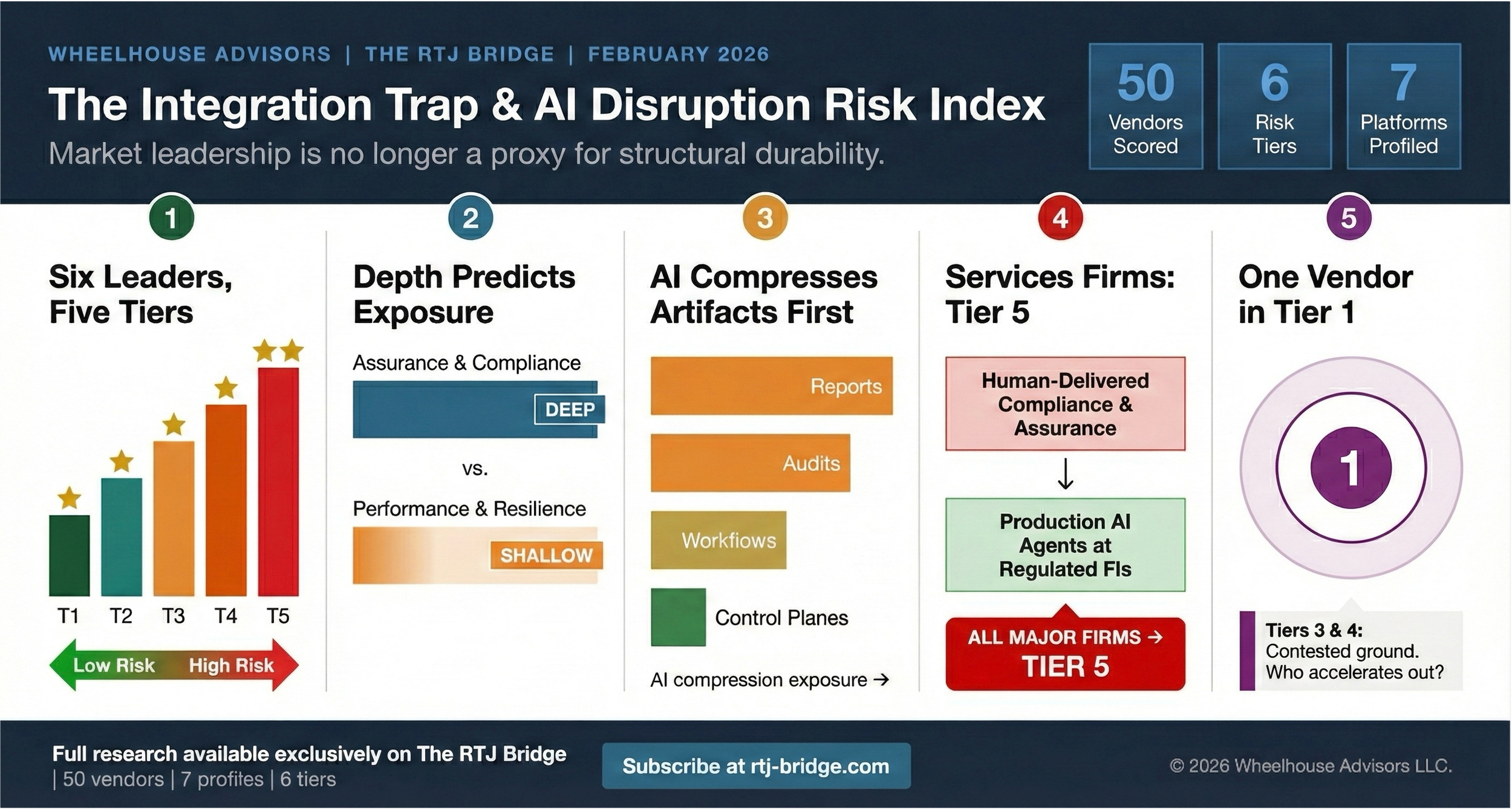
The IRM market runs on two assumptions that deserve harder scrutiny. The first: that market leadership reflects structural durability. The second: that “integrated” platforms deliver the integration that enterprises actually need. This month, Wheelhouse Advisors publishes two companion research notes on The RTJ Bridge that challenge both assumptions directly.
The Integration Trap for GRC examines seven major GRC and IRM vendors and surfaces a structural pattern the market has not confronted honestly. The IRM50 AI Disruption Risk Index extends that analysis across the full IRM50 ecosystem, scores all fifty vendors on AI disruption exposure, and assigns each to one of six risk tiers. It also delivers detailed structural assessments of the six IRM50 Market Leaders, explaining why they land in five different tiers. Together, the two studies deliver a new lens for evaluating vendor durability that buyers, boards, and vendors themselves should read carefully.
This article previews both studies. The full research, including individual vendor assessments, tier assignments, and the analytical framework behind them, is available exclusively on The RTJ Bridge.
The Integration Trap: What We Found
Every major GRC vendor now claims integration as a core capability. Diligent promises “One Platform. One View.” MetricStream markets “ConnectedGRC.” AuditBoard sells a “connected risk platform.” Mitratech advertises “The All-in-One GRC Platform.” These claims hold up. They also stop short.
The Integration Trap research evaluates seven vendors against the four objectives of the IRM Navigator™ Model: Performance, Resilience, Assurance, and Compliance (PRAC). Most platforms address all four objectives to varying degrees. But the depth of integration varies sharply. Assurance and Compliance receive the deepest integration: consolidated dashboards, automated control testing, unified reporting chains. Performance and Resilience receive shallower integration: plans are documented, risks are cataloged, but the operational execution layer where those outcomes are determined in real time remains more lightly integrated.
The result is what we call the Integration Trap: organizations detect risks faster but do not act on them faster. Faster compliance reporting without faster incident response. Unified dashboards without unified decision authority. Consolidated findings without coordinated remediation. The platforms create visibility. They do not yet create operational control.
The full research note profiles each of the seven vendors, identifies five observable Integration Trap patterns, and delivers a twelve-question vendor evaluation framework designed to expose Integration Trap dynamics before deployment, not after.
The IRM50 AI Disruption Risk Index: What It Measures
The AI Disruption Risk Index asks a question the market has avoided: given the structural pattern the Integration Trap identifies, which vendors face the greatest exposure as AI rewires the economics of risk and compliance delivery?
The Index evaluates all fifty IRM50 vendors across two structural dimensions. The first measures how much of a vendor’s value proposition depends on traditional GRC artifact production: the compliance reports, audit documentation, and assurance workflows that AI compresses first. The second measures how close a vendor stands to enabling autonomous risk management: sensing, validation, remediation triggers, and evidence closure with progressively less human intervention.
Each vendor receives a tier assignment from 1 (lowest disruption risk) to 6 (highest disruption risk). The tiers reflect structural positioning, not brand strength or feature velocity.
Five Findings That Should Get Your Attention
The six IRM50 Market Leaders land across five of the six risk tiers. ServiceNow, Riskonnect, Archer, OneTrust, KPMG, and EY all earned IRM50 Market Leader designations in 2025. On this Index, they span five separate tiers. Market leadership and structural durability are different questions. The Index note delivers detailed structural assessments of all six, including architectural analysis, acquisition context, and forward-looking trajectory for each.
The Integration Trap directly predicts AI disruption exposure. Vendors whose deepest integration concentrates in compliance and assurance workflows face higher exposure because AI compresses reporting artifacts and documentation before it displaces embedded operational control planes. The two studies connect structurally: the Integration Trap identifies the depth gradient, and the Index measures which business models are most exposed as AI compresses the shallow end first.
Professional services firms face a fundamentally different risk curve than platform vendors. The Index places every major professional services firm in Tier 5. The structural argument is specific: their core IRM-related revenue anchors in human delivery of compliance and assurance work. With regulated financial institutions now deploying production AI agents for these same functions, the research documents why scale and brand do not insulate the delivery model.
The middle tiers are contested ground, and that is where the most consequential moves will happen. Tier 3 and Tier 4 contain vendors with credible platforms, strong domain expertise, and AI feature investments. The research examines what separates vendors that will accelerate out of the middle from those that will get compressed into it.
One vendor stands alone in Tier 1. The research explains exactly why. The Tier 1 designation is not about AI marketing. It is about architectural positioning that the Integration Trap analysis makes structurally legible. The full research note details the specific criteria and what other vendors would need to demonstrate to move up.
Why This Research Matters Now
The February 2026 market environment makes this research unusually timely. Global software stocks sold off sharply on AI disruption concerns. Morgan Stanley flagged AI uncertainty as a credit risk factor in the $1.5 trillion U.S. leveraged loan market. AI disruption risk directly impacts 16% of the loan market or $235 billion. PYMNTS Intelligence research found that 45% of CFOs already use AI in compliance oversight and rules-based finance functions, with nearly 7% deploying agentic AI in live workflows.
Two developments carry direct implications for the IRM and GRC space. Goldman Sachs deployed AI agents for compliance and accounting workflows, signaling that regulated financial institutions are moving past experimentation into production-grade AI automation. Citi rolled out Stylus Workspaces, an internal platform that consolidates complex multi-step tasks across applications and data sources, choosing to build autonomous IRM capabilities internally rather than rely on external GRC products. Together, Goldman and Citi represent a pincer movement on external vendors: the work is being automated, and the platforms to manage it are being built in-house.
For vendor strategy and analyst relations teams, the implications are direct. Buyers are asking harder questions about platform durability. Boards are asking CFOs to distinguish between AI narrative and cash-flow resilience. Investors are asking which software positions hold as AI reshapes the economics of the market. This research provides the structural framework for answering those questions.
What Subscribers Get
The full research, available exclusively on The RTJ Bridge, includes:
The Integration Trap for GRC (5,400+ words). Seven vendor profiles with detailed architectural assessments. Five Integration Trap patterns with real-world scenarios. Twelve critical questions for vendor evaluation. Goldman Sachs and Citi case analysis demonstrating how enterprises are solving the Integration Trap themselves.
The IRM50 AI Disruption Risk Index (3,800+ words). Fifty vendors scored and tiered. Six Market Leader structural assessments spanning five tiers, including architectural analysis, acquisition context, and forward-looking trajectory. CFO AI adoption data and build-vs-buy market analysis. Professional services compression, platform durability, and contested ground. Actionable guidance for buyers, vendors, and boards.
These join a growing library of RTJ Bridge content including the IRM50 OnWatch series tracking vendor moves and M&A signals, strategic insight notes on market shifts and regulatory developments, executive briefings on autonomous IRM and agentic AI, and editorial series like The Risk Ignored. The RTJ Bridge also delivers strategic previews of the IRM Navigator™ research program, whose full Vendor Compass™ and VC Sonar™ reports are available separately at wheelhouseadvisors.com/irm-navigator-research.
A Note on What The RTJ Bridge Has Become: A Research Platform
When we launched The RTJ Bridge nearly a year ago, it was a subscription blog. Today, it is no longer a blog. It is an independent research platform delivering institutional-grade competitive intelligence on the IRM market. We publish vendor assessments, tier-based competitive rankings, AI disruption analysis, market sizing, and strategic advisory research at a level of depth and specificity that previously required a five- or six-figure analyst firm contract.
We built it on a premise: that the person who created the IRM category should be the one providing the independent research that holds it accountable. The volume and depth of our research has grown significantly, and our subscription pricing now reflects that evolution.
If you are a risk leader evaluating platforms, a vendor positioning against competitors, an analyst relations team tracking independent research coverage, or a board member asking whether your organization’s IRM investments will hold, The RTJ Bridge is where that intelligence lives. Subscribe at rtj-bridge.com.