

The RiskTech Journal
The RiskTech Journal is your premier source for insights on cutting-edge risk management technologies. We deliver expert analysis, industry trends, and practical solutions to help professionals stay ahead in an ever-changing risk landscape. Join us to explore the innovations shaping the future of risk management.
Subscribe for notifications when new RiskTech Journal articles and research updates are published.
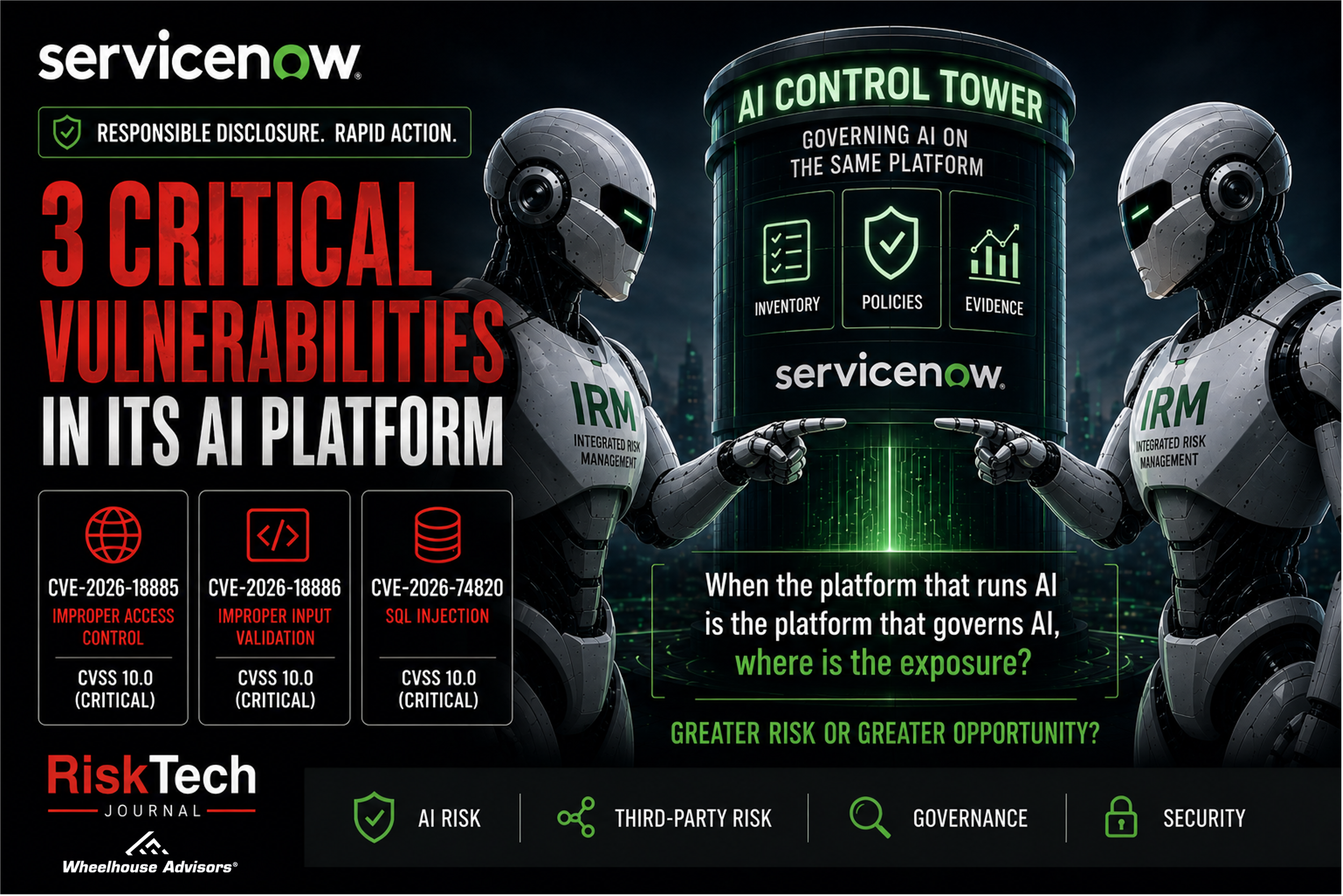
When ServiceNow Discloses Three Worst-Case Vulnerabilities, Whose Exposure Is It?
ServiceNow disclosed three vulnerabilities on August 27 that each carry the worst possible severity rating. The industry scores software flaws on a 0-to-10 scale called CVSS, and anything above 9 counts as critical. A 10.0 is the ceiling. It means an attacker can reach the flaw over the internet, needs no password and no help from a user, and can take full control of the affected system. ServiceNow assigned the maximum score to all three flaws itself, and it disclosed a fourth, rated 8.7, in the same advisory.
ServiceNow says it is not aware of the flaws being exploited, and no public attack code had surfaced as of Friday morning. Instances hosted by ServiceNow have already been patched. Customers and partners who run ServiceNow in their own environments have been told to confirm they are on a fixed release.
Most security teams will read that and reach for the patch checklist. That is the right first move. It is not the whole job.
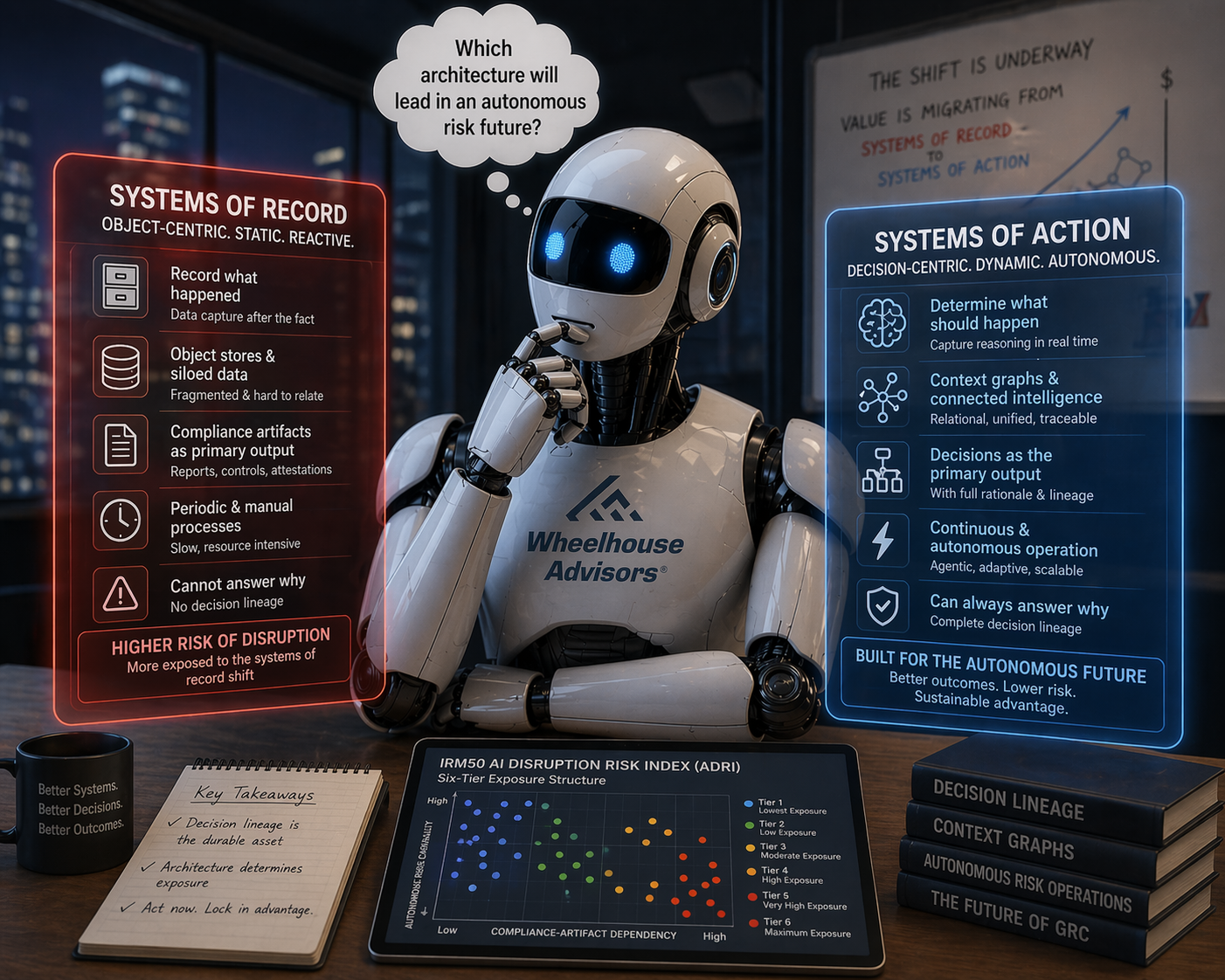
Why Risk Technology Is More Exposed to the Systems of Record Shift Than Other Software Categories
Between December 2025 and February 2026, venture commentary converged on an architectural argument: traditional systems of record are losing primacy as agentic AI takes over execution, and value is migrating from the systems that record state to the systems that capture reasoning. Sarah Wang at Andreessen Horowitz, Jamin Ball at Clouded Judgement, and Jaya Gupta and Ashu Garg at Foundation Capital each made a version of the case in pieces published within two weeks of one another.
The venture commentary drew its examples from sales, support, and finance. Those domains can tolerate lossy decision capture. Risk technology cannot. Audit, compliance, and assurance are not optional use cases bolted onto risk platforms. They are the reason the platforms exist, and each of them requires the ability to answer why something was allowed to happen.
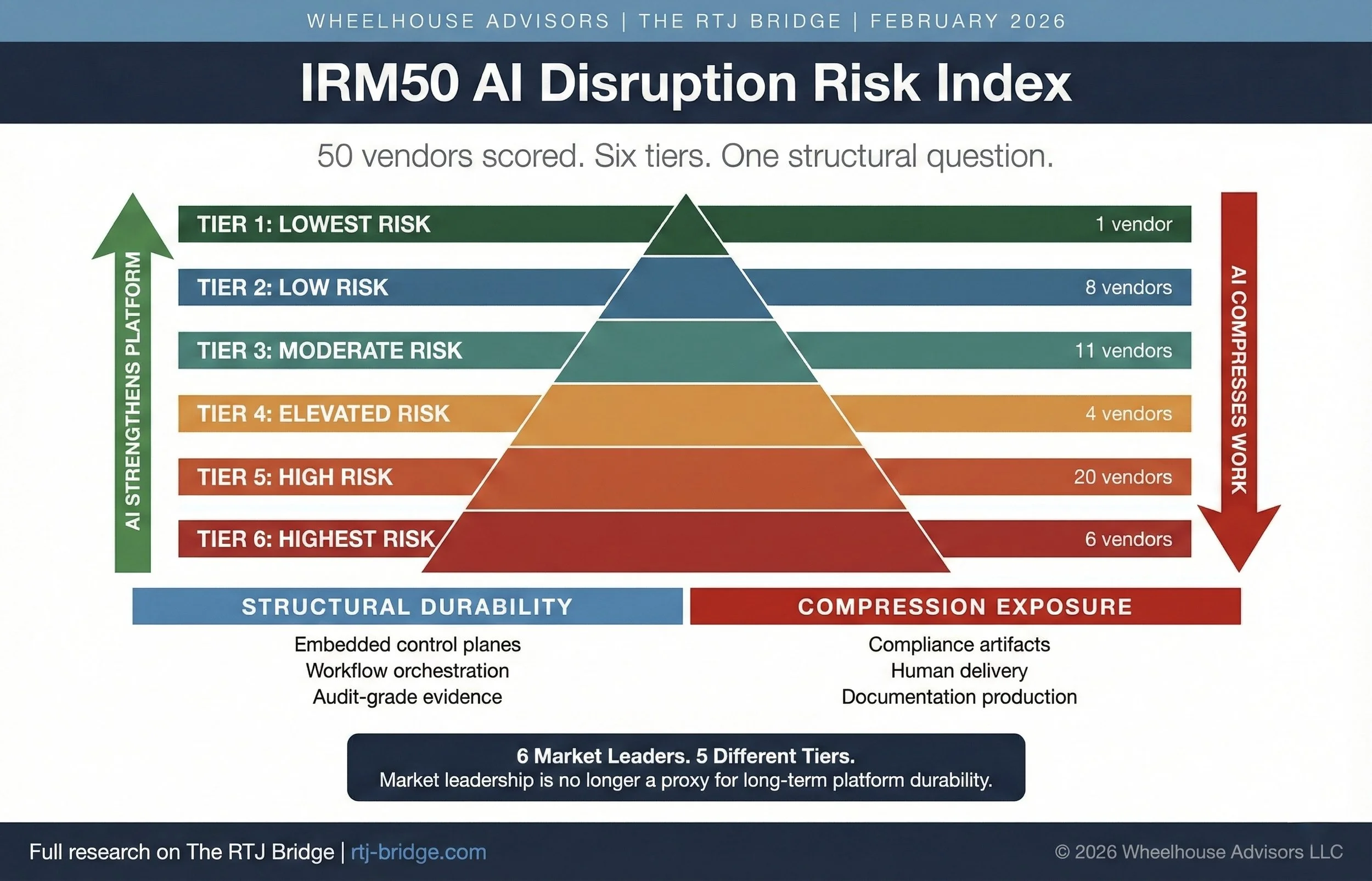
The IRM50 AI Disruption Risk Index measures vendor-level exposure across fifty IRM and GRC platforms. The gap between tier one and tier five is not incremental. It is the difference between absorbing the shift and being absorbed by it.
Professional Services Firms Admit AI Is an Existential Risk
PwC just announced PwC One, an AI platform that delivers tax, audit, and consulting services directly to clients without a PwC professional in the loop. CEO Paul Griggs warned this week that partners who resist are "not going to be here that long." Accenture said something similar earlier this month.
Two of the largest professional services firms in the world have now publicly acknowledged that AI threatens their core business model. But the bigger question is not what happens to PwC and Accenture.
It is what happens to the technology vendors who depend on them.
Subscribe free to The RiskTech Journal to learn more.
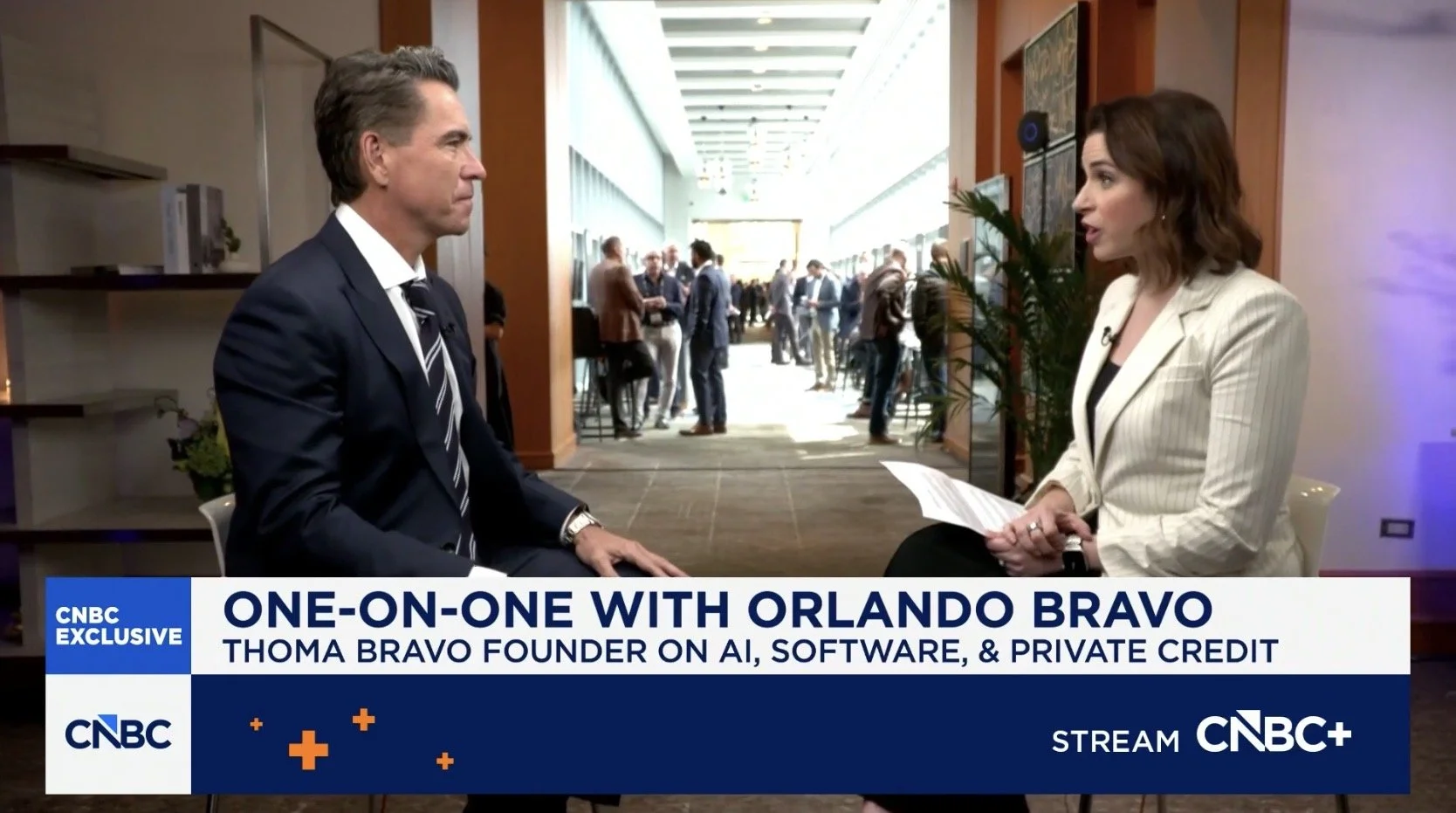
Thoma Bravo’s Investor Meeting Sends a Warning RiskTech Cannot Ignore
Orlando Bravo did not mince words at Thoma Bravo’s annual investor meeting in Miami yesterday. Speaking exclusively with CNBC’s Leslie Picker on the floor of the event, the firm’s founder and managing partner addressed the AI disruption narrative head-on – and drew a sharp line between the software companies his firm owns and the ones it would not touch. “There are many, many software companies in the public markets that will be disrupted from AI,” Bravo told Picker. “Those companies were going to be disrupted anyway. AI will create that disruption a lot faster, and some of the decreases in their valuations are very warranted.”
Thoma Bravo manages over $183 billion in assets across roughly 80 enterprise software companies, making it the largest investment firm with concentrated exposure to the software sector. That portfolio visibility – into customer contracts, renewal rates, and the operating fundamentals of dozens of companies – gives Bravo’s assessment unusual weight. This was not a market prediction. It was a practitioner’s observation. The RiskTech industry should take it seriously.
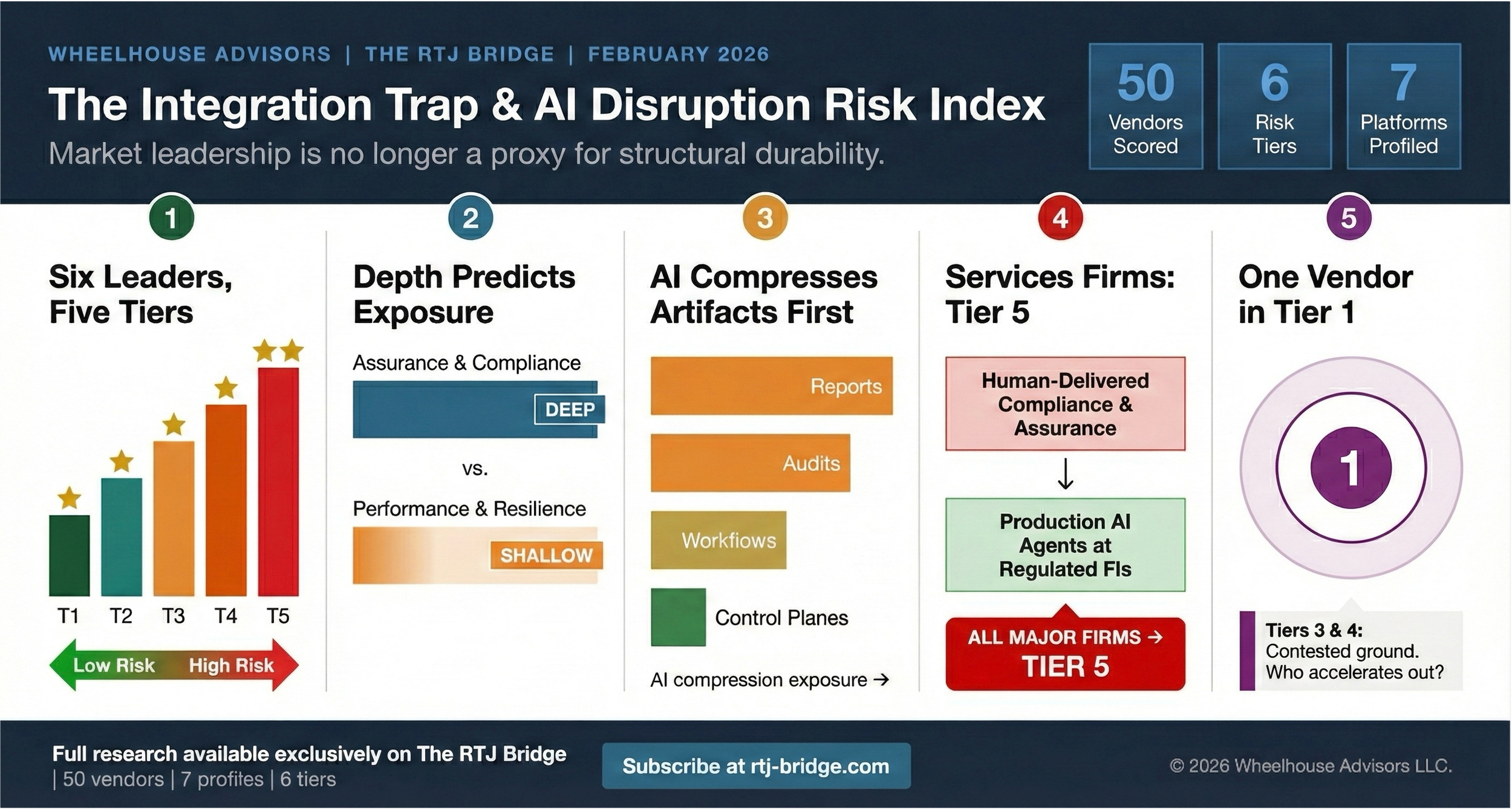
We Scored 50 IRM Vendors on AI Disruption Risk. Six Market Leaders Landed in Five Different Tiers.
The IRM market runs on two assumptions that deserve harder scrutiny. The first: that market leadership reflects structural durability. The second: that “integrated” platforms deliver the integration that enterprises actually need. This month, Wheelhouse Advisors publishes two companion research notes on The RTJ Bridge that challenge both assumptions directly.
The Integration Trap for GRC examines seven major GRC and IRM vendors and surfaces a structural pattern the market has not confronted honestly. The IRM50 AI Disruption Risk Index extends that analysis across the full IRM50 ecosystem and assigns every vendor a disruption exposure tier based on where AI will compress monetized work first. Together, they deliver a new lens for evaluating vendor durability that buyers, boards, and vendors themselves should read carefully.
This article previews both studies. The full research, including individual vendor assessments, tier assignments, and the analytical framework behind them, is available exclusively on The RTJ Bridge.