Professional Services Firms Admit AI Is an Existential Risk
PwC just said the quiet part out loud.
This week, PwC US CEO Paul Griggs told the Financial Times that partners who resist AI "are not going to be here that long." Accenture said something similar earlier this month, when CEO Julie Sweet declared that AI proficiency is now a mandatory condition for promotion and that employees who refused to adapt were shown the door. However, Accenture framed its shift as a workforce and talent story. Griggs went further, addressing the real issue: AI is an existential risk to the professional services business model itself.
Griggs declared the firm is moving decisively toward an AI-first operating model. More pointedly, the firm is converting core tax, audit, and consulting services into AI-powered tools that reach clients directly through a new platform called PwC One, explicitly moving away from the billable-hours model that has defined professional services for a generation. That is not a workforce story. It is a market structure story.
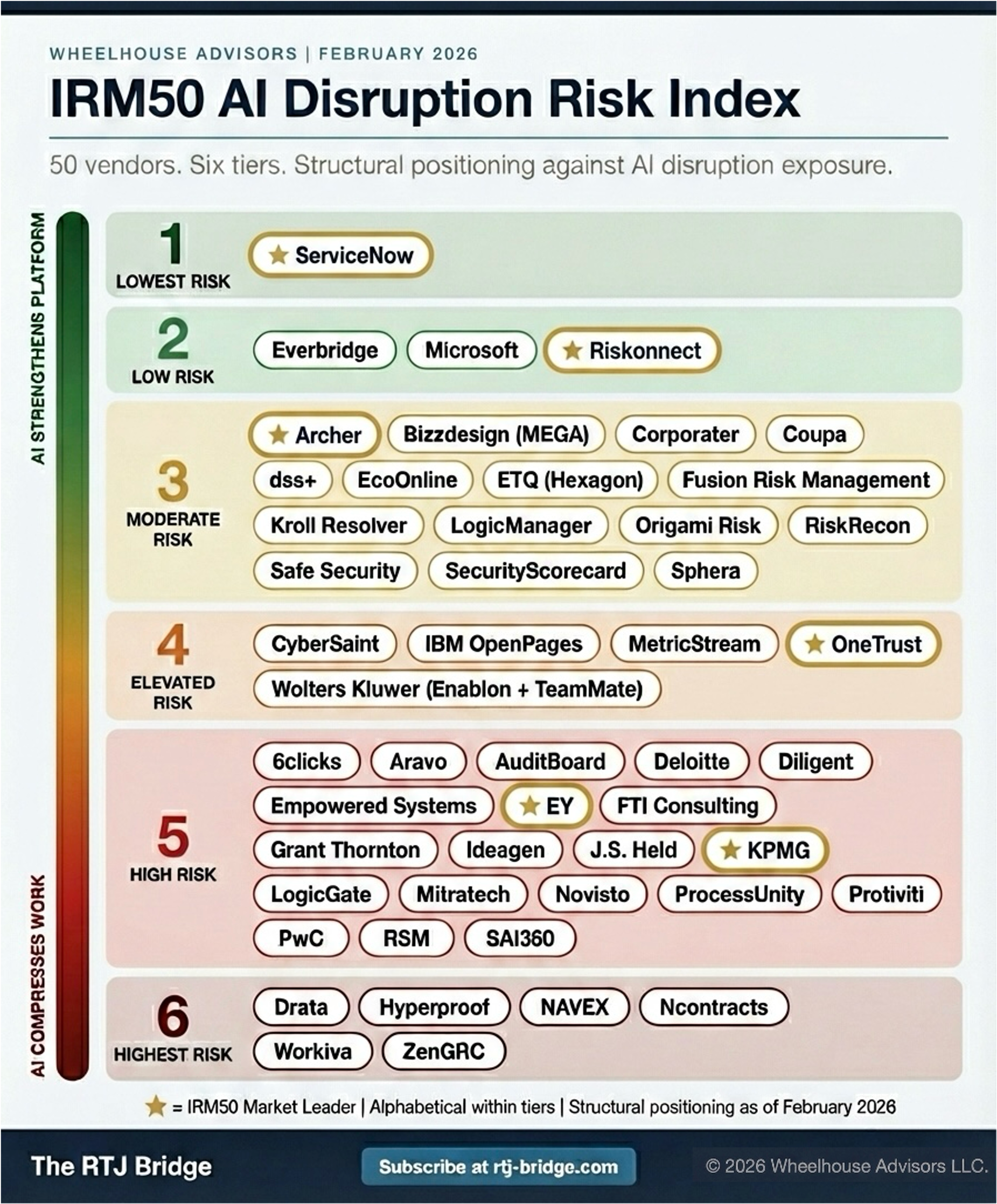
In February, Wheelhouse Advisors published the IRM50 AI Disruption Risk Index, which classifies 50 integrated risk technology and services providers across six tiers by structural exposure to AI disruption. PwC, EY, KPMG, Deloitte, and the other major professional services firms sit in Tier 5: High Risk. The rationale was not a commentary on their capability. It was a structural observation: their core IRM-related revenue anchors in human delivery of compliance artifacts, risk assessments, audit preparation, and regulatory documentation. Those are the functions AI compresses first and most completely. Griggs just said the same thing from the inside.
But the more consequential implication is not about PwC's own disruption trajectory. It is about what happens to the technology providers who depend on firms like PwC to implement, configure, and deliver value from their platforms. The human advisory layer that has made those platforms work at enterprise scale has not been a feature of the vendor relationship. It has been load-bearing infrastructure. PwC is now automating it.
For vendors in the lower tiers of the ADRI, that is not a future risk. The largest professional services firm in the US just put the timeline on the record.
The IRM50 AI Disruption Risk Index is available to subscribers at The RTJ Bridge.