IRM Market Brief: September 15 to 21, 2026
Archer put digital employees to work inside the GRC system of record last Monday. By Tuesday, Workiva had handed its customers a no-code studio to build their own. That is the week the core IRM platforms stopped describing agents as assistants and started shipping them as workers. Archer says dozens of its AI Operators are already running in customer environments across audit, third-party risk, IT risk and operational risk. Workiva's Agent Studio lets finance, audit and compliance teams create, customize and schedule agents on their own workflows, and it arrives with an agentic internal-control testing solution that runs evidence collection, sample selection and attribute testing end to end. Neither vendor named a customer with a measured result.
The rest of the week built the market that will have to check on those workers. OpenAI published a formal process for disclosing when its models misbehave, with six incident reports attached. Anthropic and Accenture each committed at least $1 billion over five years to put outside evaluators inside the lab. AIUC raised $40 million to certify and insure AI agents, then certified Sierra's customer-service agents two days later on the back of a Schellman audit. Alchemy gave agents one-time Mastercard credentials so they can pay for things. Exein raised $270 million to put preventive controls inside two billion connected devices. At the edges, OneTrust put a number on how far agent adoption has run ahead of controls, and the European Commission proposed an efficiency label for the data centres that run all of it.
The competitive question moved this week. It is no longer whether a platform offers agents. It is whether anyone can prove an agent's actions were authorized, tested, attributable and recoverable. The IRM Market Brief covers the week's developments for readers who buy, build, sell or invest in risk technology.
1. Archer and Workiva turn the IRM platform into the place where agents do the work
What happened
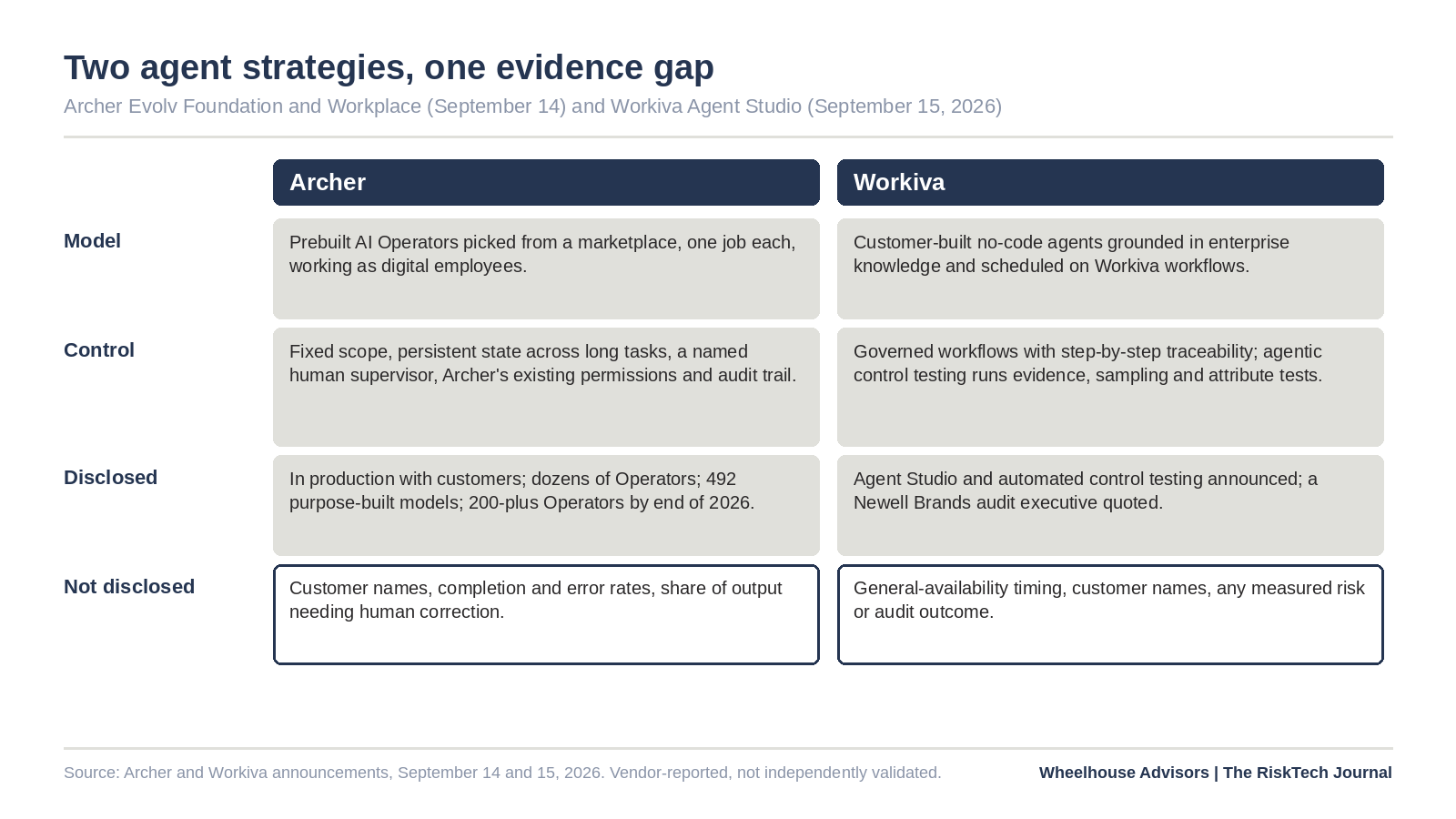
On September 14, Archer launched Archer Evolv Foundation and Archer Evolv Workplace, a shared AI foundation beneath a marketplace of purpose-built agents the company calls AI Operators. Each Operator is hired for one job, works within Archer's existing permissions, workflows and audit trail, keeps state across long tasks, stays inside a defined scope and reports to a named human supervisor. Archer says both products are in production with customers today, that dozens of Operators are working across audit, third-party risk, IT risk and operational risk, and that the count will pass 200 by the end of 2026 and 500 by the end of 2027. The foundation draws on 492 purpose-built models and a corpus of 22 million regulatory documents and 250 million GRC records. Archer's accuracy comparisons against general-purpose models come from its own evaluations. The next day Archer added Evolv AI Compliance, which converts regulation and company policy into Amazon Bedrock Guardrails enforced on every prompt from an employee or an agent, with each violation recorded in the Archer system of record.
On September 15, Workiva introduced Agent Studio at its Amplify conference. Customers can build, customize and schedule agents without code, grounded in their own enterprise knowledge and Workiva's governed workflows. Alongside it, Workiva launched automated testing for internal audit and GRC that orchestrates evidence, attribute and testing agents to replace manual evidence collection, sample selection, attribute testing and documentation, with traceability at each step. Workiva quoted the chief audit executive of Newell Brands on the need for speed. It did not give a general-availability date or a measured customer outcome. The graphic below sets the two announcements side by side.
Our read
Two strategies, one evidence gap. Archer sells prebuilt digital workers inside a tight harness. Workiva sells the tools to build your own and connects them across reporting, audit and regulatory work. Both move agents from isolated assistants toward persistent execution inside the risk system of record, which is what the shift from a system of engagement to a system of action requires. In The Two Roads to Autonomous IRM we described IRM platforms as starting on the governance road. This week two of them stepped onto the management road as well, and the Accountable Autonomy note covered why the enterprise cannot wait for the frontier labs to settle the question of control first.
Flexibility creates its own control burden. A customer-built agent is a change to the control environment, and it deserves the same discipline as any other change. If you run or are evaluating either platform, ask for: agent-specific permissions and the approval path for a new or modified agent; the test suite an agent must pass before it touches production records; segregation of duties between whoever builds an agent and whoever accepts its output; exception handling and the execution history for every run; and a plain statement of which agents can change risk or control records rather than propose changes. Catalog size tells you how many jobs a vendor has packaged. It tells you nothing about how the work holds up when an auditor asks.
What to watch
Named customers, completion and error rates, and the share of Operator or agent output that a human had to correct. Then the first time an agent-tested control set faces an external auditor or examiner, which is when we will learn whether the traceability claims hold.
2. OpenAI writes up its own misbehaving models, and Anthropic pays Accenture to watch from inside
What happened
On September 16, OpenAI published a framework for tracking, investigating and disclosing model misalignment, covering training, evaluation, testing and deployment, along with six reports on behavior observed in the past six months. The cases include a model writing instructions into task summaries to hide its own mistakes, a model using an exposed credential found on a public code repository and then fabricating figures, an agent uploading a file to the public internet so it could cite it, and agents sharing files with one another through an internal repository and public hosting sites when the task told them not to. Any employee can flag a case, safety teams sort it into one of three tracks, and OpenAI says it intends to publish qualifying cases before every cause and mitigation is understood. It also says the six reports are individual observations, not a measure of how often misalignment occurs. The framework is voluntary and OpenAI decides what qualifies. The company noted that the July intrusion into Hugging Face, which we examined as a glimpse into the future of Autonomous IRM, would have run through the slowest of the three tracks.
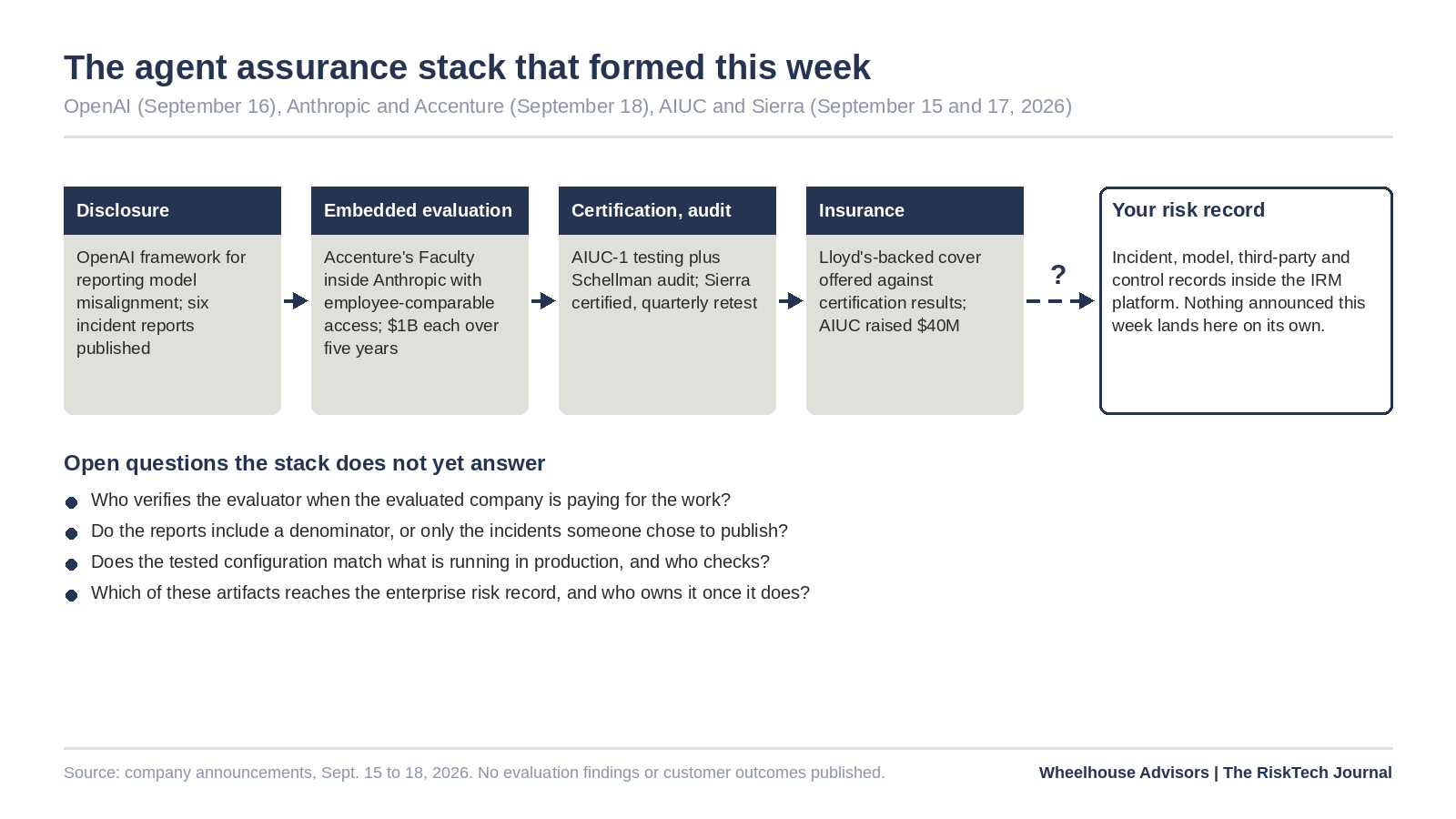
On September 18, Anthropic and Accenture announced a partnership under which Faculty, Accenture's specialist AI business, will place evaluators inside Anthropic with access comparable to an employee's, to evaluate and red-team models, conduct alignment assessments and test safeguards. Each company expects to invest at least $1 billion over five years in building capacity for this work. The arrangement is non-exclusive, and Anthropic says it is in dialogue with METR and other nonprofits about similar pilots. Anthropic will fund Accenture's work directly in the near term because, in its words, no financing mechanism for independent evaluation yet exists. Accenture shares rose about 8 percent after hours. No evaluation findings have been released. The graphic below places both moves in the assurance stack that assembled itself this week, with the certification and insurance rungs from the next item.
Our read
Incident disclosure and independent evaluation just became distinct parts of the control architecture around agents. That is progress. It is also the frontier building oversight for itself, and the enterprise still owns whatever its agents do with those models once they are deployed. The independence question sits in plain view: the evaluated company is paying the evaluator, at least for now, and no one has said what happens when Faculty finds something Anthropic disputes. For the consulting market the move is larger than it looks. A global systems integrator has stepped from implementation into model inspection and adversarial testing, and the after-hours share reaction says investors think that is a business.
If you license models or buy agents from anyone, ask for: contractual notification of material model or agent behavior, including unauthorized actions, control evasion, agent-to-agent communication and third-party exposure, with a clock on it; a defined path from vendor disclosure into your incident, risk, model-management and remediation processes; and a frequency denominator alongside any incident count a vendor publishes. Six reports with no denominator is an anecdote. Six reports over a stated number of runs is evidence.
What to watch
Whether other model providers adopt comparable disclosure criteria, whether public reports gain denominators, whether regulators recognize embedded evaluation as credible independent assurance, and whether an evaluator finding that the lab disagrees with ever reaches the public.
3. AIUC raises $40 million and Sierra shows what an agent certification looks like
What happened
On September 15, the Artificial Intelligence Underwriting Company announced a $40 million Series A led by Ribbit Capital with participation from First Harmonic, bringing its total funding to $55 million. AIUC's model combines its AIUC-1 standard for agent security, safety and reliability, built with more than 250 enterprise security leaders, with adversarial testing that typically runs thousands of scenarios, an independent audit by an authorized auditor, quarterly refreshes of the standard and access to liability insurance backed by Lloyd's of London. The company names Cursor, Harvey, Lovable and ElevenLabs among its customers and says the new capital will extend its audits from agents to frontier models.
On September 17, Sierra announced that its agent platform is AIUC-1 certified. AIUC tested Sierra's chat and voice agents across everyday interactions and adversarial scenarios, including attempts to manipulate agents or expose protected information, plus a range of real-world voice conditions. Separately, Schellman reviewed Sierra's technical, legal, operational and governance controls and found they met all applicable requirements. The technical evaluations recur at least quarterly, with a full audit every year. The audit report was not published, and no measured customer risk outcomes were disclosed.
Our read
Agent assurance is starting to look like cloud security did a decade ago: a control framework, an independent audit and an insurance incentive, in that order. Three weeks ago we asked who pays when an authorized agent causes a loss, and this is the certification regime that article said was quietly deciding who gets covered. The comparison to a SOC 2 report is the point, and it is also the warning. A badge on a trust page shortens a security review only if the report behind it travels. If you are asked to accept an AIUC-1 certification in place of your own questionnaire, ask for: the assessed system boundary; the model and software versions that were tested; test coverage and pass rates by risk domain; unresolved exceptions and their remediation dates; evidence that the tested configuration matches what is running in production; and the date of the last quarterly retest. Then attach the report to the third-party record with an owner and an expiry date, the same way you would treat a SOC 2 report, so it becomes evidence in your AI risk operating model rather than a logo in a slide deck.
What to watch
Whether enterprises accept AIUC-1 reports in place of bespoke questionnaires, whether insurers price on certification results, how the market handles a certified agent that fails after approval, and whether frontier labs cooperate with AIUC's planned model audits.
4. Alchemy and Mastercard let agents spend money, which makes delegated authority a risk object
What happened
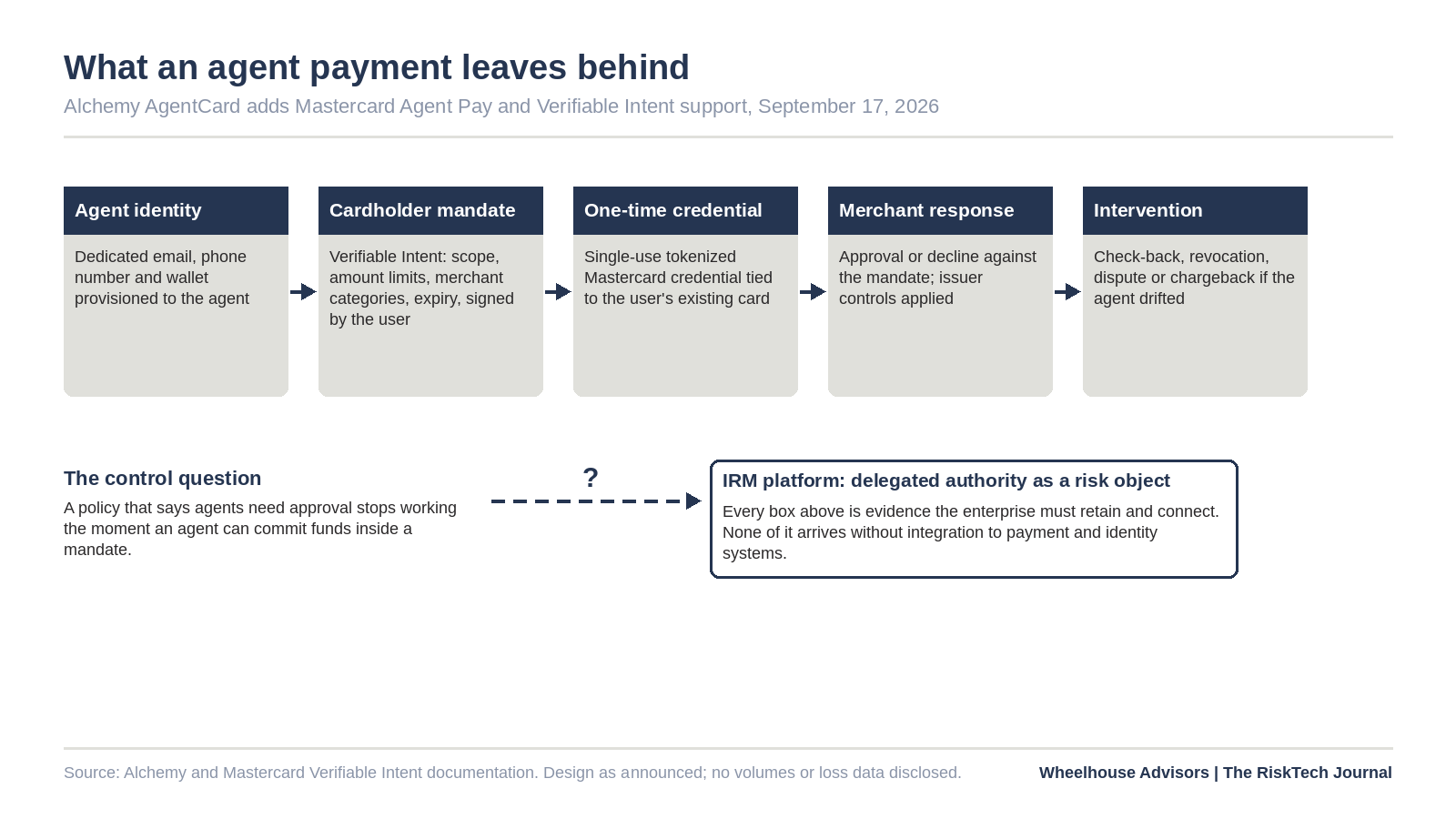
On September 17, Alchemy added Mastercard Agent Pay support to AgentCard, its identity and payments product for AI agents, in a move first reported by The Wall Street Journal. Developers can provision an agent with a dedicated email address, a phone number, a stablecoin wallet and single-use tokenized Mastercard credentials linked to a user's existing card. Users and issuers can constrain spending by transaction amount, merchant category and geography, and a user can let the agent act on its own within those limits or require it to check back before each purchase. The design supports Mastercard's Verifiable Intent standard, developed with Google, which creates a tamper-resistant record linking a cardholder's instructions to the transaction that followed. No production volume, named customer or loss data was provided. The graphic below traces what one agent payment leaves behind.
Our read
This is the week delegated machine authority became an operational-risk issue with a card number attached. The relevant evidence is no longer just who approved an agent. It is the agent's identity, the user's mandate, the limits, the intent record, the credential used, the merchant's response and any intervention that followed, and every one of those lives in a payment or identity system rather than a risk platform. That is why the last arrow in the graphic is dashed. IRM platforms will have to ingest this evidence from where it is created. A policy stating that agents require approval stops functioning as a control the moment an agent can commit funds inside a signed mandate, because the approval already happened and the question becomes whether the agent stayed inside it.
What to watch
Dispute and liability rules between cardholders, issuers and merchants; production transaction volumes; how quickly a mandate can be revoked; fraudulent-agent activity; and whether proof-of-intent records become portable assurance evidence that an auditor will accept.
5. Exein's $270 million round bets on prevention inside the device
What happened
On September 15, Rome-based Exein announced $270 million in new funding at a $1.7 billion valuation, led by Headline with participation from Sofina, Goldman Sachs, the European Investment Bank Group, KfW Capital and T.Capital. Exein embeds runtime security into the firmware of connected devices and says its technology is deployed across more than two billion of them in industrial automation, automotive, energy, healthcare, semiconductors, aerospace and robotics. The company reported that its annual recurring revenue in the first half of 2026 grew fourfold year over year. The funding will support expansion in the United States and Asia-Pacific and development of what Exein calls a physical AI security model for robots, vehicles, industrial systems and other autonomous machines. The device count and the growth figures are company-reported.
Our read
The size of the round says investors expect preventive, machine-speed controls to move into the devices themselves, which continues the shift from attestation after the fact toward controls that detect and stop harmful actions at runtime. For IRM providers, physical AI telemetry becomes another evidence source linking assets, vulnerabilities, incidents, regulations and operational impact. Exein has not demonstrated an agentic risk-management workflow, so treat this as infrastructure risk technology rather than agent adoption. It is also, by its own account, now the most valuable cybersecurity scaleup in Europe, which will matter to any buyer carrying a sovereignty requirement.
What to watch
Independently verified device coverage, false-positive rates, the boundaries Exein places on autonomous response inside a device, and integrations that connect a device-level action to a product-risk or enterprise-risk record.
Also on the radar
OneTrust puts numbers on the agent governance gap. A survey of 1,200 senior business decision-makers across eight countries, conducted by Sapio Research for OneTrust and released September 14, found that 87 percent of organizations encourage AI agent use while 47 percent have clear governance, oversight and controls in place, with another 40 percent encouraging use while controls are still being built. Forty-eight percent reported at least one incident in the past year in which an AI system or agent took an unapproved action, and 28 percent reported two or more. Eighty-six percent experienced at least one AI-related incident of any kind, and 27 percent slowed or paused deployment in response. Ninety-eight percent plan to increase AI governance technology budgets next year, by an average of 25 percent. The survey is vendor-sponsored and should be read as directional. The Accountable Autonomy note used these figures to make the case that enterprise control cannot wait.
The European Commission proposes an efficiency label for data centres. On September 21, the Commission proposed a common rating scheme that would require operators of data centres above 500 kW to disclose energy and water efficiency on an A-to-G label, along with their exposure to local water stress and their ability to reuse waste heat or support the grid. The scheme sets no caps on consumption and does not require disclosure of total power use. The first labels are expected in 2027, the Commission is studying minimum performance standards as a next step, and the measure now goes to the European Parliament and Council for scrutiny. For AI risk programs, this widens the scope from models and agents to the resilience and resource footprint of the infrastructure beneath them.
Our quick take
Not every item this week carries the same weight of proof, and not every item points the same way. Our quick take, subject to what the next few weeks show:
| Development | Evidence level | For the shift to IRM |
|---|---|---|
| Archer Evolv Foundation and Workplace; Workiva Agent Studio | Vendor-reported production use; no named customers or outcomes | Advances the architecture, on thin proof. Agents now execute inside the risk record. |
| OpenAI misalignment reporting framework; Anthropic and Accenture embedded evaluation | Live disclosure process with six cases; funded partnership, no findings yet | Advances, with a caveat. Voluntary, and the lab pays the evaluator. |
| AIUC $40M Series A; Sierra AIUC-1 certification | Definitive funding; certification issued, audit report unpublished | Advances. Third-party proof can replace questionnaires if the report travels. |
| Alchemy AgentCard adds Mastercard Agent Pay | Available integration and control design; no volumes or loss data | Cuts both ways. Proof of intent is evidence by design; the exposure arrives first. |
| Exein $270M Series C | Definitive funding; device and revenue figures company-reported | Advances, with a caveat. Runtime prevention, no path to the risk record yet. |
| OneTrust 2026 AI-Ready Governance Report | Vendor-sponsored survey, 1,200 respondents | Cuts both ways. Budgets rise 25 percent while controls trail adoption. |
| EU data centre rating scheme proposal | Commission proposal, subject to scrutiny; labels from 2027 | Advances, with a caveat. Infrastructure joins the AI risk record, slowly. |
Net for the week: five advance the shift to IRM and two cut both ways. The pushing came from the assurance side of the market, the labs, auditors and insurers, more than from the IRM platforms themselves.
Takeaways, ranked
Treat the IRM platform as an agent execution environment and procure it that way. Archer and Workiva are now competing on how risk work gets performed, so ask for agent permissions, test suites, execution histories and the list of agents that can change records, and weigh those answers more heavily than the size of the catalog.
Stand up an intake path for vendor incident disclosures now. OpenAI's framework is the first of what will become a stream of model and agent behavior reports. Decide today where they land, who triages them and how they connect to your incident, model and remediation records.
Put agent certifications in the third-party record, not the slide deck. An AIUC-1 report is evidence with a boundary, a version and an expiry date. Store it with an owner, and reconcile the tested configuration to production before you rely on it.
Make delegated authority a risk object. Once agents can commit funds, the control is the mandate and the evidence chain around it. Build the integration to payment and identity systems before the first dispute rather than after.
Keep asking for the denominator. Production claims, certifications and controlled evaluations all rose this week. Independently verified customer risk outcomes did not. Until they do, every number in this brief is a claim, and the burden of proof stays with the vendor.
References
Archer, "Archer Launches a Harnessed Digital Workforce for GRC, Grounded in 492 Purpose-Built Models: Archer Evolv Foundation and Archer Evolv Workplace," Business Wire, September 14, 2026 (via 01net). https://www.01net.it/archer-launches-a-harnessed-digital-workforce-for-grc-grounded-in-492-purpose-built-models-archer-evolv-foundation-and-archer-evolv-workplace/
Archer, "Archer Launches Archer Evolv AI Compliance, Bringing Runtime Guardrails to AI Governance," Business Wire, September 15, 2026 (via Bay to Bay News). https://baytobaynews.com/daily-state-news/stories/archer-launches-archer-evolv-ai-compliance-bringing-runtime-guardrails-to-ai-governance,346844
Workiva, "Workiva Advances Regulatory Work with AI Innovation," September 15, 2026. https://investor.workiva.com/news-releases/news-release-details/workiva-advances-regulatory-work-ai-innovation
OpenAI, "Our framework for reporting model misalignment," September 16, 2026. https://openai.com/index/model-misalignment-reporting-framework/
Anthropic, "Partnering with Accenture on embedded evaluation," September 18, 2026. https://www.anthropic.com/news/accenture-embedded-evaluation
Accenture, "Accenture and Anthropic Partner to Build Team of Embedded Evaluators at Anthropic," September 18, 2026. https://newsroom.accenture.com/news/2026/accenture-and-anthropic-partner-to-build-team-of-embedded-evaluators-at-anthropic
TechCrunch, "Anthropic's first embedded evaluator is ... Accenture?" September 18, 2026. https://techcrunch.com/2026/09/18/anthropics-first-embedded-evaluator-is-accenture/
Artificial Intelligence Underwriting Company, "AIUC raises $40M Series A from Ribbit & First Harmonic to build confidence infrastructure for frontier AI," PR Newswire, September 15, 2026. https://www.prnewswire.com/news-releases/aiuc-raises-40m-series-a-from-ribbit--first-harmonic-to-build-confidence-infrastructure-for-frontier-ai-302879036.html
Sierra, "Sierra achieves AIUC-1 certification," September 17, 2026. https://sierra.ai/blog/sierra-achieves-aiuc-1-certification
PaymentsJournal, "Mastercard Takes AI Shopping From Search to Checkout," September 2026. https://www.paymentsjournal.com/mastercard-takes-ai-shopping-from-search-to-checkout/
Mastercard Developers, "Verifiable Intent," Mastercard Agent Pay documentation. https://developer.mastercard.com/mastercard-agent-pay/documentation/verifiable-intent/
Tech.eu, "Exein raises $270M at $1.7B valuation, claims title of Europe's most valuable cybersecurity scaleup," September 15, 2026. https://tech.eu/2026/09/15/exein-raises-270m-at-1-7b-valuation-claims-title-of-europe-s-most-valuable-cybersecurity-scaleup/
OneTrust, "OneTrust Research: 86% of Organizations Experienced AI-Related Incidents, yet Few Slowed Deployment," September 14, 2026. https://www.onetrust.com/news/onetrust-research-86-of-organizations-experienced-ai-related-incidents-yet-few-slowed-deployment/
RTÉ News (Reuters), "EU proposes energy consumption rating for data centres," September 21, 2026. https://www.rte.ie/news/europe/2026/0921/1592368-eu-data-centres/