What Risk Leaders Need to Know About AI Infrastructure
Source: wheelhouseadvisors.com
Risk leaders are sitting in vendor briefings where the presenter uses the words "agentic," "MCP," "orchestration," and "autonomous" in the same sentence, often without defining any of them. Most audiences nod along. A growing number are starting to ask harder questions. The ones who understand the infrastructure layer underneath the marketing claims are getting better answers.
This is not a technology article. It is a procurement and governance article. The AI infrastructure concepts that matter for risk leaders are not technical curiosities. They determine whether a vendor's agentic AI claims are architecturally real or a chat interface with a new label. They determine whether your organization's AI agents will operate within auditable guardrails or outside them. And they determine how exposed your technology investments are as AI reshapes the economics of risk and compliance delivery.
Here is what you need to know.
The Protocol Layer: What MCP Actually Is
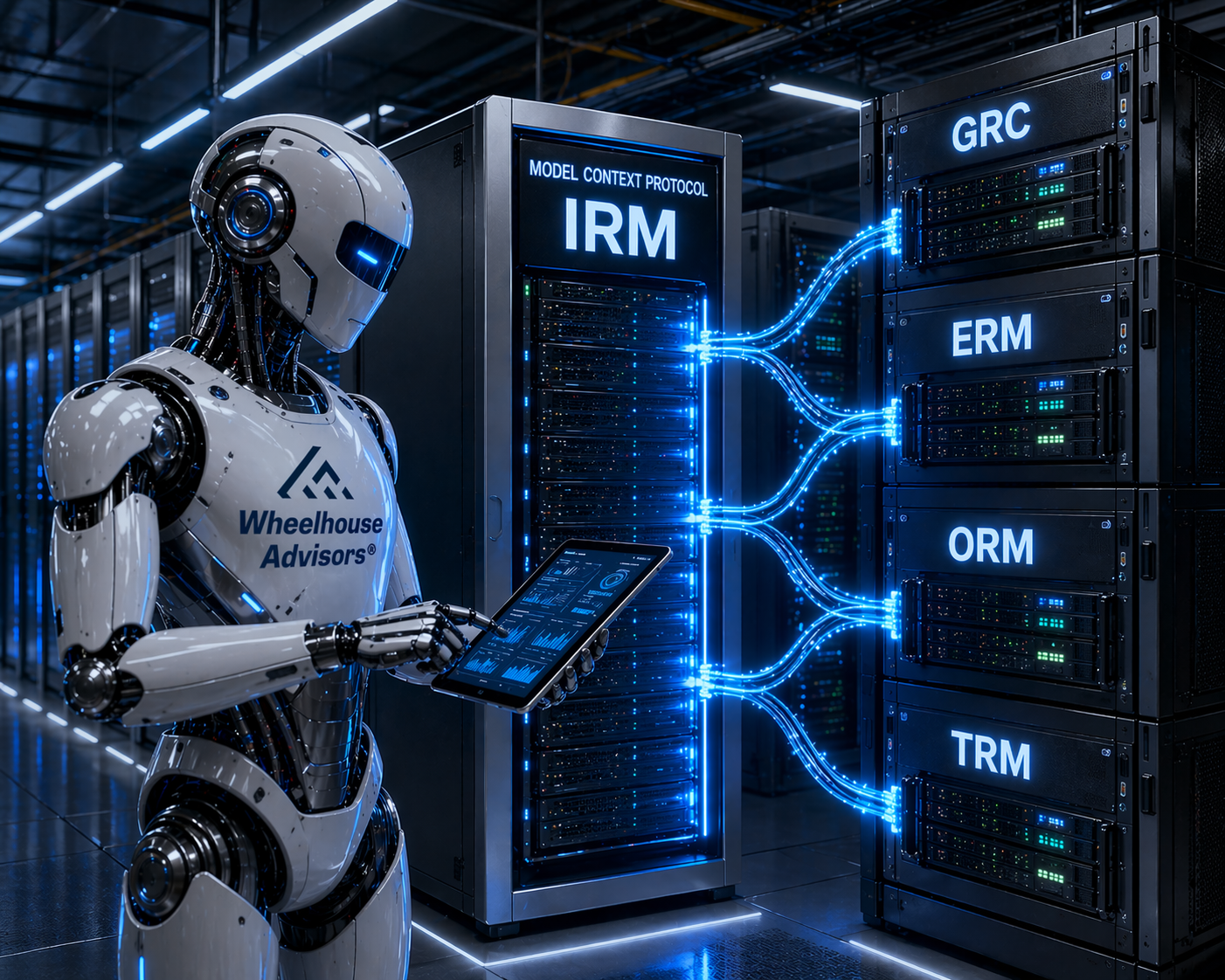
Model Context Protocol, or MCP, is an open-source standard that defines how AI models connect to external tools and data sources. It is, in plain terms, the handshake specification that allows an AI agent to reach into a system, retrieve information, and take action within it.
The reason MCP matters for risk leaders is not technical. It is evaluative. When a vendor tells you their platform has "AI-native integration" or "deep agentic connectivity," the underlying question is: how does the AI actually communicate with the system? Is it using a structured, standardized protocol that maintains consistent context and auditability across interactions? Or is it executing command-line scripts the way a human would type instructions into a terminal?
That distinction has a name. A CLI integration, which stands for command-line interface, is how many vendors deliver AI connectivity when they have not built a proper MCP server. The AI calls the tool by running a command, reads the output, and acts on it. It works. It is also more brittle, harder to audit, and less capable of the kind of continuous, stateful interaction that autonomous risk management requires.
When you ask a vendor how their AI agent connects to their platform, you are asking about MCP versus CLI whether you use those words or not. A vendor with a native MCP server has invested in the infrastructure for genuine agentic integration. A vendor offering CLI-based connectivity is telling you, often without realizing it, that the agentic layer was not part of the original architecture.
The Statefulness Problem
AI agents that can take action inside your risk and compliance systems create an immediate governance question: does the agent remember what it did?
This is the statefulness problem, and it sits at the center of every serious Autonomous IRM discussion. A stateless agent processes each interaction independently, with no memory of prior actions. A stateful agent maintains context across interactions, knows what it has already done, and can build toward a more complex workflow over time.
Stateless agents create a continuity problem. If your AI agent reviews a control, generates a finding, and then forgets it reviewed that control, you have a compliance documentation liability, not a compliance automation capability.
Stateful agents solve the continuity problem and create an auditability problem. If the agent remembers everything it has done and uses that memory to make decisions, your audit trail requirement expands significantly. Who reviewed what the agent decided to remember? What guardrails govern how it uses that context? What happens when the agent's accumulated state reflects a misclassification from three months ago?
Neither architecture is inherently wrong. Both require governance frameworks that most organizations have not built yet. The IRM Navigator Model's Autonomous stage, in which agents operate within validated guardrails with minimal human intervention, is not achievable without resolving the statefulness question first. Vendors who claim to deliver Autonomous IRM without a clear answer on stateful agent governance are describing a destination without a map.
Model Orchestration: Who Is Running the Agents
A single AI model answering a single question is not an agentic workflow. Autonomous risk management requires multiple agents working in sequence or in parallel: one agent sensing signals from operational systems, another validating those signals against policy, a third triggering remediation workflows, a fourth closing the evidence loop for audit. That coordination layer is called model orchestration.
Model orchestration frameworks, tools like CrewAI and the growing number of proprietary orchestration layers being built inside enterprise platforms, are what make multi-agent workflows possible. They define how agents are sequenced, how they pass context to each other, how errors are handled when one agent fails, and how the overall workflow is monitored and logged.
For risk leaders, model orchestration is relevant for two reasons. First, it is where the three-system taxonomy becomes operationally real. The System of Record stores the data. The System of Engagement surfaces it to users and workflows. The System of Action is where agents, coordinated by an orchestration layer, actually sense, decide, and act. Vendors whose AI capabilities live entirely in the System of Record or System of Engagement are not delivering agentic risk management regardless of what the product sheet says.
Second, orchestration is where vendor lock-in concentrates. A platform with a proprietary orchestration layer that does not expose standard APIs or MCP connections is not a composable System of Action. It is a closed loop that your organization cannot extend, audit independently, or migrate away from without losing the workflow logic embedded in the orchestration layer itself.
The Infrastructure Question You Should Be Asking
The practical implication of MCP, statefulness, and orchestration converges on a single procurement question that most RFPs do not include: where does your AI agent's intelligence live, and how does it get there?
A vendor with genuine agentic infrastructure will be able to answer this with specificity. The agent connects to the platform via an MCP server. It maintains stateful context within a defined session scope, with audit logging at each state transition. Orchestration is handled by a documented workflow layer that exposes agent actions to the oversight function.
A vendor without genuine agentic infrastructure will answer this with marketing language. The platform is AI-native. The agents are deeply integrated. The intelligence is embedded across the workflow. None of those phrases answer the question.
The IRM Navigator™ Curve establishes five maturity stages, from Foundational through Autonomous, and prohibits stage-skipping. An organization cannot operate Autonomous risk management without first achieving Extended integration, which requires continuous cross-domain telemetry and unified decision support. The infrastructure layer is what makes Extended integration possible. MCP provides the connectivity standard. Statefulness provides the continuity. Orchestration provides the coordination. Without all three, what vendors call "autonomous" is, at best, Coordinated with better marketing.
What This Means for Your Technology Decisions
The infrastructure layer is not a technical detail that belongs in an IT evaluation. It is the architectural foundation that determines whether a vendor's agentic AI claims will hold up under the operating conditions your organization actually faces: regulated workflows, audit requirements, cross-domain risk signals, and the expectation that when an agent acts, someone can explain why.
MCP tells you how the agent connects. Statefulness tells you whether it remembers. Orchestration tells you who is coordinating. Together, they tell you whether a vendor is delivering a System of Action or a System of Record with a conversational interface on top.
Most vendor briefings are not designed to surface this distinction. Most RFPs do not ask for it. That is the gap the market is operating in right now, and it is widening as agentic AI moves from pilot into production. The IRM50 AI Disruption Risk Index evaluates which vendors in the IRM market have the architectural foundation to deliver on agentic claims and which are carrying the most exposure as the infrastructure layer matures. That analysis is available exclusively on The RTJ Bridge at wheelhouseadvisors.com/rtj-bridge.