Where Do 33 Providers Land on the 2026-2027 IRM Navigator Vendor Compass for GRC?
The 2026-2027 IRM Navigator Vendor Compass for Governance, Risk and Compliance (GRC) is Wheelhouse Advisors' evaluation of the providers that supply GRC capability to the enterprise. It covers 33 providers, 24 technology providers and nine services providers, all constituents of the 2026-2027 IRM50, and places each one in one of three categories according to its position on two axes. The graphic below shows the categories and the providers in each. The report shows where each provider sits on the axes and why, with a profile and placement rationale for every one.
GRC is the verification system of integrated risk management (IRM). It supplies the auditable evidence that connects the goals set in enterprise risk management (ERM), the processes run in operational risk management (ORM), and the assets governed in technology risk management (TRM) to accountable policies, certifiable controls, and reliable disclosures. The report evaluates providers on how well they produce that evidence and how far it travels.
Reading the Graphic
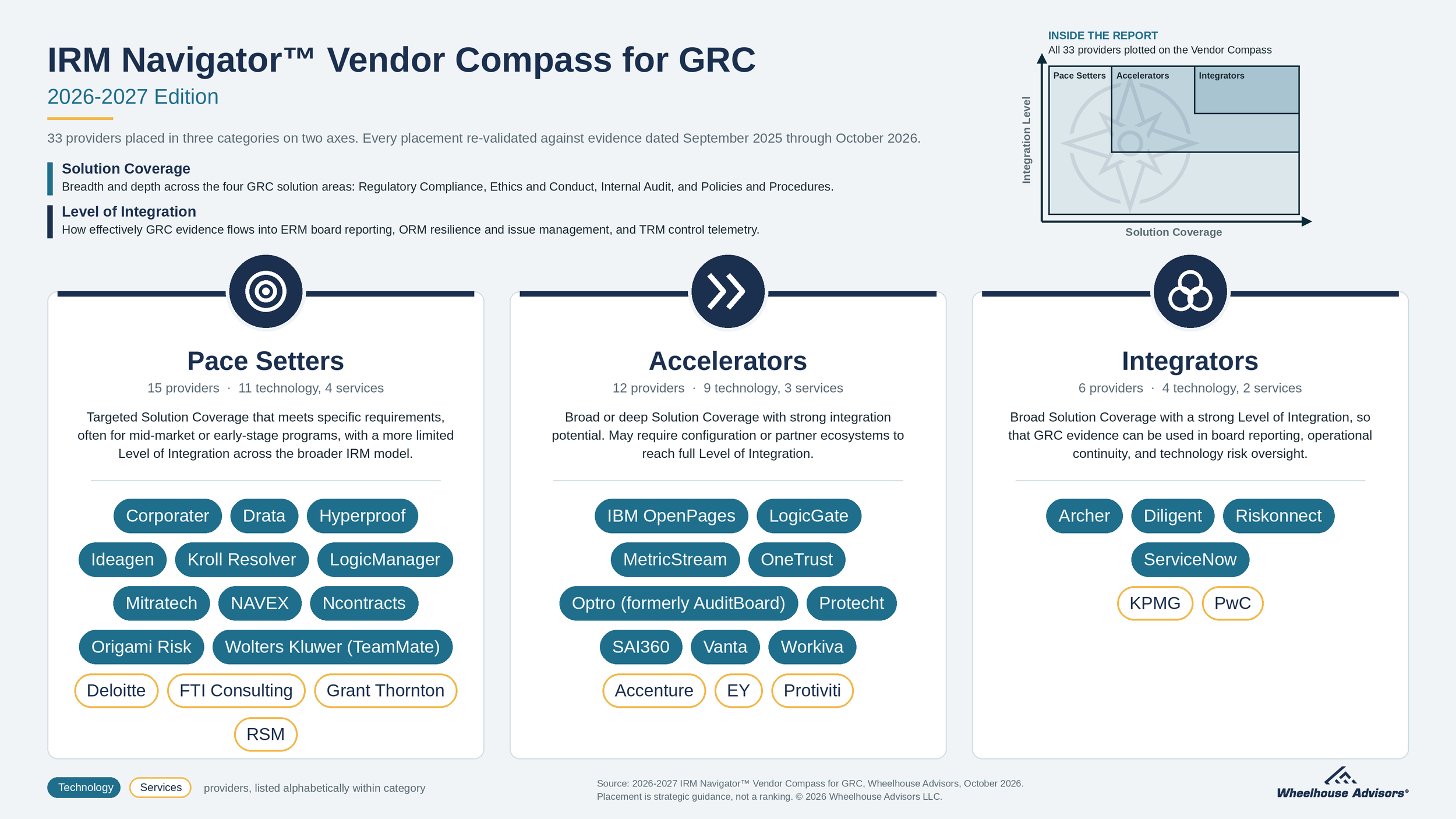
Figure 1: 2026-2027 IRM Navigator Vendor Compass for GRC, providers by category. Source: Wheelhouse Advisors.
Solution Coverage, the horizontal axis of the Compass, measures breadth and depth across the four GRC solution areas: Regulatory Compliance, Ethics and Conduct, Internal Audit, and Policies and Procedures. Level of Integration, the vertical axis, measures how effectively a provider's GRC evidence flows into ERM board reporting, ORM resilience and issue management, and TRM control telemetry. Coverage carries 60 percent of a provider's combined score and Integration 40 percent, and the combined score determines the category.
Pace Setters offer targeted coverage that meets specific requirements, often for mid-market or early-stage programs, with a more limited level of integration across the broader IRM model. Accelerators bring broad or deep coverage with strong integration potential, and may need configuration or partner ecosystems to reach full integration. Integrators combine broad coverage with a strong level of integration, so that GRC evidence can be used in board reporting, operational continuity, and technology risk oversight. The categories describe fit, not rank. A Pace Setter is the right choice for many programs, and the report's buyer guidance says which ones. Technology providers and services providers appear in the same categories; services providers are evaluated on GRC delivery and plotted as a separate series in the report so the two can be read apart.
The small Compass at the top right of the graphic is the frame the report uses, the two axes and the three category zones, without the provider positions. The positions, and the movements since the 2025 edition, are in the report.
The 2026-2027 Roster by Category
Providers are listed alphabetically within each category, technology providers first.
Pace Setters (15). Technology providers: Corporater, Drata, Hyperproof, Ideagen, Kroll Resolver, LogicManager, Mitratech, NAVEX, Ncontracts, Origami Risk, and Wolters Kluwer (TeamMate). Services providers: Deloitte, FTI Consulting, Grant Thornton, and RSM.
Accelerators (12). Technology providers: IBM OpenPages, LogicGate, MetricStream, OneTrust, Optro (formerly AuditBoard), Protecht, SAI360, Vanta, and Workiva. Services providers: Accenture, EY, and Protiviti.
Integrators (6). Technology providers: Archer, Diligent, Riskonnect, and ServiceNow. Services providers: KPMG and PwC. Archer holds the 2026-2027 IRM50 Segment Market Leader designation for GRC, named in the 2026 IRM Navigator Viewpoint Report.
VC Sonar for GRC (10, outside the IRM50). Anecdotes, CUBE, DataSnipper, Fieldguide, ModelOp, Monitaur, Norm Ai, RegASK, Shield, and Sprinto.
What Buyers Should Use It For
The first use is shortlisting. The category and the profile tell a buyer what to expect in coverage breadth and integration posture before the first demo, and the IRM Navigator Curve, from Foundational through Autonomous, tells a program which category matches the stage it intends to reach in the next 24 to 36 months rather than the one it occupies today. Buyer guidance runs in two tracks, for large enterprises and for small and mid-size enterprises. The second track says when a Pace Setter or an Accelerator is a better fit than an Integrator, and what configuration burden and total cost of ownership look like at each stage.
The second use is pressure-testing claims. The report gives buyers a test for "agentic" and "autonomous" claims: an agent counts as executing when it runs a control test, an evidence request, or an audit task at a named customer within a defined human review threshold, and a copilot that drafts or recommends does not. It separates Agentic GRC, agents governing compliance workflows, from Autonomous IRM, agents operating across all four IRM domains with independent verification, and it says which providers have shown the first. The same guidance covers how to test integration claims, through named customers whose GRC evidence is used in board reporting, issue management, and control validation, and how to weigh a GRC selection against the ERM, ORM, and TRM platforms already in place or planned.
What Vendors Should Use It For
A provider on the Compass gets the rationale for its own placement and for every neighbor's, with the evidence each rests on, and it gets the evidence bar for each category stated plainly. Documented cross-domain outcomes, not connector lists, separate Integrators from Accelerators. Coverage across all four solution areas is rare, and Ethics and Conduct is where most portfolios break. Announced agents and assistants are rated as what they are. The report also sets out what will differentiate over the next two years: evidence reuse across audit, compliance, and control testing; documented flows into the other three segments; AI governance in production; and agentic execution with published provenance and human review thresholds. For roadmap and positioning decisions, that list is the shortest summary of what buyers will ask for.
Providers outside the IRM50 should read the VC Sonar section, which covers ten emerging providers with autonomous capability in Assurance and Compliance by solution area and evidence status, and which states the standard for inclusion.
What Investors Should Use It For
The report sizes the GRC segment, including technology and migrated services, at $17.2 billion in 2026, growing to $35.8 billion in 2033 at 11.1 percent a year, within a total IRM market that grows from $69.7 billion to $159.4 billion, and it explains why GRC is the second largest of the four segments and the slowest growing. It maps ownership across the provider base, where private equity transactions, acquisitions, and renames between 2024 and 2026 changed who owns which roadmap. It indexes the ten VC Sonar providers by solution area and evidence status and maps those with verified execution against the five layers of Autonomous IRM and six control domains, so the capabilities no provider has yet proven are visible as empty cells. For diligence on a GRC platform or an agentic compliance entrant, the profiles and the Sonar are the starting point.
Where to Find It
The 2026-2027 IRM Navigator Vendor Compass for GRC includes the full Vendor Compass visual with all 33 providers plotted, a profile and placement rationale for each provider, the market overview and forecast, buyer guidance by maturity stage, the VC Sonar for GRC, and a roadmap to 2029. It is available at wheelhouseadvisors.com/irm-navigator-research. The 2026-2027 IRM50 is at wheelhouseadvisors.com/2026-2027-irm50. The report is also the subject of the Season 9 opener of The Risk Wheelhouse podcast, S9E1: Stop Buying GRC Hype, published October 9.