When ServiceNow Discloses Three Worst-Case Vulnerabilities, Whose Exposure Is It?
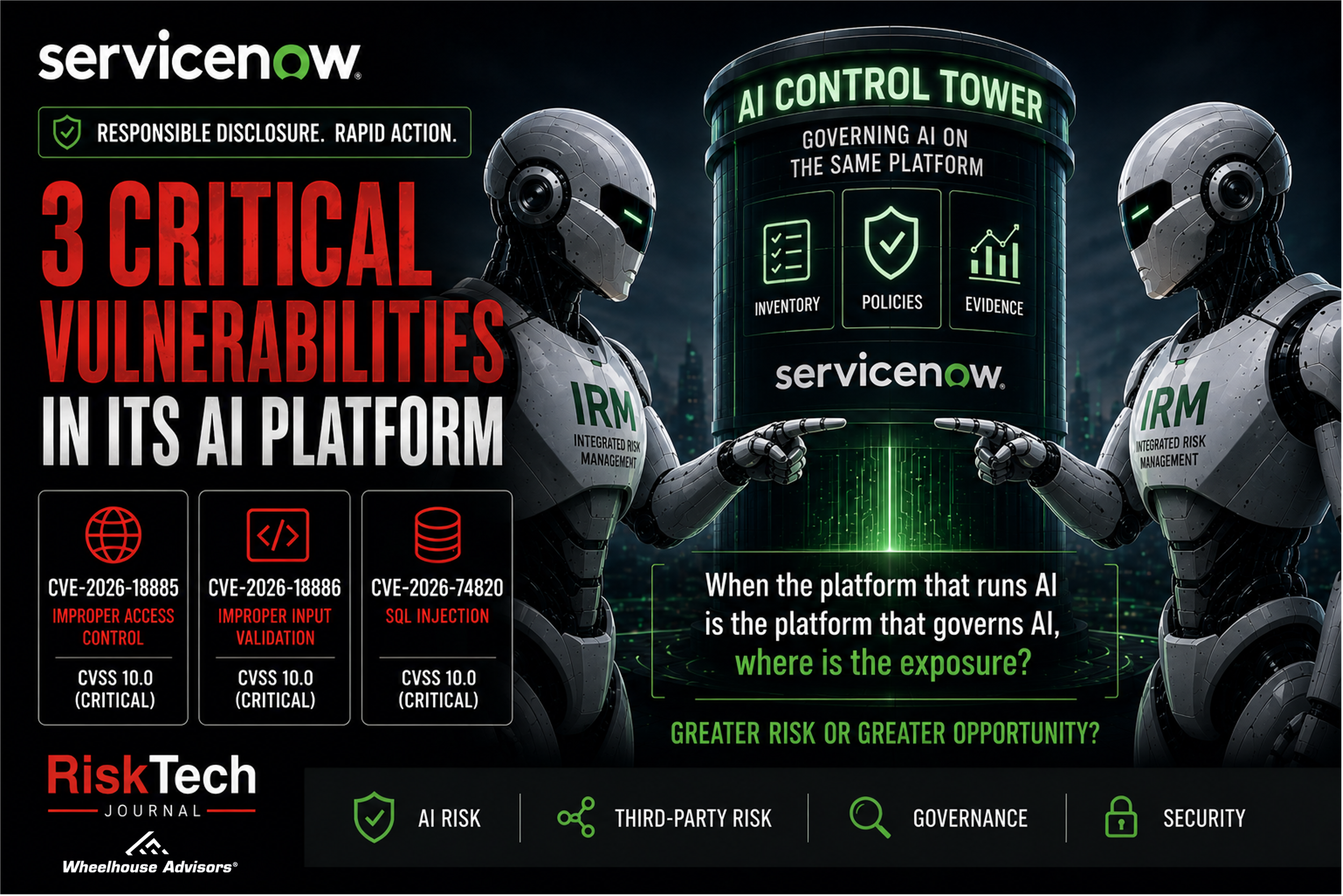
ServiceNow disclosed three vulnerabilities on August 27 that each carry the worst possible severity rating. The industry scores software flaws on a 0-to-10 scale called CVSS, and anything above 9 counts as critical. A 10.0 is the ceiling. It means an attacker can reach the flaw over the internet, needs no password and no help from a user, and can take full control of the affected system. ServiceNow assigned the maximum score to all three flaws itself, and it disclosed a fourth, rated 8.7, in the same advisory.
ServiceNow says it is not aware of the flaws being exploited, and no public attack code had surfaced as of Friday morning. Instances hosted by ServiceNow have already been patched. Customers and partners who run ServiceNow in their own environments have been told to confirm they are on a fixed release.
Most security teams will read that and reach for the patch checklist. That is the right first move. It is not the whole job.
Severity and Concentration Usually Arrive Separately. Here They Arrive Together.
For the typical enterprise vulnerability, how bad the flaw is and how much of the business depends on the affected system are two separate questions. A critical flaw in a niche application is a contained problem. A moderate flaw in a core system is a manageable one. ServiceNow collapses that distinction.
The platform routinely sits underneath incident management, IT operations, asset and configuration data, security workflows, employee processes, automation, and risk and compliance activities. Wheelhouse Advisors has long described this position within the IRM Navigator Model as a System of Action: the layer where information from many domains converges and where automated work actually gets done. That position is exactly why so many IRM50 vendors build on top of ServiceNow, and why it sits where it does in the AI Disruption Risk Index. The platform’s gravity is its commercial strength.
Gravity pulls in both directions. An attacker who takes control at the platform layer does not compromise one application. They inherit the platform’s reach: the connections holding privileged credentials into other systems, the configuration database describing the entire technology estate, the workflows authorized to change things elsewhere, and the risk and control records the organization relies on to prove it is in control. The exposure extends well past the platform itself to everything the instance can see and everything it can do.
Source: risktechjournal.com
The Vendor’s Fix Is Not the Customer’s Fix
The disclosure also carries a lesson in shared responsibility that risk leaders keep having to relearn. ServiceNow patched its hosted instances before publishing. Self-hosted customers and partners are on their own clock. A single vendor advisory therefore describes two entirely different exposure states depending on how the platform is deployed, and the vendor’s statement that it has fixed the issue says nothing about whether any particular customer has.
The point reaches beyond ServiceNow. As enterprises standardize on a shrinking number of platforms, “the vendor handled it” is becoming the default answer inside risk committees. It is only true where the vendor actually controls the patch cycle. Responsibility follows architecture, not the logo on the contract.
The Platform That Governs AI Is the Platform Running It
There is a second layer to this disclosure that the security coverage skips past. The affected product is the ServiceNow AI Platform, the same platform ServiceNow is pushing hardest as the place where enterprise AI agents get built, deployed, and put to work. ServiceNow is also one of the few vendors selling a credible answer to how those agents should be governed. Its AI Control Tower is positioned as the inventory, policy, and oversight layer for every AI system in the enterprise, and Gartner placed it among the leaders in its first Magic Quadrant for AI governance platforms in June. In the Autonomous IRM taxonomy that Wheelhouse Advisors uses, AI Control Tower is the governance half of a matched pair, with Autonomous Security and Risk covering the management half.
That pairing is the strongest strategic position in the market, and it is also the point of this disclosure. AI Control Tower runs on the platform it governs. The agents it inventories, the policies it enforces, and the evidence it produces all live on the same instance that an attacker could, until this week, reach without a password. An attacker at the platform layer does not merely bypass the governance layer. They can rewrite its records, including every audit trail that proves an AI agent stayed within policy.
None of this argues against buying AI governance from the platform vendor. It argues for understanding what that purchase is. The five-layer IRM for AI architecture Wheelhouse Advisors published earlier this year treats Verification and Audit as a distinct layer for a reason: the evidence that AI is under control has to hold up even when the system producing the AI does not. A vendor moving as fast as ServiceNow on agentic capability will keep generating attack surface at the same pace, and this advisory shows that even a company with a mature security program ships maximum-severity flaws. The question for buyers is whether their AI governance evidence survives a compromise of the platform that generated it.
The Questions That Outlast the Patch
Risk leaders should treat this as a platform-concentration event rather than a patch event. Verifying patch state on self-hosted instances is the minimum. The more durable exercise is understanding what the affected instance can reach.
Which critical processes depend on a given instance? Which connections hold privileged credentials, and into what? What data lives there, including the configuration and asset records that map the rest of the environment? Which automated workflows can change other systems without a human in the loop? And if the platform were compromised, would the organization detect it through monitoring that lives outside the platform, or would it be relying on the compromised system to report its own compromise?
That last question separates integrated risk management from integrated risk exposure, and it applies with double force when the platform is also governing the organization’s AI. A platform that consolidates risk, security, and operational data is enormously valuable right up until it becomes the single point an attacker needs. The defense is independent observability: logs and control evidence that remain trustworthy even when the platform is not.
No exploitation has been reported. This time the industry got a disclosure before an incident. The organizations that use the interval to map what their ServiceNow instance actually touches will be in a very different position from those that closed the ticket when the patch landed.
References
ServiceNow, “August 2026 CVE Advisory Notification,” KB3152242, Now Support Portal, August 27, 2026. https://support.servicenow.com/kb?id=kb_article_view&sysparm_article=KB3152242
The Hacker News, “Three CVSS 10.0 ServiceNow Flaws Could Let Unauthenticated Attackers Execute Code and SQL,” August 28, 2026. https://thehackernews.com/2026/08/three-cvss-100-servicenow-flaws-could.html
ServiceNow, “ServiceNow Launches AI Control Tower, a Centralized Command Center to Govern, Manage, Secure, and Realize Value From Any AI Agent, Model, or Workflow,” Business Wire, May 6, 2025. https://www.businesswire.com/news/home/20250506205072/en
ServiceNow, “ServiceNow is a Leader in the Gartner Magic Quadrant for AI Governance Platforms,” citing Gartner, Magic Quadrant for AI Governance Platforms, Lauren Kornutick, Sumit Agarwal, Priya Sundararaman, Nader Henein, Brandon Medford, June 16, 2026. https://www.servicenow.com/lpayr/gartner-mq-aigovernance.html
Wheelhouse Advisors, “Governing AI at the Speed of AI: Why Autonomous IRM Is the Only Architecture That Operates at AI Speed,” The RTJ Bridge, May 5, 2026. https://www.wheelhouseadvisors.com/rtj-bridge